By Team INVC | INVC NEWS
NEW DELHI, India | September 21, 2026 — If you have a cheque waiting to clear, cash to deposit, documents to submit or any banking job that still requires a branch counter, this may be the week to finish it.
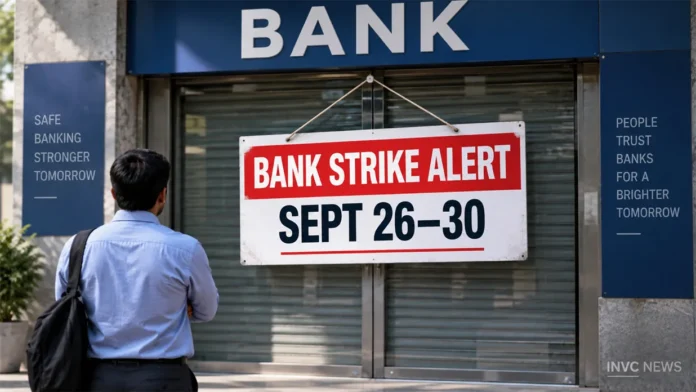
Indian bank customers could face five consecutive days of disruption to branch-based banking from September 26 to September 30, as a regular weekend shutdown is set to run directly into a three-day nationwide strike called by the United Forum of Bank Unions.
September 26 is the fourth Saturday of the month, followed by Sunday on September 27. Bank unions have then called a nationwide strike for Monday, September 28, Tuesday, September 29 and Wednesday, September 30. SBI, Union Bank of India, Indian Bank and other lenders have started warning customers to complete important branch transactions in advance.
For anyone who still depends on a bank branch, those dates matter.
However, this is not the same as the entire banking system shutting down for five days. ATMs, UPI, mobile banking and internet banking are expected to remain available, while banks are preparing contingency arrangements to keep essential services running.
That distinction could save customers a great deal of confusion.
Why September 26 Could Become the Real Deadline
The strike itself begins on September 28.
But customers who wait until that Monday may already be too late for branch work.
September 26 falls on the fourth Saturday, when bank branches normally remain closed. September 27 is Sunday. Therefore, Friday, September 25 could effectively become the last normal working day before a possible five-day stretch of limited branch services.
The disruption may not look identical everywhere. Previous bank strikes have produced different levels of impact across cities and states, while some branches continue limited operations depending on staffing.
Still, major lenders are taking the threat seriously enough to issue advance advisories.
For customers, the safest approach is simple: do not leave essential counter-dependent work until the last moment.
SBI Tells Customers to Plan Ahead
State Bank of India has advised customers to complete essential branch-related transactions before the September 28-30 strike period.
At the same time, SBI says it is making arrangements to maintain essential banking services. ATMs, Automated Deposit and Withdrawal Machines and Customer Service Points are among the channels expected to remain accessible, alongside digital banking facilities.
Union Bank of India and other public-sector lenders have also issued customer advisories over possible disruption.
That means people should not panic about everyday digital payments.
Paying a shop through UPI, transferring money through a mobile app or checking an account online should remain very different from walking into a branch for a cheque, cash or document-based transaction.
Cheque Clearing and Counter Services Could Feel the Biggest Impact
The real pressure is likely to fall on work that still needs bank employees inside branches.
Cash deposits and withdrawals at counters, cheque-related processing and other staff-assisted services may face delays if union participation is widespread.
Businesses may feel the impact more sharply than ordinary digital-first customers because many companies still depend on cheque clearing, cash handling and branch documentation.
Similarly, customers dealing with loan paperwork, account changes, KYC-related documentation, bank drafts or other physical processes should avoid assuming that September 28-30 will operate like normal working days.
Even transactions that eventually clear could take longer if backlogs build.
UPI and Mobile Banking Should Keep India Moving
The good news is that India’s digital banking infrastructure is expected to absorb much of the pressure.
UPI, internet banking, mobile banking and ATM networks are expected to remain available during the strike period, according to current bank advisories and reports.
For millions of customers, that means daily payments may continue with relatively little change.
You should still keep more than one payment option available.
A UPI transaction can fail for technical reasons on an ordinary day. Therefore, keeping a second UPI-linked account, debit card or some emergency cash can provide a useful backup during a period when branch support may be harder to access.
The key message is not “withdraw all your money.”
It is plan essential branch work early and keep digital alternatives ready.
Why Are Bank Employees Going on Strike?
The most important demand behind the industrial action is the implementation of a five-day banking week.
UFBU, an umbrella group representing seven bank employee and officer unions, has argued that the issue has remained unresolved despite being discussed during the March 2024 wage settlement.
The unions are also raising pension-related demands, including pension updation, a uniform dearness allowance formula for pensioners and an option for employees covered by the National Pension System to move to the old pension scheme.
Another issue involves the revised Performance Linked Incentive framework.
UFBU says its affiliated unions represent around 90% of the banking workforce, which explains why even a limited period of industrial action can create substantial operational pressure.
Finance Ministry Steps In Before the Strike
The looming disruption has now reached the Finance Ministry.
The ministry called senior executives from public-sector banks, regional rural banks, the Indian Banks’ Association and NABARD for a September 21 meeting to review contingency preparations.
The Department of Financial Services called the discussion to assess how banks can keep essential customer services functioning if the strike proceeds.
That development is important because the strike dates fall close to the end of September, when banks also handle half-yearly closing activities.
The government and banks therefore have a strong incentive to minimise disruption.
As of September 21, however, bank advisories continue to treat the September 28-30 action as a live possibility, so customers should plan on that basis rather than assume that negotiations will automatically cancel it.
Five Days Does Not Mean Five Days Without Money
The phrase “five-day bank shutdown” is likely to spread rapidly across social media.
It also needs context.
Branches could face five consecutive days without normal operations because the planned three-day strike follows a fourth Saturday and Sunday.
But customers are not expected to lose access to their bank accounts for five days.
Digital transactions should continue. ATMs should remain available. Mobile and internet banking should continue operating.
The primary risk involves branch-dependent services and possible processing delays, not the disappearance of India’s banking network.
That is an important difference.
What Should Customers Finish Before September 26?
Anyone with time-sensitive branch work should ideally deal with it by September 25.
That includes important cheque deposits, large counter-based cash transactions, document submissions, bank drafts and other work requiring assistance from branch employees.
Businesses that depend heavily on physical banking should also consider how a possible processing backlog could affect payments at the end of the month.
Meanwhile, routine UPI users may notice very little if digital systems function normally.
A few minutes of planning this week could prevent a frustrating trip to a locked or understaffed branch next week.
September 28 Will Decide How Big the Disruption Becomes
The true scale of the strike will become clear only when employees begin industrial action.
Participation can vary across banks and regions. Government intervention or further negotiations could also change the situation before September 28.
For now, however, major banks have already started warning customers.
That makes one date particularly important.
September 25.
If your banking job needs a person behind a counter, a signature, a cheque, a document or a physical branch, finishing it by then may be considerably easier than trying to solve it during the five days that follow.
India may not face five days without banking.
But millions of customers could face five days when the branch they need is much harder to use.