By Team INVC | INVC NEWS
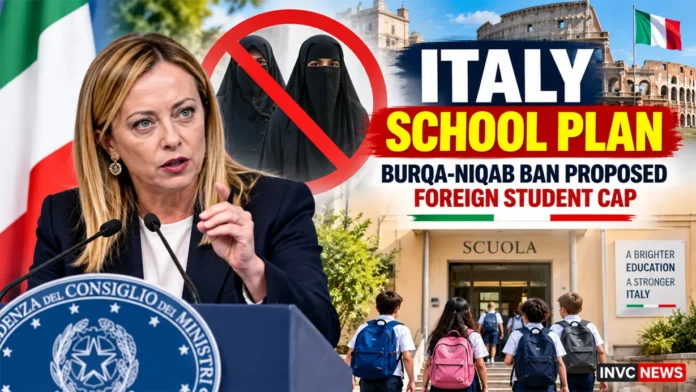
ROME, Italy | September 21, 2026 — Italian Prime Minister Giorgia Meloni has announced plans for a new education measure that would ban face coverings such as the burqa and niqab in schools and introduce a legal cap on the number of foreign students allowed in individual classrooms.
Meloni said the proposal is expected to reach Italy’s Council of Ministers soon, making immigration, integration and school policy the latest major political debate in the country.
The measure has not yet become law, and the government has not publicly specified the exact numerical limit it wants to impose on foreign students per class.
What Meloni Announced
Speaking on September 20 at Fenix, an event organised by the youth wing of her Brothers of Italy party, Meloni outlined three main measures.
The planned legislation would:
Set a maximum number of foreign students in each classroom
Ban burqas and niqabs in schools
Require parents of foreign students facing serious school-integration difficulties to learn Italian
Meloni presented the measures as part of an effort to improve integration and prevent schools from developing classrooms in which language barriers become difficult to manage.
No Exact Foreign Student Cap Announced Yet
One important detail remains unresolved.
Meloni did not announce the exact percentage or number of foreign students that would be permitted in each classroom under the proposed law.
Italy has previously discussed a benchmark of around 30% foreign students per class, but that approach came through an education ministry circular rather than a binding national law.
School administrators say that earlier approach proved difficult to implement in neighbourhoods where a high proportion of local children come from immigrant families.
The new proposal is significant because Meloni says the government now intends to establish the limit through legislation.
Burqa and Niqab Ban Would Apply in Schools
The proposed measure would also prohibit face coverings such as the burqa and niqab within schools.
These garments cover substantially more of the face and body than a conventional headscarf.
Reuters specifically reported the proposal as covering burqas and niqabs.
The final legal text will matter because it will determine precisely which forms of clothing or face covering fall within the prohibition and whether any exemptions apply.
Until that legislation is published and approved, the scope of the proposed ban should not be treated as final.
Parents Could Face Italian-Language Requirement
Meloni also said parents of foreign students experiencing serious difficulties integrating into school would be required to learn Italian.
The government argues that stronger language skills among parents could make communication between families and schools easier and help children integrate more effectively.
However, details remain unclear about how the requirement would operate, how proficiency would be measured or what consequences would follow if a parent failed to comply.
Those questions are expected to become clearer when the government publishes the proposed legislation.
About 11.6% of Students Are Non-Citizens
According to figures cited by Reuters, around 11.6% of students in Italy are currently non-citizens.
The national percentage, however, does not show how unevenly foreign students are distributed.
Some schools and neighbourhoods have substantially higher concentrations because immigrant communities are more concentrated in particular cities or districts.
That geographic difference could become one of the main practical challenges for any national classroom cap.
School Principals Raise Practical Questions
Italy’s National Association of School Principals has questioned how a compulsory cap would work in practice.
Association president Antonello Giannelli said schools, particularly primary and nursery schools, normally accept children who live in the surrounding neighbourhood.
In areas with large immigrant populations, enforcing a fixed cap could mean sending some children to schools much farther from home.
Giannelli said the educational objective could be understandable but warned that implementation would be technically difficult.
Debate Over the Right to Education
The proposal is also expected to trigger legal and political debate.
School representatives and unions have raised concerns that strict limits could conflict with the principle that children should have practical access to education near where they live.
Supporters of the government’s approach argue that more balanced classrooms could improve language learning and integration.
Critics question whether citizenship is the right criterion and whether redistribution of students would create new problems for families and schools.
Those competing arguments are likely to become more prominent once the government releases the legislative text.
Meloni Frames Policy Around Integration
Meloni has presented the initiative as an integration policy rather than simply an immigration restriction.
She argued that Italian children should not become isolated minorities within individual classrooms and said schools should promote linguistic and cultural integration.
Education Minister Giuseppe Valditara has also defended the principle of avoiding classrooms heavily concentrated with foreign students, arguing that segregation is not an effective integration model.
Opposition parties and other critics dispute elements of that approach and have challenged the government’s framing.
Proposal Still Needs Government and Legislative Action
The most important point for readers is that Italy has not yet enacted these measures nationwide.
Meloni says a government measure is heading to the Council of Ministers.
After that, its legal pathway will depend on the form of legislation adopted by the government and any parliamentary process required under Italian law.
Therefore, claims that Italy has already imposed a nationwide burqa ban in schools or an exact foreign-student quota would be premature.
The details to watch next are:
The exact classroom cap
The precise definition of prohibited face coverings
Any exemptions
How Italian-language requirements for parents would work
When the rules would take effect
Until the government publishes the final text, those elements remain unsettled.