By Team INVC | INVC NEWS
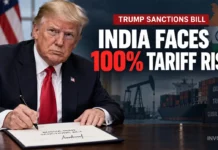
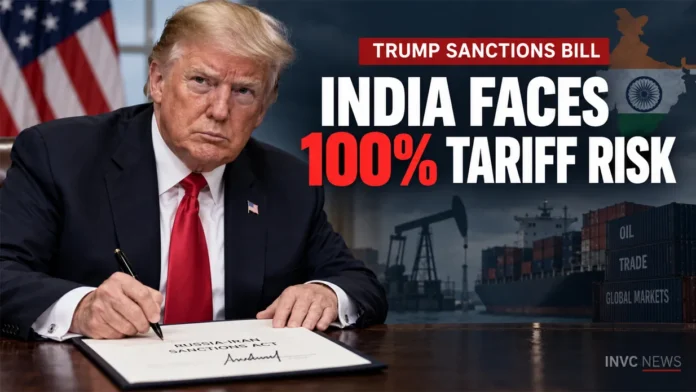
WASHINGTON, United States | September 19, 2026 — US President Donald Trump has signed a sweeping Russia-Iran sanctions law that could expose major buyers of Russian oil and natural gas, including India and China, to tariffs of up to 100%.
The move marks a major escalation in Washington’s economic pressure campaign against Russia while creating a fresh trade challenge for countries that continue to import Russian energy.
However, the new law does not mean that a 100% tariff has automatically been imposed on India or China. Instead, it gives the US president expanded authority to apply tariffs of up to 100% against major purchasers of Russian oil and natural gas if the administration chooses to use those powers.
Trump signs sanctions law on September 18
President Trump signed H.R. 5334 into law on Friday, September 18.
The legislation, known as the Lindsey O. Graham Sanctioning Russia and Iran Act of 2026, expands US sanctions, tariffs and other restrictions connected with Russia.
It also extends existing US sanctions authorities relating to Iran.
The legislation had already cleared both chambers of the US Congress before reaching President Trump’s desk.
Why India and China are in focus
One of the most closely watched provisions allows the United States to impose tariffs of up to 100% on imports from countries that rank among the biggest purchasers of Russian crude oil or natural gas.
India and China have emerged as major destinations for Russian energy exports, putting both countries directly in focus as Washington considers how to enforce the law.
That does not mean every Indian export entering the United States will immediately face a 100% tariff.
The actual impact will depend on how the Trump administration implements the legislation, which countries it identifies under the relevant provisions and whether any exemptions or waivers apply.
Why the law matters for India
For India, the issue reaches far beyond its relationship with Russia.
Russian crude has played an important role in India’s energy sourcing strategy, particularly as New Delhi seeks competitive supplies for one of the world’s largest energy-consuming economies.
A major disruption to Russian oil purchases could therefore affect refiners, crude sourcing decisions and potentially domestic energy costs.
At the same time, the United States remains an important trade and strategic partner for India.
That creates a difficult balancing act for New Delhi: securing affordable energy while protecting access to one of its key export markets.
India puts energy security first
India had already responded after the legislation passed the US Congress.
The Ministry of External Affairs said the government was monitoring developments and remained firmly committed to ensuring energy security for India’s roughly 1.4 billion people.
New Delhi has maintained that it will continue diversifying its energy sources according to changing market conditions.
India has also indicated that it will consider measures required to safeguard its trade and economic interests.
The issue has been discussed between Indian and US officials at senior levels, with New Delhi conveying concerns about possible consequences for bilateral trade and the wider global energy market.
100% tariff is a threat, not an automatic levy
This distinction is critical.
The new law provides President Trump with additional tariff authority. It should therefore not be interpreted as confirmation that India is already paying a new 100% US tariff.
Implementation remains the key question.
Washington will need to determine which countries meet the law’s conditions, what tariff rate should apply and whether exemptions, waivers or other provisions should be used.
That means the next decisions from the Trump administration could be more important for India than the signing itself.
Russia’s energy sector and shadow fleet also targeted
The legislation goes beyond tariffs.
It expands sanctions targeting Russian officials, financial institutions, energy-related entities and networks accused by the United States of helping Russia maintain energy exports despite Western restrictions.
The law also addresses vessels associated with Russia’s so-called shadow fleet, which Western governments say has been used to transport oil while reducing the effectiveness of existing sanctions.
Washington says the broader objective is to increase economic pressure on Moscow over the Russia-Ukraine war.
Iran sanctions extended
Iran is another major component of the legislation.
The law extends existing US sanctions authorities connected with Iran for another five years.
Those provisions are separate from the Russian energy tariff mechanism, although both have been incorporated into the same legislation.
What happens next for India?
Attention will now turn to implementation.
India will closely watch whether Washington formally identifies it under the tariff provisions, the level of any tariff considered and whether diplomatic negotiations can produce exemptions or other relief.
Oil markets will also matter.
If major buyers reduce purchases of Russian crude, global supply routes could shift, creating new pricing pressures across energy markets.
For New Delhi, the central challenge will be protecting energy security while limiting disruption to India-US trade.
The signing of the sanctions law therefore opens a new phase of negotiations rather than automatically triggering a 100% tariff.