By Team INVC | INVC NEWS
NEW DELHI, India | September 18, 2026 —
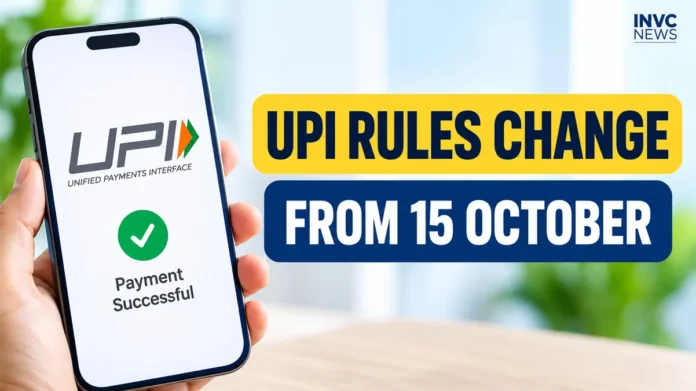
UPI Charges from October 15, 2026 have triggered widespread questions among millions of Indians who use PhonePe, Google Pay, Paytm and other UPI apps every day. The most important point is simple: ordinary consumers will not have to pay an additional transaction fee for making UPI payments.
Under the new framework, a 0.4% Merchant Discount Rate, or MDR, will apply to specified person-to-merchant UPI transactions above ₹2,000 from October 15.
The merchant bears the MDR under the framework. Banks, payment apps and other participants in the digital-payment ecosystem share the fee.
Person-to-person transfers will continue to remain completely free regardless of the amount sent.
The government has also said that approximately 96% of merchant UPI transactions will remain outside the new MDR charge.
Will Customers Pay for UPI Transactions Above ₹2,000?
No.
A customer paying ₹2,500, ₹5,000, ₹10,000 or another amount through UPI will not automatically face a transaction charge simply because the payment exceeds ₹2,000.
The new charge applies to specified person-to-merchant transactions, not ordinary person-to-person money transfers.
Banks and payment service providers cannot pass the MDR directly to consumers as a UPI transaction fee under the announced framework.
That distinction is important because social-media messages describing the new rule as a blanket “UPI tax” can create confusion.
What Happens If You Send ₹10,000 to a Friend?
Nothing changes.
If you transfer ₹10,000 from your bank account to a friend’s or family member’s account through UPI, the transaction remains free.
The government has clarified that all person-to-person UPI transactions will remain free irrespective of their value.
Therefore, the ₹2,000 threshold does not apply to P2P transfers.
What Happens If You Pay a Shop ₹2,500?
This is where the new rule becomes relevant.
A qualifying merchant transaction above ₹2,000 can attract an MDR of 0.4%.
For example, 0.4% of ₹2,500 equals ₹10.
However, this does not mean the customer automatically pays ₹10 extra.
MDR is a merchant-side payment-system charge distributed among participants such as banks and payment application providers.
Payments Up to ₹2,000 Remain Free
UPI merchant payments of ₹2,000 or less will continue under the zero-MDR framework.
For the overwhelming majority of everyday transactions—tea, groceries, local transport, medicines, food orders and smaller purchases—the new framework may therefore make no difference.
The government estimates that around 96% of person-to-merchant UPI transactions will remain unaffected.
Small Merchants Get Protection
The framework also provides protection for smaller businesses.
Small merchants receiving up to ₹1 lakh per month through eligible UPI QR-code transactions will continue to receive payments under the zero-MDR system.
This provision is particularly relevant for street vendors, neighbourhood stores and other small businesses that increasingly depend on QR-code payments.
The government says the exemption is designed to protect financial inclusion while allowing the wider UPI ecosystem to develop a sustainable revenue model.
What Is the Maximum UPI MDR?
The standard MDR on qualifying merchant transactions above ₹2,000 is 0.4%.
However, the framework also contains limits for larger payments.
For qualifying transactions of ₹75,000 or more, the MDR is capped at ₹300 per transaction.
Some sectors operate under different structures.
Essential and high-volume categories can receive lower or fixed charges depending on the transaction type.
Why Is the Government Allowing UPI MDR?
UPI expanded rapidly partly because consumers and merchants could use the system without the transaction charges commonly associated with cards.
However, running India’s enormous digital-payments infrastructure also costs money.
Banks and payment companies must fund servers, cybersecurity systems, fraud prevention, customer support, payment processing and technology upgrades.
The government’s position is that a limited merchant-side MDR can help make the ecosystem financially sustainable without imposing charges on ordinary users or smaller merchants.
UPI Has Become Central to India’s Digital Economy
UPI now processes billions of payments every month.
In August 2026 alone, the system handled around 24.5 billion transactions worth almost ₹29.8 trillion.
UPI accounts for the vast majority of India’s digital-payment transactions by volume and has also expanded internationally.
Its enormous scale means that even a small MDR on a limited category of transactions could generate substantial revenue for banks and payment companies.
Banks and Fintech Companies Could Benefit
The new fee structure could create a meaningful new revenue stream for India’s payment ecosystem.
Banks, payment applications and payment aggregators are expected to share MDR revenue.
That prospect has already attracted investor interest in companies linked to digital payments.
However, the final financial impact will depend on merchant exemptions, transaction mix, payment volumes and how the fee is distributed.
Could Merchants Increase Prices?
This is one of the key questions surrounding the change.
The government says consumers cannot be charged directly for using UPI under the framework.
However, critics argue that some larger merchants could eventually incorporate payment-processing costs into overall product pricing.
Whether that happens widely will depend on competition, merchant margins and enforcement of the payment rules.
Consumers should therefore distinguish between an official UPI transaction fee charged directly to them and a merchant’s broader pricing decisions.
UPI Fee Triggers Political Debate
The decision has also entered India’s political debate.
Congress leaders, including Rahul Gandhi, have criticised the introduction of MDR on larger merchant transactions and questioned the government’s justification for the move.
The government has rejected suggestions that ordinary citizens are being charged for UPI transactions.
Finance Ministry statements emphasize that consumers will continue to use UPI free of transaction charges and that most merchant payments will also remain outside the MDR framework.
The two sides therefore disagree primarily over the broader economic impact of the policy rather than whether person-to-person UPI transfers remain free.
UPI Charges From October 15: What Changes?
For ordinary users, the simplest summary is:
Sending money to another person: Free.
Receiving money from another person: Free.
Paying a merchant ₹2,000 or less: No MDR.
Qualifying merchant payment above ₹2,000: Merchant-side MDR of 0.4%.
Eligible small merchants: Continue under zero-MDR protection.
Large qualifying transactions: MDR capped under prescribed limits.
Customer transaction fee: None under the announced framework.
What PhonePe, Google Pay and Paytm Users Should Know
Users do not need to stop using their regular UPI apps because of the new framework.
PhonePe, Google Pay, Paytm and bank UPI apps will continue to function in the same basic way for consumers.
The major change takes place behind the payment—the economic arrangement between merchants, banks, payment apps and other ecosystem participants.
Therefore, consumers should be cautious about messages claiming that every payment above ₹2,000 will automatically become chargeable.
That interpretation is incorrect.
Bottom Line
The new UPI framework does not introduce a universal charge on Indians sending or receiving money through UPI.
Person-to-person payments remain free regardless of value.
Customers making merchant payments also do not pay a direct UPI transaction fee.
Instead, a limited 0.4% MDR applies to specified merchant payments above ₹2,000, while smaller transactions and eligible small merchants remain protected.
For millions of people using UPI for ordinary daily payments, the experience should therefore remain largely unchanged when the new framework takes effect on October 15, 2026.