By Team INVC | INVC NEWS
PATNA, India | September 15, 2026 —
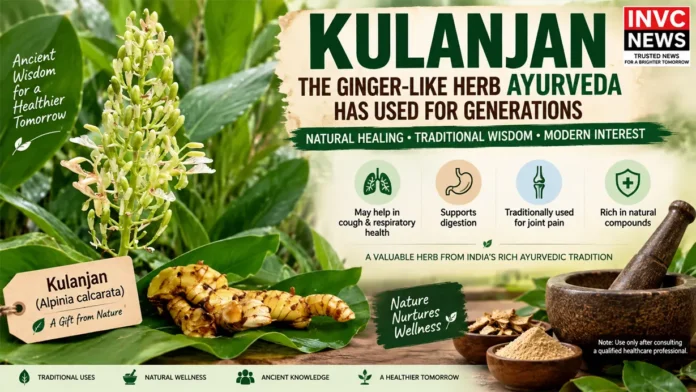
Kulanjan benefits have attracted attention in traditional medicine for generations, but this aromatic, ginger-like plant deserves a closer look before anyone treats it as a home remedy.
Known botanically in the material highlighted by Bihar’s environment department as Alpinia calcarata, Kulanjan belongs to the ginger family, Zingiberaceae. It grows as a perennial rhizomatous herb and thrives in tropical regions, including parts of India.
Its long green leaves and delicate flowers make the plant visually distinctive. However, the part that has attracted the greatest medicinal interest lies underground: its aromatic rhizome.
Traditional systems have used that rhizome for problems ranging from cough and throat discomfort to indigestion and joint complaints. Scientific research has also identified several biologically active compounds in the plant.
That sounds promising.
But there is an important difference between traditional use, laboratory or animal evidence, and a clinically proven treatment in humans.
What Is Kulanjan?
Alpinia calcarata is a perennial herb closely related to other members of the ginger family.
Kerala’s Department of Agriculture describes it as a plant with a pungent rootstock and identifies the rhizome as its economically important part. The plant can grow in tropical conditions and the rhizome features in traditional medicinal formulations.
A scientific review indexed by the U.S. National Library of Medicine also describes Alpinia calcarata as a rhizomatous perennial cultivated in countries including India, Sri Lanka and Malaysia.
This underground rhizome explains why Kulanjan can remind people of ginger.
Why Is Its Rhizome Considered Important?
Researchers have found several groups of phytochemicals in Alpinia calcarata rhizomes.
Studies have reported polyphenols, tannins, flavonoids, steroid glycosides and alkaloids. Researchers have also examined the plant’s essential oils.
One major volatile component identified in rhizome and leaf oils is 1,8-cineole, although chemical composition can differ depending on where the plant grows.
Those compounds help explain why researchers continue to investigate the herb.
They do not, however, automatically prove that consuming Kulanjan will prevent or cure a particular disease.
Kulanjan and Cough: Why Traditional Medicine Uses It
Respiratory complaints represent one of Kulanjan’s best-known traditional uses.
Published reviews document traditional use of Alpinia calcarata rhizomes for cough, bronchitis, asthma and other respiratory complaints.
Its aromatic nature has also contributed to its traditional reputation.
However, anyone experiencing persistent coughing, breathing difficulty, wheezing, chest pain, high fever or worsening respiratory symptoms should seek medical evaluation rather than relying on an herbal remedy.
A traditional use is not a substitute for diagnosis.
Can Kulanjan Help With Joint Pain and Arthritis?
Traditional medicine has also associated the rhizome with rheumatism and arthritis.
This claim has attracted scientific attention because researchers have investigated extracts of Alpinia calcarata for anti-inflammatory and pain-related biological activity.
A study published in the Journal of Ethnopharmacology examined its anti-inflammatory effects, while broader reviews report experimental anti-inflammatory and antinociceptive activity.
That evidence makes the plant scientifically interesting.
Still, laboratory or animal findings should not be translated into a promise that Kulanjan can treat arthritis in people.
People with persistent joint pain should identify the underlying cause first.
What About Digestion?
Traditional formulations have also used Kulanjan for digestive complaints.
Kerala’s agriculture guidance notes its use in indigenous formulations associated with stimulating digestion, while scientific literature records traditional use for indigestion and stomach discomfort.
Researchers have additionally studied Alpinia calcarata extracts for gastroprotective effects, including experimental work in animal models.
Again, this requires careful interpretation.
Animal research can identify potentially useful biological effects, but it does not establish the appropriate human dose, effectiveness or long-term safety of a home preparation.
Scientists Have Found More Than Folk-Medicine Claims
Kulanjan becomes especially interesting when traditional knowledge and modern laboratory research are examined separately.
Scientific reviews report experimental antioxidant, anti-inflammatory, antimicrobial and gastroprotective activities, among several other investigated properties.
Researchers have also identified essential-oil constituents and numerous plant compounds.
This evidence gives scientists reasons to continue studying Alpinia calcarata.
It does not justify calling the plant a proven treatment for diabetes, asthma, arthritis, infection or other medical conditions.
That distinction is crucial for responsible health reporting.
Don’t Confuse Every “Kulanjan” Product With the Same Plant
There is another issue consumers should know.
Common plant names can vary significantly between regions and traditional systems.
For example, Kerala Agriculture identifies Alpinia calcarata as kulainjan in Hindi. Yet an ICFRE medicinal-plants publication lists Alpinia galanga with Kulanjan among its local names.
Therefore, someone buying a product simply labelled “Kulanjan” should not assume its botanical identity.
Check the scientific name on the product or consult a qualified professional.
That small step can prevent one herb from being mistaken for another.
Is Kulanjan Safe to Use at Home?
Natural does not automatically mean risk-free.
The concentration of active compounds can differ between plants, extracts, powders and oils. Dosage also matters.
People who take regular medicines, have chronic medical conditions, are pregnant or breastfeeding, or plan to give herbal products to children should seek professional advice before medicinal use.
The same caution applies when symptoms persist or worsen.
Kulanjan may have a long history in traditional medicine, and modern research has found intriguing biological properties in its rhizome.
The evidence is nevertheless strongest when described accurately:
Kulanjan is a traditional medicinal plant under scientific investigation — not a miracle cure.