By Team INVC | INVC NEWS
BRUSSELS, Belgium | September 15, 2026 —
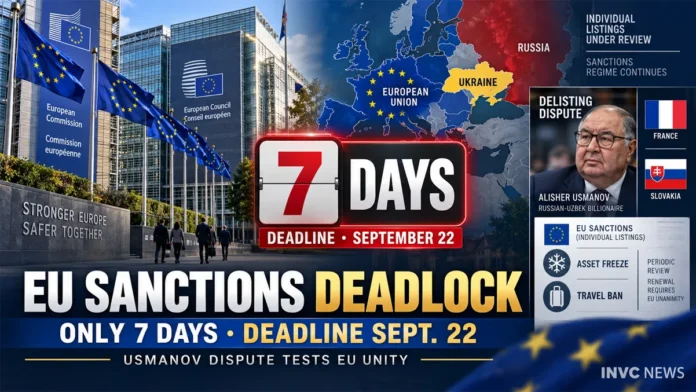
EU Russia Sanctions Renewal has turned into a fresh test of European unity after the bloc’s ambassadors failed to agree on a standard six-month extension of sanctions targeting thousands of people and companies linked to Russia’s war against Ukraine.
Instead, the European Union has extended the individual sanctions regime for just seven days, until September 22, giving all 27 member states more time to resolve a dispute over whether Russian-Uzbek billionaire Alisher Usmanov should remain on the list.
France has joined Slovakia in calling for Usmanov’s removal, according to diplomats familiar with the negotiations.
That disagreement has prevented the unanimous approval required for the normal six-month renewal.
The result does not mean the EU has lifted sanctions on Russia.
Nor does it affect the bloc’s broader economic restrictions covering areas such as banking, energy, trade, technology and Russia’s war economy.
However, the unusually short extension exposes how difficult it can be for Brussels to maintain a common sanctions front when every member state holds a veto.
EU Extends Individual Russia Sanctions Until September 22
The existing individual sanctions were due to expire on September 15.
EU ambassadors meeting in the Committee of Permanent Representatives, known as Coreper, agreed to push the expiry date back by seven days.
That keeps the current listings in force until midnight on September 22.
The temporary extension gives governments additional time to examine proposals for the next six-month renewal.
Normally, these sanctions are rolled over twice a year.
This time, the process has stalled because member states have not agreed on who should remain on the list.
Nearly 3,000 People and Entities Face Restrictions
The sanctions regime covers nearly 3,000 individuals and entities.
Those listed can face asset freezes inside the European Union.
Individuals may also face travel bans preventing them from entering or transiting EU territory.
EU citizens and businesses are generally prohibited from making funds or economic resources available to sanctioned parties.
The measures have expanded dramatically since Russia launched its full-scale invasion of Ukraine in February 2022.
The EU argues that the restrictions target people and organizations involved in supporting Russia’s military campaign, political system and actions undermining Ukraine’s territorial integrity.
Alisher Usmanov Becomes the Flashpoint
At the center of the latest disagreement is billionaire Alisher Usmanov.
Usmanov was born in Uzbekistan and built a business empire spanning metals, mining, telecommunications, internet companies and media.
He remains under both European Union and US sanctions.
Usmanov has repeatedly challenged European sanctions through the courts and has sought to overturn measures imposed against him.
His legal team has also disputed some of the claims and published material used to justify his inclusion on sanctions lists.
The question now dividing governments is whether the EU should continue sanctioning him.
France Joins Slovakia in Seeking Usmanov’s Removal
Slovakia had already pushed for Usmanov to be removed from the sanctions list.
France has now joined that request.
French officials have simultaneously stressed that Paris remains committed to supporting Ukraine and increasing pressure on Russia’s war machine.
The French position therefore does not appear to represent a broader call for weakening sanctions on Moscow.
Instead, France has cited a specific national-security issue and approaches from international partners concerning Usmanov.
That distinction matters.
Paris can support tough sanctions against Russia while arguing that one particular person should no longer appear on the list.
However, because renewals require unanimity, even one disputed name can complicate the entire package.
Why One Billionaire Can Hold Up Thousands of Sanctions
EU foreign-policy sanctions require agreement from all 27 member states.
That means Brussels cannot simply approve a renewal through a majority vote.
Every government must agree.
This unanimity rule gives individual capitals enormous leverage.
A state can raise an objection involving one person, one company or a broader policy question and delay the entire renewal.
That is exactly why the September 22 deadline matters.
European diplomats now have only days to find a compromise before the temporary extension expires.
Slovakia Has Long Taken a Different Line on Russia
Slovakia has maintained a more complicated relationship with Moscow than many other EU countries.
Bratislava has repeatedly questioned elements of European policy toward Russia and Ukraine.
That does not automatically translate into opposition to every sanctions measure.
However, Slovakia has frequently pressed Brussels to consider national economic and political interests before extending restrictions.
The latest Usmanov dispute again demonstrates how individual governments can shape EU-wide policy.
This Is Not the Same as EU Economic Sanctions on Russia
This distinction is essential.
The current seven-day extension applies to the individual listings regime involving sanctioned people and entities.
The European Union’s broader sectoral economic sanctions are on a different timetable.
In June, EU governments took the unusual step of extending major economic sanctions against Russia for 12 months, until July 31, 2027.
Those measures cover important areas including finance, trade, energy, technology and restrictions designed to reduce Russia’s ability to fund its war.
The longer renewal was partly intended to reduce the number of occasions on which disagreements between member states could threaten continuity.
Therefore, a failure to agree on the current individual listings would not suddenly reopen normal EU-Russia trade.
EU Has Adopted 21 Sanctions Packages
Europe has steadily expanded its restrictions since Russia’s full-scale invasion.
By July 2026, the EU had adopted its 21st sanctions package.
That package added new restrictions on Russian energy, financial services and cryptocurrency activity.
It also expanded individual listings and targeted entities accused of helping Moscow evade previous sanctions.
The EU has additionally focused on Russia’s so-called shadow fleet, financial institutions and access to technology that could support military production.
Brussels says the objective is to weaken Russia’s ability to finance and sustain the war.
Ukraine Will Watch the September 22 Decision Closely
For Kyiv, sanctions are not simply symbolic.
Ukraine has repeatedly urged European governments to maintain and increase economic pressure on Moscow.
Any visible disagreement inside the EU can therefore become politically significant.
Russia has consistently argued that Western sanctions have failed to achieve their objectives and have also damaged European economies.
Ukraine takes the opposite view, arguing that sustained restrictions gradually reduce Moscow’s access to money, technology and international markets.
A last-minute EU dispute can give both sides ammunition in that larger political argument.
France Faces a Delicate Political Balance
France’s position is likely to receive particularly close attention because Paris has been one of Ukraine’s major European supporters.
Calling for Usmanov’s removal could therefore be portrayed as inconsistent with French pressure on Moscow.
French officials are pushing back against that interpretation.
Their argument is effectively that reviewing an individual’s designation does not equal abandoning the wider sanctions strategy.
European sanctions law also requires listings to remain legally defensible.
If a sanctioned person successfully challenges the evidence used against them, governments may face pressure to revise the listing.
That legal dimension has become increasingly important as Russian business figures challenge EU decisions in European courts.
Court Challenges Are Becoming Part of the Sanctions Battle
Sanctions are political tools, but they must also survive legal scrutiny.
Individuals targeted by EU measures can challenge them before European courts.
That forces Brussels to justify why each person remains listed.
Usmanov has pursued multiple legal challenges with the goal of lifting restrictions against him.
His case demonstrates a broader problem for the EU.
A sanctions regime involving thousands of people and companies requires continuous legal review.
Governments must show that listings remain justified rather than simply renewing them indefinitely without updated reasoning.
Seven-Day Extension Exposes a Structural EU Weakness
The immediate crisis may be resolved before September 22.
However, the episode exposes a recurring weakness in EU foreign policy.
Unanimity can demonstrate powerful unity when all 27 governments agree.
It can also turn relatively narrow disagreements into bloc-wide crises.
Russia sanctions have repeatedly produced last-minute negotiations in Brussels.
Hungary played a major role in several earlier disputes, while Slovakia has also challenged elements of the EU’s Russia policy.
The EU tried to reduce that vulnerability by extending economic sanctions for a full year.
Individual listings still require the six-month review process.
What Happens Before September 22?
EU ambassadors now have several possible routes.
They could agree to keep Usmanov sanctioned and approve the full six-month renewal.
They could remove him while extending sanctions against the remaining listed individuals and companies.
Governments could also negotiate another compromise involving changes elsewhere in the list.
What Brussels cannot easily do is ignore the deadline.
Without another unanimous agreement, the legal basis for the affected sanctions would face expiry.
That gives negotiators a powerful incentive to reach a deal.
EU Unity Faces Another Ukraine War Test
The political importance of the dispute extends beyond one billionaire.
Europe wants to show Moscow that its support for Ukraine remains durable.
Russia, meanwhile, has long calculated that economic pressure, elections and national interests could eventually divide Western governments.
Every visible EU disagreement therefore carries geopolitical significance.
A seven-day extension is not a collapse of the sanctions regime.
It is not evidence that Europe has abandoned Ukraine.
But it is a reminder that maintaining pressure on Russia requires constant political negotiation among 27 governments with different national interests.
The next deadline is now clear.
By September 22, the European Union must either restore consensus on its individual Russia sanctions or face a far more serious test of the unity it has tried to maintain throughout the Ukraine war.