By Team INVC | INVC NEWS
RIYADH, Saudi Arabia | September 15, 2026 —
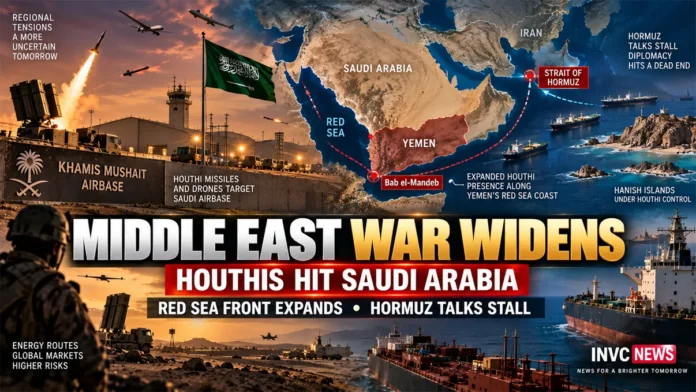
Strait of Hormuz Crisis has entered a more dangerous phase after Yemen’s Iran-aligned Houthis launched dozens of missiles and drones toward a major Saudi military airbase, wounded civilians in southern Saudi Arabia and consolidated positions along Yemen’s strategic Red Sea coast.
The latest escalation is rapidly transforming what had centered on Iran, the Strait of Hormuz and Gulf shipping into a broader regional confrontation stretching from southern Saudi Arabia to Yemen and the Bab el-Mandeb Strait.
The Houthis said they targeted a military airbase at Khamis Mushait with missiles and drones, aiming at aircraft hangars, radar systems, runways and ammunition facilities.
Saudi authorities activated emergency alerts in Khamis Mushait and three other southern cities.
The Saudi-led coalition said 13 civilians were wounded during the attacks.
Saudi and Yemeni forces have responded by intensifying airstrikes against Houthi positions in western Yemen, but the group continues to hold substantial territory along the Red Sea coast.
At the same time, hopes for an immediate diplomatic breakthrough over the Strait of Hormuz have weakened after Gulf Arab states postponed planned talks with Iran.
Together, the military escalation and diplomatic setback are raising a much larger question for the world: Could two of the planet’s most important energy shipping corridors come under severe pressure at the same time?
Houthis Launch Dozens of Missiles and Drones at Saudi Arabia
The latest attack marks a sharp expansion of Houthi military operations against Saudi Arabia.
Houthi forces said they fired dozens of missiles and drones at the Khamis Mushait military airbase in southern Saudi Arabia.
The group said the operation targeted military infrastructure including aircraft hangars, radar installations, ammunition depots and runways.
It described the attack as retaliation for Saudi airstrikes inside Yemen.
Saudi authorities issued emergency alerts across several southern cities as incoming threats were detected.
The Saudi-led coalition later said 13 civilians had suffered injuries.
The extent of damage to the military facility remained unclear early Tuesday.
The attack nevertheless sends a powerful signal: the renewed Yemen conflict is no longer confined to territory inside Yemen.
Saudi Arabia and Yemen Intensify Airstrikes
Saudi and Yemeni forces have responded with heavier aerial attacks against Houthi-held positions.
The strikes have concentrated on western Yemen, including areas around the historic Red Sea port of Mocha.
Saudi Arabia previously led a military coalition against the Houthis for years before the conflict entered a quieter phase following a 2022 ceasefire.
That fragile calm is now breaking down.
Fighting has intensified rapidly this month as Houthi forces pushed against troops aligned with Yemen’s internationally recognized government.
The renewed Saudi-Houthi confrontation threatens to reopen one of the Middle East’s most devastating conflicts.
Houthis Tighten Grip Along Yemen’s Red Sea Coast
The military battle is not only about Saudi territory.
Houthi forces have expanded dramatically across Yemen’s western coastline.
Officials from Yemen’s internationally recognized government say the group now maintains effective control over much of the Red Sea coast.
That development has major strategic implications.
The Red Sea coastline gives the Houthis greater ability to threaten shipping routes leading toward the Bab el-Mandeb Strait.
Bab el-Mandeb connects the Red Sea with the Gulf of Aden and the Arabian Sea.
Commercial ships traveling between Asia and Europe through the Suez Canal depend heavily on this route.
Any sustained disruption can force vessels to travel around Africa, adding substantial time and cost to global trade.
Greater and Lesser Hanish Islands Add Another Strategic Prize
The Houthi advance has also reached strategic Red Sea islands.
Houthi forces have taken Greater Hanish and Lesser Hanish, strengthening their presence across the southern Red Sea.
The islands sit near shipping lanes connecting the Red Sea and Bab el-Mandeb.
They follow earlier Houthi territorial gains that included Perim, also known as Mayun Island, near the mouth of the Red Sea.
Taken together, these positions could provide the group with greater ability to monitor or threaten maritime traffic.
That makes the Houthi advance important far beyond Yemen’s civil war.
It directly intersects with global shipping and energy security.
Bab el-Mandeb Becomes Critical as Hormuz Remains Restricted
The Red Sea developments would be serious under any circumstances.
They are far more consequential because the Strait of Hormuz is already heavily disrupted.
Before the current conflict, roughly one-fifth of the world’s oil exports moved through Hormuz.
Iran has imposed severe restrictions on traffic through the strategic waterway during the wider confrontation.
Saudi Arabia and other Gulf producers therefore turned increasingly toward alternative routes.
One of the most important was the Red Sea.
Now that route is also under growing military pressure.
The possibility of simultaneous disruption around Hormuz and Bab el-Mandeb has become one of the biggest risks facing global energy markets.
Saudi East-West Pipeline Adds to the Pressure
Saudi Arabia faces another problem.
Its critical East-West Pipeline was knocked offline after an aerial attack last week.
The approximately 1,200-kilometer pipeline carries crude from Saudi Arabia’s eastern oil-producing regions toward the Red Sea.
Saudi Arabia originally developed the route to reduce dependence on the Strait of Hormuz.
During the current crisis, that function became even more important.
A prolonged outage could disrupt oil volumes equivalent to roughly 4% of global supply while Hormuz remains heavily restricted.
Saudi Arabia has not announced a firm date for full pipeline operations to resume.
The combination of pipeline damage and Houthi territorial expansion has therefore narrowed Riyadh’s room to maneuver.
Greater and Lesser Hanish Seizure Raises Shipping Fears
Control of Red Sea islands gives the Houthis more than symbolic territory.
These positions sit near one of the world’s busiest maritime corridors.
Ships traveling from the Indian Ocean toward the Suez Canal pass through the Bab el-Mandeb area before entering the Red Sea.
Energy cargoes, container vessels and other commercial shipping all depend on this corridor.
If shipping companies judge the area too dangerous, insurers can raise premiums, vessels can reroute and transportation costs can climb.
Those costs eventually affect businesses and consumers far beyond the Middle East.
Yemen Humanitarian Crisis Worsens Again
The military escalation is also creating another humanitarian emergency.
Nearly 94,000 people have reportedly fled their homes since fighting intensified in Yemen this month.
Taiz and Lahj have suffered particularly heavy displacement.
Thousands of people have moved into temporary shelters, while around 200 schools in southwestern Yemen have reportedly been converted into accommodation for displaced families.
More than 2,000 people have also crossed the sea into Djibouti.
Health authorities reported more than 500 deaths during a recent week-long period, underscoring the speed at which the conflict has deteriorated.
The figures revive painful memories of Yemen’s long civil war, which killed well over 100,000 people before the 2022 ceasefire significantly reduced large-scale fighting.
Washington Resists Direct Military Intervention
Saudi Arabia is also looking toward Washington.
Saudi Crown Prince Mohammed bin Salman has discussed regional security with US Central Command chief Admiral Brad Cooper as Riyadh evaluates its response to the Houthi offensive.
Saudi Arabia has sought greater US military assistance.
However, Washington has so far resisted entering the renewed Yemen conflict through direct strikes.
The United States has instead indicated that it can provide intelligence-sharing and targeting assistance.
That distinction is important.
Direct American military involvement against the Houthis could expand the conflict further and increase the possibility of confrontation with Iran.
President Donald Trump has simultaneously maintained that Tehran may still want a broader agreement with Washington.
Hormuz Talks Postponed as Diplomacy Falters
The military escalation comes just as hopes for regional diplomacy have weakened.
Oman had planned to host discussions involving Iran and Gulf Arab states over negotiations aimed at reopening the Strait of Hormuz.
Those talks were postponed.
Iran says Saudi Arabia requested the postponement.
Saudi Arabia has not publicly accepted Tehran’s characterization.
Iranian officials say Tehran and Oman have already developed a proposed framework covering the strait.
However, Saudi officials have raised concerns about the potential long-term consequences of any arrangement that could give Iran greater influence over shipping rules in Hormuz.
The dispute highlights a fundamental problem.
Everyone wants safer shipping, but Gulf governments and Iran disagree over who should control the security architecture.
Iran Says Its Conditions Must Be Met
Washington continues to signal interest in diplomacy.
President Trump has argued that Iran wants an agreement.
However, senior Iranian officials have pushed back against that narrative.
Tehran maintains that negotiations cannot move forward until Iranian conditions are addressed.
That means hopes for a rapid diplomatic solution remain uncertain.
The postponement of the Oman meeting now leaves military developments moving faster than diplomacy.
Two Strategic Straits, One Expanding Crisis
The Middle East crisis has now developed two interconnected maritime fronts.
The first is the Strait of Hormuz.
The second is Bab el-Mandeb and the southern Red Sea.
Hormuz serves Persian Gulf energy producers.
Bab el-Mandeb links the Indian Ocean to the Red Sea and Suez Canal.
Pressure on either waterway can disrupt world trade.
Pressure on both simultaneously would create a much larger global shock.
That is why the Houthi advance matters to countries thousands of miles away.
Oil Markets Watch Every Saudi-Houthi Move
Energy markets are reacting closely to each military development.
Crude prices jumped sharply after the weekend escalation before giving back part of their gains.
Traders are now watching physical oil flows rather than just political rhetoric.
Any prolonged disruption to Saudi exports, Red Sea shipping or Hormuz traffic could push a larger geopolitical premium into oil prices.
Countries that rely heavily on imported energy, including India, would face particular exposure.
Higher crude prices can weaken currencies, increase transport expenses and feed inflation.
India Could Feel the Economic Shock
India imports most of the crude oil it consumes.
A sustained Middle East supply disruption therefore has direct economic consequences.
More expensive oil can increase India’s import bill and raise demand for US dollars.
That can pressure the rupee.
Higher transportation and production costs can also gradually feed into inflation.
Airlines, logistics companies, paint manufacturers, tyre producers, chemical companies and fuel retailers are among the sectors particularly sensitive to expensive crude.
The risk therefore stretches well beyond petrol and diesel.
Saudi Arabia Faces a Difficult Strategic Choice
Riyadh now confronts an unusually complicated security picture.
Saudi Arabia wants to prevent Houthi missiles and drones from threatening cities and infrastructure.
It also wants to protect oil exports through the Red Sea.
At the same time, Saudi leaders have spent years trying to avoid returning to a full-scale war in Yemen.
An aggressive ground or air campaign could become costly.
A restrained response could allow the Houthis to consolidate more strategic territory.
Saudi Arabia must therefore balance military pressure, diplomacy and energy security at the same time.
Houthis Also Face Heavy Pressure
The Houthis have gained territory quickly, but their expansion carries risks.
Saudi and Yemeni airstrikes are intensifying.
Holding large stretches of coastline requires troops, logistics and defensive infrastructure.
The group must also protect missile and drone sites from aerial attacks.
Meanwhile, any direct attack that causes substantial civilian casualties inside Saudi Arabia could trigger a much stronger response.
The conflict is therefore moving into an increasingly unpredictable stage.
Why the Next 48 Hours Matter
Several developments could determine whether the crisis accelerates or stabilizes.
First, Saudi Arabia must decide how far to expand its military response.
Second, Houthi forces may attempt to consolidate or expand Red Sea positions.
Third, Oman could try to revive the postponed Hormuz talks.
Fourth, Washington must decide whether intelligence support remains sufficient if Saudi Arabia faces larger attacks.
Finally, global energy markets will watch shipping and pipeline flows closely.
A major disruption at either Hormuz or Bab el-Mandeb could quickly change the economic consequences of the conflict.
Middle East War Is No Longer Confined to One Front
The most important development is the widening geography of the conflict.
Iran, Saudi Arabia, Yemen, the Persian Gulf and the Red Sea are increasingly becoming part of the same security crisis.
Houthi missiles reaching Saudi Arabia, territorial gains along Yemen’s coast, stalled Hormuz diplomacy and damage to alternative oil infrastructure have created a dangerous combination.
Diplomacy still offers a path away from a larger confrontation.
However, military events are currently moving faster than negotiations.
For the global economy, the warning is clear.
The Strait of Hormuz Crisis is no longer only about Hormuz. The fight now stretches toward Saudi Arabia and the Red Sea — placing two of the world’s most important energy and trade corridors under pressure at the same time.