By Team INVC | INVC NEWS
FORT WORTH, United States | September 15, 2026 —
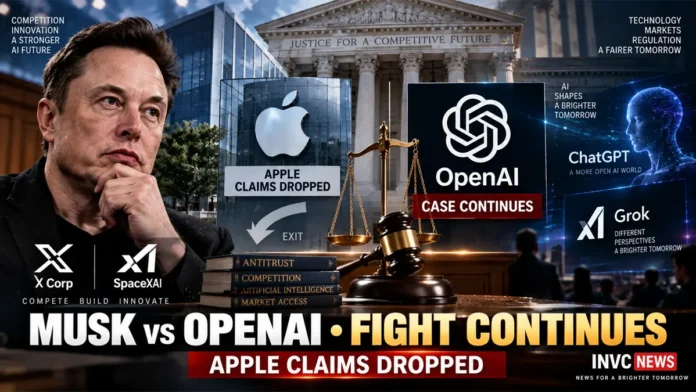
Elon Musk Apple Antitrust Lawsuit has taken a dramatic turn after Musk-linked X Corp and SpaceXAI moved to end their antitrust claims against Apple while keeping their legal battle against OpenAI alive.
The move removes Apple from one of the most closely watched technology antitrust disputes in the United States, but it does not end the larger fight over competition in the generative AI market.
X Corp and SpaceXAI asked a federal court in Texas to dismiss their claims against Apple with prejudice, meaning those same claims cannot be refiled.
The filing did not explain why the companies decided to end the Apple portion of the case and did not say whether the two sides reached a settlement.
OpenAI remains a defendant.
That means the legal battle over ChatGPT, Grok and the fast-growing AI chatbot market is far from over.
Apple Is Out, but OpenAI Is Still in the Fight
The original lawsuit accused Apple and OpenAI of working together in a way that allegedly restricted competition in both smartphones and generative AI chatbots.
Musk’s companies argued that Apple’s decision to integrate ChatGPT into Apple Intelligence gave OpenAI an unfair advantage over rival AI systems, including xAI’s Grok.
The lawsuit also alleged that Apple’s App Store practices made it harder for rival AI applications to compete.
Apple and OpenAI denied wrongdoing.
Apple maintained that its arrangement with OpenAI did not prevent it from working with other AI providers.
OpenAI rejected the allegations and argued that Musk’s legal campaign was part of a broader effort against the company.
Now, with Apple removed from the case, the legal spotlight shifts directly toward OpenAI.
What Does “With Prejudice” Mean?
The wording of the dismissal matters.
A dismissal “with prejudice” generally means the plaintiffs cannot bring the same claims against Apple again.
That gives Apple a far cleaner exit than a temporary withdrawal.
However, the filing does not reveal what happened behind the scenes.
It does not state whether Apple made any payment, changed any business practice or agreed to any commercial terms.
Without public details, it would be wrong to describe the development as a financial settlement.
The most accurate conclusion is simpler: the Apple portion of the antitrust dispute is ending, while the OpenAI portion continues.
How the Dispute Began
X Corp and xAI filed the antitrust lawsuit in federal court in the Northern District of Texas in August 2025.
The case accused Apple and OpenAI of violating US competition law by allegedly locking rivals out of important parts of the smartphone and AI chatbot markets.
At the center of the dispute was Apple’s integration of ChatGPT into Apple Intelligence.
Apple announced its OpenAI partnership as part of a broader artificial intelligence push across iPhones and other devices.
Under the integration, users can access ChatGPT through certain Apple Intelligence features.
Musk’s companies argued that this arrangement gave OpenAI privileged access to Apple’s enormous device ecosystem.
They also claimed that competing AI services such as Grok suffered from Apple’s App Store policies and promotional choices.
Judge Previously Allowed the Case to Move Forward
The lawsuit survived an important early challenge.
In November 2025, a federal judge rejected motions from Apple and OpenAI seeking to dismiss the case at that stage.
The judge stressed that the ruling did not decide whether Musk’s allegations were ultimately correct.
Instead, it allowed the litigation to continue.
That distinction remains important today.
Apple’s exit should not be interpreted as a court finding that the company violated antitrust law.
Likewise, the continued case against OpenAI does not mean the claims have been proven.
The litigation remains contested.
Why OpenAI Still Faces Legal Pressure
The remaining case puts renewed attention on OpenAI’s position in the generative AI market.
ChatGPT became one of the fastest-growing consumer technology products ever launched and helped push generative AI into the mainstream.
Its rapid rise also triggered intense competition from companies including Google, Anthropic, Meta and xAI.
Musk’s companies argue that OpenAI has benefited from relationships and market practices that make it harder for rivals to compete fairly.
OpenAI rejects that view.
The company has repeatedly said it competes through technology and product performance rather than unlawful exclusion.
The court will now have to consider the remaining allegations without Apple playing the same central role in the dispute.
Grok vs ChatGPT Adds Another Layer
The legal dispute also reflects a much larger commercial rivalry.
Musk founded xAI to compete directly in advanced artificial intelligence.
Its Grok chatbot has become one of ChatGPT’s most visible rivals.
Grok is integrated heavily into X and has also expanded into other Musk-linked products.
That puts xAI and OpenAI in direct competition for users, developers, enterprise customers and influence over the future of artificial intelligence.
Every distribution advantage matters.
That is why integration into operating systems, app stores and major consumer platforms has become so commercially important.
The fight is not simply about which chatbot produces better answers.
It is also about who controls access to hundreds of millions of potential users.
Apple Intelligence Was Central to the Original Claim
Apple’s push into generative AI created the commercial backdrop for the lawsuit.
Rather than relying entirely on one in-house chatbot, Apple built Apple Intelligence as a broader AI platform and included ChatGPT access for some queries.
Musk’s companies argued that this arrangement could steer Apple users toward OpenAI.
Apple rejected the suggestion that its partnership created an unlawful exclusive arrangement.
The company argued that nothing prevented it from adding other AI partners.
That position weakened the idea that one OpenAI deal automatically locked competitors out permanently.
Now Apple no longer needs to defend that argument in this particular lawsuit.
No Public Explanation for Apple’s Exit
One of the biggest unanswered questions is why the Apple claims ended now.
The court filing offered no detailed explanation.
There is also no public confirmation of a financial or commercial settlement.
All three sides have strong reasons to keep certain negotiations private.
Apple may have wanted to eliminate litigation risk.
Musk’s companies may have decided that continuing against OpenAI alone better serves their legal strategy.
The parties could also have reached terms that remain confidential.
Until more information becomes public, any stronger conclusion would be speculation.
The OpenAI Case Could Still Matter for AI Competition
The remaining lawsuit could have broader implications beyond Musk and OpenAI.
Regulators, courts and technology companies around the world are increasingly examining how dominant digital platforms distribute artificial intelligence services.
Questions include whether operating-system owners can favor particular AI partners, how app stores treat competing chatbots and whether exclusive distribution deals can limit competition.
The answers could shape future agreements between smartphone makers and AI developers.
That makes the case important even if Apple is no longer directly involved.
Musk and OpenAI Have a Complicated History
The legal fight also carries a personal history.
Musk helped establish OpenAI before later separating from the organization.
Since then, he has become one of its most vocal critics while simultaneously building xAI as a competitor.
That history has produced several legal and public clashes.
The antitrust case is separate from other disputes involving OpenAI’s corporate structure and development strategy.
Still, the broader rivalry between Musk and OpenAI gives every legal development additional attention.
What Happens Next?
The immediate next step is straightforward.
Apple’s part of the case is expected to end once the court acts on the dismissal request.
The remaining claims against OpenAI continue.
OpenAI may seek additional information about any agreement between Musk’s companies and Apple if it believes those terms could affect its defense.
Further motions, discovery disputes and legal arguments are therefore likely.
A trial is not guaranteed.
Cases of this size can end through dismissal, settlement or other court rulings before reaching a jury.
Why This Story Matters Beyond Silicon Valley
The dispute highlights a central battle in modern technology: who controls the gateways through which consumers access artificial intelligence?
Apple controls one of the world’s most valuable smartphone ecosystems.
OpenAI controls one of the best-known generative AI platforms.
Musk controls X and is building xAI into a major AI competitor.
When those companies fight over distribution, integration and competition, the outcome can affect millions of users and the future structure of the AI market.
Apple may now be leaving this particular courtroom battle.
The broader AI war is not ending.
If anything, the focus has narrowed.
Musk’s legal fight now points more directly at OpenAI — and the struggle over who controls the next generation of AI distribution remains very much alive.