By Team INVC | INVC NEWS
KYIV, Ukraine | September 14, 2026 —
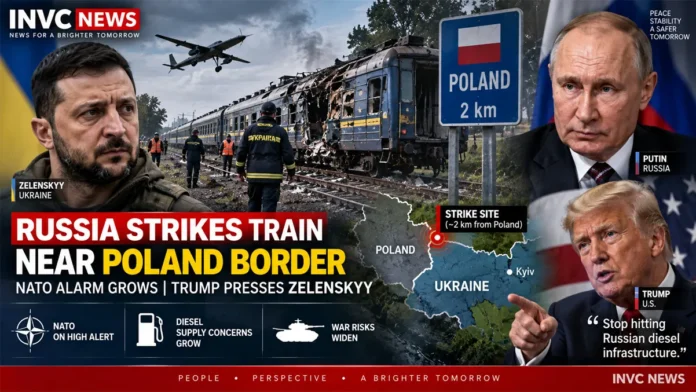
Russia Ukraine War September 14 2026 entered a potentially more dangerous phase after a Russian drone struck a passenger train just two kilometers from Ukraine’s border with NATO member Poland, while President Donald Trump separately urged Ukrainian President Volodymyr Zelenskyy to stop attacking Russian diesel infrastructure.
The two developments highlight a widening strategic dilemma around the war.
Russia is intensifying attacks close to Ukraine’s western borders and critical links with Europe. At the same time, Ukraine’s long-range campaign against Russian refineries has begun affecting international fuel markets and drawing direct pressure from Washington.
Russian Drone Hits Passenger Train Near Poland
A Russian drone struck a passenger train near the Polish border on Sunday.
Ukraine’s railway operator said the attack occurred roughly 2 kilometers from Poland, making it one of the latest Russian strikes extremely close to NATO territory.
No casualties were reported.
However, the political implications immediately drew attention because the railway line regularly carries foreign officials travelling to and from Kyiv.
Former British Prime Minister Boris Johnson and other European political figures had reportedly travelled along the route shortly before the attack.
Former Swedish Prime Minister Carl Bildt said their train had passed earlier and that the following train was evacuated as the drone approached.
Ukraine’s railway operator said it was possible that a train carrying foreign political figures had been the intended target.
That claim has not been independently established.
Poland Calls Strikes Near NATO Border an Escalation
Polish Foreign Minister Radoslaw Sikorski described the increasing Russian attacks close to NATO territory as an escalation.
The latest incident raises concern because Poland plays a crucial role in supplying Ukraine.
Military equipment, humanitarian assistance and commercial goods move through Polish-Ukrainian border crossings.
Any sustained Russian campaign against logistics routes in western Ukraine could therefore have consequences beyond the immediate battlefield.
NATO has so far avoided becoming directly involved in the war, but repeated military incidents close to alliance territory continue to increase the risk of miscalculation.
Another Strike Hits Near Major Poland-Ukraine Crossing
The passenger train attack was not the only incident near the Polish border.
A truck less than one kilometer from the border was also hit earlier on Sunday.
The incident temporarily disrupted operations around the Dorohusk-Yahodyn crossing, one of the important transport links between Poland and Ukraine.
Russia’s Defence Ministry said its forces had targeted infrastructure used to facilitate military cargo arriving from Europe.
Moscow has increasingly focused on logistics routes connecting Ukraine with its Western partners.
Kyiv argues that these attacks are intended to disrupt military supplies, trade and civilian transportation.
Trump Tells Zelenskyy: Stop Hitting Russian Diesel
While fighting intensified near Poland, President Donald Trump opened another front in the political debate surrounding the war.
Trump called on Zelenskyy to stop Ukrainian strikes against Russian oil refineries and infrastructure involved in diesel production and distribution.
Ukraine has used long-range drones extensively against Russian energy facilities.
Those strikes have reduced Russian refining capacity, contributed to domestic fuel shortages and forced Moscow to restrict fuel exports.
Kyiv considers Russian energy infrastructure a legitimate target because fuel revenues support Moscow’s war effort and Russian refineries supply its military.
Trump, however, argued that the attacks are now affecting fuel availability globally.
Diesel Prices Turn Ukraine War Into Global Economic Issue
The dispute has moved beyond battlefield strategy.
Diesel supplies have tightened dramatically as disruptions involving Russia combine with wider instability in global energy markets.
Diesel powers trucks, trains, agricultural machinery, ships and large sections of industrial activity.
That means sustained shortages can push up transportation and food costs and contribute to broader inflation.
Trump said Ukraine had other potential military targets and should avoid Russian diesel infrastructure because of its effect on the global economy.
His intervention could become a significant test of relations between Washington and Kyiv.
Ukraine Continues Strikes on Russian Oil Facilities
Ukraine has shown little sign of abandoning its campaign against Russia’s energy sector.
Ukrainian forces said they struck a major refinery at Slavyansk-on-Kuban in Russia’s Krasnodar region.
Russian authorities said an attack on an enterprise in the area injured three people and damaged an oil pipeline.
Another drone attack affected Nizhnekamsk in Russia’s Tatarstan region, an important center for oil refining and industrial production.
Russian officials reported deaths and injuries following attacks in the area.
Moscow said its forces intercepted hundreds of Ukrainian drones during the night.
Russia Intensifies Attacks on Odesa
Russia, meanwhile, continued its large-scale drone campaign against Ukraine.
Odesa again came under heavy attack.
The Black Sea port remains crucial to Ukraine because it handles major agricultural and other exports.
Repeated Russian attacks have damaged residential districts, warehouses and infrastructure across the city.
Ukraine accuses Moscow of trying to cripple its export capacity and place additional pressure on the country’s economy ahead of winter.
Russia says it targets military and infrastructure facilities supporting Ukraine’s war effort.
War Increasingly Targets Economic Lifelines
The latest developments reveal a major shift in the conflict.
With frontline movements relatively limited in several sectors, both sides increasingly target the economic systems that sustain the other’s war effort.
Ukraine is attacking Russian refineries, fuel installations and industrial facilities.
Russia is striking Ukrainian energy infrastructure, ports and transport links connecting Kyiv with Europe.
That strategy raises the economic cost of the conflict far beyond the battlefield.
It also increases the risk that civilian infrastructure and international supply chains will suffer greater disruption.
Why the Poland Border Strike Matters
Poland is a NATO member.
A deliberate Russian attack on Polish territory could trigger an entirely different security crisis.
There is no indication that Sunday’s strike crossed into Poland.
However, a Russian military strike occurring only a few kilometers from the frontier underlines how narrow the geographical buffer has become.
The closer Russian operations move toward NATO territory, the greater the possibility of an accident, navigation error or unintended escalation.
European governments are therefore watching western Ukraine increasingly closely.
Trump Pressure Could Reshape Kyiv’s Strategy
Trump’s intervention adds another variable.
Ukraine sees Russian fuel infrastructure as one of its most effective long-range targets because attacks can weaken Moscow’s military logistics while reducing revenue and fuel availability.
Washington now appears increasingly concerned about the global economic impact.
Zelenskyy must therefore balance Ukraine’s military objectives against growing pressure from its most powerful international partner.
Whether Kyiv reduces its refinery campaign could become one of the most important political questions surrounding the next phase of the war.
For now, neither side appears ready to reduce military pressure.
Russia is pushing its strikes closer to Ukraine’s NATO-linked logistics network, while Ukraine continues targeting Russia’s economic infrastructure deep behind the front line.
The result is a war increasingly shaped not only by territory, but also by energy, global prices, European security and the risk of a wider confrontation.