By Team INVC | INVC NEWS
STRAIT OF HORMUZ, Oman | September 13, 2026 —
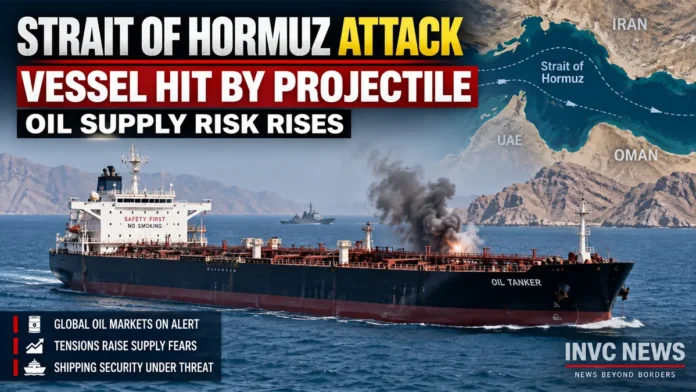
A Strait of Hormuz attack raised fresh concerns over global energy supplies Sunday after a commercial vessel was struck by an unknown projectile while transiting one of the world’s most strategically important shipping corridors.
The United Kingdom Maritime Trade Operations, or UKMTO, reported the incident early Sunday and said authorities were investigating.
Initial information did not establish the identity of the attacker.
The condition of the crew, extent of damage to the vessel and possible environmental impact also remained unknown in the early assessment.
The latest incident comes during an exceptionally dangerous period for commercial shipping across the Gulf and adds another layer of risk to oil markets already dealing with severe Middle East supply disruptions.
Strait of Hormuz Attack Raises New Shipping Risk
UKMTO said it received a report that an unknown projectile had struck a vessel moving through the Strait of Hormuz.
Maritime authorities have not yet publicly established what type of projectile hit the ship or who launched it.
No verified information available in the initial warning identified the vessel responsible for the attack.
Similarly, authorities had not confirmed the condition of the crew when the incident was first reported.
That uncertainty makes attribution particularly sensitive.
Until investigators provide additional evidence, the incident should be treated as an attack involving an unknown projectile and an unidentified attacker.
Strait of Hormuz already facing severe disruption
The latest strike comes after months of conflict severely disrupted shipping through the Strait of Hormuz.
The narrow waterway connects the Persian Gulf with the Gulf of Oman and Arabian Sea.
Its importance extends far beyond the countries bordering it.
Large quantities of crude oil, petroleum products and liquefied natural gas traditionally pass through the strait on their way to global markets.
Any sustained disruption can therefore affect energy prices across Asia, Europe and other major importing regions.
The current conflict has already dramatically reduced normal commercial traffic through the waterway.
That makes every new security incident potentially important for energy markets.
Oil prices already above $100
The new attack arrives after a volatile week for crude oil.
Brent crude finished Friday at $104.61 a barrel, even after falling during that trading session.
The international benchmark still recorded a sharp weekly gain as traders priced in growing risks to Middle Eastern energy supplies and shipping routes.
The latest Hormuz incident occurred while markets were closed for the weekend.
Consequently, traders will closely watch crude prices when international oil markets reopen.
A sustained deterioration in Gulf shipping security could add another geopolitical risk premium to oil prices.
However, the size and direction of any market reaction will depend on new information about the vessel, the attack and whether further incidents occur.
Saudi East-West pipeline attack increases pressure
The Hormuz incident comes immediately after another major threat to regional energy infrastructure.
Saudi Arabia temporarily shut its vital East-West oil pipeline as a precaution following a drone attack.
Saudi and Iraqi authorities said the drones involved in that attack originated from Iraqi territory.
No immediate claim of responsibility established who ordered the strike.
The East-West pipeline stretches roughly 1,200 kilometers, or about 745 miles, across Saudi Arabia.
It has become particularly important during the disruption in the Strait of Hormuz because it allows Saudi crude to move westward toward the Red Sea.
The route therefore provides an alternative to sending exports through Hormuz.
Pipeline has carried millions of barrels per day
The Saudi pipeline has recently transported approximately 4 million to 5 million barrels of oil per day.
That volume represents roughly 4% to 5% of global oil supply.
Its role has become even more significant while normal Gulf shipping remains disrupted.
A prolonged interruption to both Hormuz and alternative export infrastructure would create a more serious challenge for global oil markets.
Saudi authorities were assessing the damage from the pipeline attack.
The extent to which exports would be affected remained an important question.
Hormuz and Red Sea risks are converging
Energy markets now face pressure on more than one major maritime route.
The Strait of Hormuz represents the Gulf’s critical gateway.
Meanwhile, instability around Yemen and the Bab el-Mandeb raises concerns over access to the Red Sea.
That combination is particularly important because alternative routes become more valuable when one corridor is disrupted.
If security deteriorates simultaneously across several routes, shipping companies can face longer journeys, higher insurance costs and greater operational risks.
Those additional costs can eventually feed into energy and transportation prices.
Recent attacks have already hit commercial shipping
Sunday’s incident did not occur in isolation.
Commercial vessels have faced a series of security incidents around the Gulf, Gulf of Oman and Strait of Hormuz in recent weeks.
On September 9, a Panama-flagged tanker carrying approximately 2 million barrels of Iraqi fuel oil was struck by a drone in Iraqi territorial waters.
A fire broke out aboard the vessel.
Officials said its 22 crew members were safe and no cargo leaked into the water.
UKMTO also reported other merchant vessels affected by military activity in the region.
These incidents demonstrate how commercial shipping has increasingly become exposed to the wider conflict.
US and Iran conflict has transformed shipping risk
The maritime crisis forms part of the broader confrontation involving the United States and Iran.
Recent exchanges have included attacks on tankers and other shipping.
That escalation has made the Gulf increasingly difficult for commercial operators.
Shipping companies must now evaluate military activity, projectile threats, insurance coverage and the availability of protective measures before moving through high-risk waters.
The consequences extend beyond the ships themselves.
Any disruption involving tankers can affect crude oil, refined products and other energy supplies moving between producers and consumers.
US adjusts protection for Hormuz shipping
Security arrangements for vessels navigating Hormuz have also changed.
The United States has provided air-based protection for some commercial vessels using a route near the Omani side of the strait.
However, protection has increasingly been organized around designated transit windows rather than continuous coverage.
That arrangement reflects the difficulty of protecting commercial traffic indefinitely in a highly contested maritime environment.
Shipowners must therefore make increasingly complex decisions about when and how to transit.
Sunday’s projectile strike is likely to intensify those concerns.
Why Strait of Hormuz matters to India
India has a major economic interest in the security of Middle Eastern energy routes.
The country remains heavily dependent on imported crude oil.
A sustained increase in global oil prices can raise India’s import bill and create additional pressure on inflation, transportation costs and the rupee.
Higher crude prices can also affect aviation fuel, diesel, manufacturing costs and corporate margins.
Therefore, a serious disruption around Hormuz can quickly move from being a geopolitical story to an Indian economic story.
Indian investors will consequently watch both international crude prices and domestic market sentiment when trading resumes.
Asian economies face significant exposure
The implications extend across Asia.
China, India, Japan, South Korea and other major Asian economies rely heavily on Middle Eastern energy supplies.
Any persistent reduction in Gulf exports can force refiners and governments to seek alternative supplies.
That process can increase freight costs and intensify competition for crude from other regions.
The longer shipping disruption continues, the more important alternative suppliers and strategic petroleum reserves become.
Monday’s Oman meeting gains importance
The latest attack comes just before an important regional diplomatic meeting.
Iran is expected to attend talks with Gulf Arab states in Oman on Monday, with the future of the Strait of Hormuz among the issues under discussion.
Iraq is also expected to participate.
However, expectations for an immediate breakthrough remain limited.
The talks nevertheless carry greater significance following Sunday’s incident.
Any arrangement that improves predictability or maritime security around Hormuz could help reduce some of the risk currently embedded in energy markets.
Conversely, failure to ease tensions could prolong uncertainty.
No attacker identified in latest vessel strike
Attribution will become one of the most closely watched parts of the investigation.
The region contains several state and non-state actors capable of conducting attacks.
Recent incidents also occurred within the broader US-Iran confrontation.
Still, those circumstances do not prove responsibility for Sunday’s projectile strike.
Authorities have not publicly identified the attacker.
INVC NEWS will therefore not attribute the incident to Iran, the Houthis, the United States or any other actor without verified evidence.
That distinction is essential in a rapidly evolving conflict where incorrect attribution could materially distort the story.
What happens next?
Several developments could rapidly change the situation.
Authorities may identify the vessel and disclose its flag, cargo, destination and ownership.
UKMTO could provide an updated damage assessment.
Information about casualties or environmental impact may also emerge.
Investigators may determine what type of projectile struck the vessel.
Most importantly, authorities could eventually establish responsibility.
Oil-market reaction will provide another major indicator when trading resumes.
Global oil market faces another critical test
The Strait of Hormuz has long been considered one of the most consequential chokepoints in the global energy system.
The current conflict has turned that theoretical vulnerability into an active supply concern.
Saudi Arabia’s East-West pipeline provided an important alternative route while Hormuz traffic remained severely constrained.
Now, attacks affecting both maritime traffic and alternative oil infrastructure are raising the stakes.
Sunday’s Strait of Hormuz attack does not yet establish the scale of the latest disruption.
However, a commercial vessel being struck by an unknown projectile adds another serious warning for shipowners, energy traders and governments already confronting one of the most unstable periods for Middle Eastern oil transportation in years.