By Team INVC | INVC NEWS
WASHINGTON, United States | September 12, 2026 —
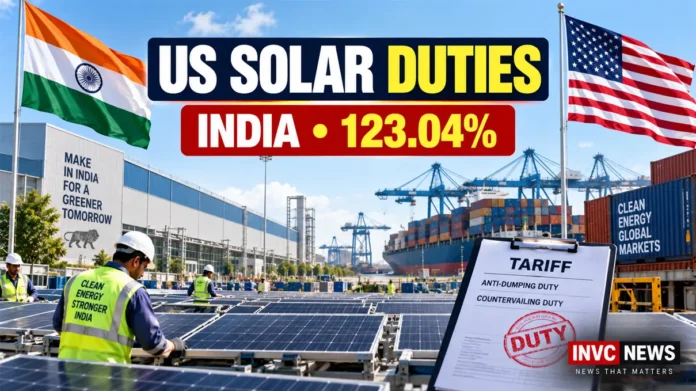
US Tariff on Indian Solar Panels has entered a critical new phase after the U.S. Commerce Department finalized steep anti-dumping and countervailing duty determinations on solar cells and modules imported from India, potentially creating a major new hurdle for Indian manufacturers targeting the American renewable-energy market.
The Commerce Department assigned a final anti-dumping margin of 123.04% to Indian producers. It also established a 126.09% countervailing duty rate for Indian producers in the subsidy investigation.
The decision covers crystalline silicon photovoltaic cells, whether or not assembled into modules.
However, the trade case has not completed every procedural step.
The U.S. International Trade Commission must still determine whether the imports materially injured or threatened the American solar manufacturing industry. That decision is scheduled for October 14.
If the commission reaches an affirmative determination, final duty orders are expected to follow in November.
Why did the US target Indian solar imports?
The U.S. investigation concluded that producers in India, Indonesia and Laos sold solar products in the American market below fair value and benefited from government subsidies.
American solar manufacturers have argued that such practices make it difficult for U.S.-based factories to compete.
The trade case was brought by the Alliance for American Solar Manufacturing and Trade, whose members include First Solar, Hanwha Qcells and Mission Solar Energy.
The dispute forms part of a much broader battle over where the world’s solar equipment gets manufactured.
For more than a decade, the United States has used trade remedies against Asian solar imports as Washington attempts to expand domestic manufacturing capacity.
India faces some of the steepest rates
The final Commerce Department determinations are substantial.
For India, the anti-dumping margin stands at 123.04%, while the countervailing duty rate is 126.09%.
Indonesia received a 94.36% anti-dumping margin, while countervailing rates range from 73.2% to 173.7%.
Laos faces a 65.43% anti-dumping margin, with countervailing rates ranging from 82.03% to 153.67%.
These are separate trade-remedy calculations. Therefore, readers should not simply add the headline percentages together and describe the result as one universal 249% tariff on every Indian solar shipment.
Actual customs treatment can depend on the applicable orders, subsidy offsets and other trade rules.
That distinction is important for investors and solar companies assessing the impact.
Why the US market matters so much to India
America has become an exceptionally important export destination for India’s rapidly expanding solar manufacturing industry.
Indian manufacturers increased capacity aggressively as governments around the world attempted to diversify solar supply chains beyond China.
The U.S. market offered particularly attractive opportunities.
Earlier industry estimates showed that the United States accounted for around 90% of India’s solar module exports.
Consequently, increasingly restrictive access to the American market could force Indian manufacturers to find alternative export destinations or sell more production domestically.
That shift could reshape pricing across India’s solar supply chain.
Indian solar manufacturing capacity has surged
India has spent years trying to build a globally competitive solar manufacturing ecosystem.
Government incentives, domestic-content policies and import restrictions helped accelerate investment in module and cell manufacturing.
Indian solar module production capacity reached approximately 74 GW by March 2025, after expanding rapidly.
Industry projections have pointed toward capacity potentially reaching about 190 GW by 2027.
Such rapid expansion creates opportunity, but it also creates a new challenge.
Manufacturers need enough domestic and overseas demand to absorb the additional capacity.
If access to the United States becomes significantly harder while Indian project tendering slows, excess manufacturing capacity could place pressure on domestic prices and margins.
Could India face a solar panel glut?
That is now one of the biggest questions facing the industry.
High U.S. trade barriers were already threatening India’s solar export model before the latest final determinations.
A prolonged reduction in American shipments could redirect substantial module supplies toward India.
More domestic supply can benefit solar developers if equipment prices decline.
For manufacturers, however, aggressive competition could compress margins.
Companies with large export exposure may face a different challenge from businesses whose order books are predominantly domestic.
Investors should therefore avoid treating every Indian solar manufacturer as equally exposed.
Waaree, Premier Energies and Vikram Solar come into focus
Listed Indian solar manufacturers are likely to remain under investor scrutiny as markets digest the latest U.S. action.
Earlier in the year, shares of Waaree Energies, Premier Energies and Vikram Solar came under sharp pressure following preliminary U.S. trade determinations.
Their exposure, however, differs considerably.
Previous analyst estimates indicated that U.S. shipments represented a significant portion of Waaree’s order book, while Vikram Solar also had export exposure.
Premier Energies, meanwhile, had indicated that its order book was domestically focused at that stage.
Investors should use the companies’ latest disclosures rather than assuming those earlier exposure levels remain unchanged.
Could Indian manufacturers simply find new export markets?
Diversification is one possible response.
Europe, the Middle East, Africa and other fast-growing renewable-energy markets could provide alternative demand.
Yet replacing the United States would not necessarily happen quickly.
Different countries have different technical standards, pricing structures, trade policies and procurement requirements.
Indian companies would also face strong competition from established Asian solar manufacturers.
As a result, the ability to diversify geographically could become an increasingly important differentiator between manufacturers.
What does this mean for India’s renewable-energy ambitions?
The impact is not entirely negative for India’s domestic renewable-energy market.
If manufacturers redirect more panels toward Indian customers, domestic developers could gain access to greater supplies.
Competitive equipment prices could also support project economics.
At the same time, weaker export margins could affect manufacturers that built capacity partly around overseas demand.
India therefore faces a balancing act.
The country wants a large domestic solar manufacturing base while also pursuing ambitious renewable-energy deployment targets.
A sustainable industry ultimately needs competitive manufacturers, predictable demand and diversified export markets.
Could the duties make US solar panels more expensive?
The trade measures are intended to protect American manufacturers from imports that U.S. authorities consider unfairly priced or subsidized.
However, restricting lower-cost imports can also change procurement costs for solar developers.
The final effect will depend on U.S. domestic manufacturing capacity, inventories, alternative suppliers and overall solar demand.
American policymakers are therefore balancing two priorities: expanding domestic solar manufacturing and maintaining an affordable supply of equipment for renewable-energy projects.
The China factor remains important
The latest case is also part of a longer transformation of the global solar supply chain.
The United States first imposed anti-dumping and anti-subsidy duties on Chinese solar products in 2012.
Manufacturing subsequently expanded across several other Asian countries.
Washington has continued investigating imports as production locations changed.
India emerged as one of the beneficiaries of efforts to diversify supply chains, but the latest case demonstrates that moving production outside China does not automatically eliminate U.S. trade-policy risk.
What happens next?
The next major date is October 14, 2026.
The U.S. International Trade Commission is scheduled to make its final injury determination.
An affirmative finding would clear the way for the Commerce Department to issue final anti-dumping and countervailing duty orders, expected in November.
Until that process concludes, the latest Commerce Department action should be described as a final determination in its trade investigations, rather than suggesting that every procedural step has already been completed.
For Indian solar manufacturers, investors and renewable-energy developers, the next several weeks could determine how difficult access to one of India’s most important solar export markets becomes.