NEW DELHI, India | September 10, 2026 —
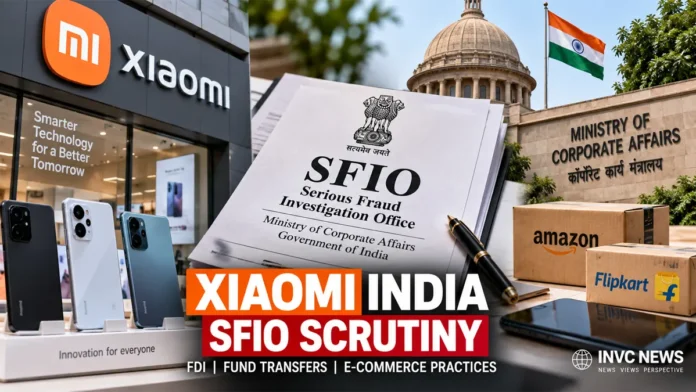
Xiaomi India SFIO Probe has emerged as a major regulatory risk for one of India’s best-known smartphone brands after the Serious Fraud Investigation Office recommended a detailed examination of Xiaomi’s Indian business, foreign investment compliance, movement of funds and e-commerce practices.
The recommendation could deepen scrutiny of Xiaomi Technology India Private Limited and related entities if the Ministry of Corporate Affairs approves a formal investigation.
For now, however, the government has not announced a completed finding against Xiaomi.
That distinction matters.
Xiaomi says it has not received any notice or communication from the SFIO and maintains that it complies fully with Indian law.
The proposed investigation therefore represents a significant regulatory development, not a finding of wrongdoing.
What has SFIO recommended?
The proposed investigation focuses on several areas involving Xiaomi’s India operations.
According to the investigation framework, authorities could examine the beneficial ownership of foreign investors and group entities, movement of funds, changes in control and whether required government approvals were obtained under India’s foreign investment rules.
Investigators could also review financial statements, auditor reports and records involving current and former directors, chief financial officers and compliance officials.
The framework reportedly contains 21 areas of examination.
That indicates the proposed review could be broader than a routine corporate compliance check if the government gives final approval.
Why FDI rules matter for Xiaomi
India tightened investment rules involving entities from countries sharing a land border with India in 2020.
Under the stricter framework, investments from Chinese entities generally required prior government approval.
The rules affected companies across technology, manufacturing, automobiles and other industries.
Chinese businesses repeatedly argued that the process slowed investment approvals and complicated expansion plans.
India has since eased parts of the framework as relations with China have gradually stabilized, but authorities continue to apply additional scrutiny in strategically sensitive sectors.
Smartphones sit directly inside that policy debate because the industry involves electronics manufacturing, consumer data, software ecosystems, supply chains and large cross-border financial flows.
Fund movements could become a central issue
One of the most important areas mentioned in the proposed SFIO investigation involves movement of funds.
Investigators could examine whether Xiaomi’s transactions complied with applicable foreign investment rules and whether all required approvals were obtained.
The review could also assess the ownership structure of investors and related entities.
These questions do not establish that violations occurred.
They define the areas authorities may examine if the proposed investigation moves forward.
For Xiaomi, that difference is crucial because the company is already involved in separate disputes with Indian authorities.
Xiaomi already faces a major asset-freeze dispute
Xiaomi has been fighting a long-running dispute involving ₹55.51 billion, or roughly $584 million, in Indian bank assets that authorities froze in 2022 over alleged illegal remittances.
The company has denied wrongdoing in that matter.
The latest SFIO recommendation adds another potential regulatory challenge at a time when Xiaomi is trying to rebuild its position in the Indian smartphone market.
That makes the story important not only from a legal perspective but also from a competitive business standpoint.
E-commerce practices may also come under scrutiny
The proposed investigation could extend into Xiaomi’s online sales model.
Smartphone companies transformed India’s mobile market over the past decade by launching devices aggressively through platforms such as Amazon and Flipkart.
Exclusive online launches became an important part of that strategy.
However, India’s foreign investment framework places restrictions on how foreign-funded e-commerce marketplaces can influence sellers, inventory and preferential arrangements.
The SFIO framework reportedly proposes examining whether Xiaomi exercised effective control over Indian sellers or launch partners while presenting those relationships as independent.
Authorities may also examine whether preferential or exclusive launches complied with the intended structure of India’s e-commerce FDI policy.
Again, these are questions proposed for investigation, not established violations.
Amazon and Flipkart angle could widen interest
The e-commerce component makes the Xiaomi case particularly important.
Smaller retailers in India have repeatedly argued that exclusive smartphone launches and preferential online arrangements put offline sellers at a disadvantage.
Amazon and Flipkart have rejected allegations that they violate Indian e-commerce rules.
Competition authorities have previously scrutinized relationships between major smartphone companies and large online marketplaces.
Any detailed SFIO investigation could therefore bring renewed attention to how smartphone brands structure online launches and seller relationships.
Xiaomi has lost smartphone market share in India
The timing is difficult for Xiaomi.
Once India’s largest smartphone brand, Xiaomi has slipped to fourth place, according to Counterpoint Research data cited in current reporting.
Its Indian smartphone market share has fallen to around 13%, compared with roughly 19% previously.
Competition from Samsung, Apple and other brands has intensified.
At the same time, Xiaomi’s India revenue reportedly fell to about $2.52 billion in 2025, approximately 40% below the level recorded three years earlier.
That means the company enters this possible investigation from a weaker competitive position than it held during its peak years in India.
Could the proposed probe affect Xiaomi phone buyers?
For ordinary Xiaomi and Redmi users, there is no immediate reason to assume smartphones will stop working, disappear from stores or lose software support.
The proposed SFIO investigation concerns corporate and regulatory compliance.
It does not automatically block Xiaomi from selling devices in India.
Consumers should therefore separate the regulatory story from product availability unless authorities announce specific restrictions later.
However, a prolonged investigation could affect the company indirectly.
Greater compliance costs, delayed investments, management attention and restrictions on business structures can influence expansion plans, manufacturing partnerships or future product strategy.
Those effects would depend entirely on how the case develops.
Xiaomi says it complies with Indian laws
Xiaomi has pushed back against the implication that its India operations violate the law.
The company says it has not received any formal communication from the SFIO regarding the proposed investigation.
It has also emphasized that compliance with Indian law remains a priority.
This response is important because the government has not yet approved a full SFIO investigation.
The Ministry of Corporate Affairs could approve the recommendation, seek additional information, refer parts of the matter to other departments or decide not to proceed.
There is no fixed timeline for that decision.
Why this case matters beyond Xiaomi
The significance extends well beyond one smartphone company.
India is simultaneously trying to attract electronics manufacturing investment, reduce dependence on imported components and maintain regulatory oversight of foreign capital.
Chinese companies remain deeply embedded in India’s electronics supply chain.
At the same time, policymakers continue to scrutinize investment structures, technology flows and control of sensitive businesses.
The Xiaomi case therefore sits at the intersection of several major policy questions:
foreign investment, India-China economic relations, smartphone manufacturing, online retail and corporate compliance.
BRICS timing adds a diplomatic dimension
The recommendation has surfaced just before the BRICS Summit in New Delhi, where Chinese President Xi Jinping is expected to attend.
India and China have been working to improve political relations after years of border tension.
Yet commercial ties remain far more complicated.
Chinese companies continue to face close regulatory scrutiny, while Indian policymakers remain cautious about dependence on Chinese investment and technology.
The possible Xiaomi investigation illustrates that diplomatic improvement does not automatically translate into unrestricted business access.
New Delhi appears willing to stabilize relations with Beijing while continuing to enforce tighter rules in sensitive commercial sectors.
What happens next?
The most important development to watch is the Ministry of Corporate Affairs’ decision.
If the ministry approves the SFIO recommendation, investigators could begin a detailed review of Xiaomi Technology India and related entities.
That process could include examination of corporate documents, investment approvals, financial transactions, e-commerce arrangements and statements from company officials.
If approval does not come, the proposed investigation may not proceed in its current form.
Until then, the Xiaomi India SFIO Probe remains a recommended investigation rather than an active finding of corporate wrongdoing.
For Xiaomi, however, the regulatory uncertainty arrives at a difficult moment.
The company is fighting to regain smartphone market share, manage existing legal disputes and compete in an Indian market that has become increasingly important—and increasingly demanding—for global technology companies.