NEW DELHI, India | September 8, 2026 —
Petrol Cars Sales India has reached a historic turning point as CNG, hybrid and electric passenger vehicles collectively overtook petrol-powered cars in retail sales for the first time in August 2026, signalling a major shift in what Indian car buyers want from their next vehicle.
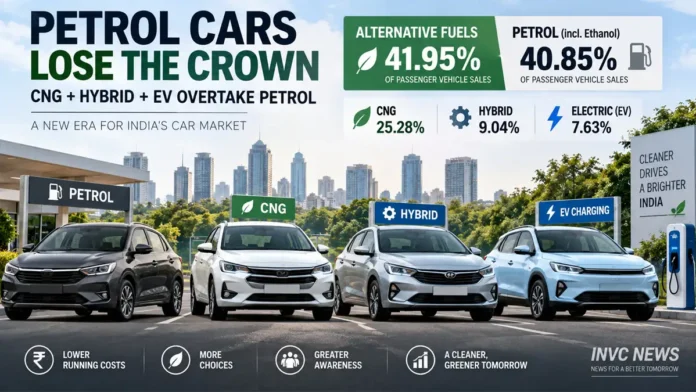
Alternative-fuel passenger vehicles captured 41.95% of retail sales, edging ahead of petrol and ethanol-powered models at 40.85%, according to industry retail data.
CNG emerged as the biggest alternative to petrol, accounting for 25.28% of passenger vehicle sales. Hybrids captured 9.04%, while electric vehicles reached 7.63%.
Diesel, once the dominant choice for high-mileage buyers, accounted for approximately 17.21%.
The milestone comes as buyers increasingly consider running costs, fuel availability, electric range, charging infrastructure and future ownership expenses before selecting a new car.
It also comes amid elevated global crude oil prices and continuing consumer discussion around India’s transition to E20 petrol.
Petrol’s Market Share Falls Below Alternative Fuels
The change has happened quickly.
In August 2025, petrol-powered vehicles commanded around 46.37% of the passenger vehicle market.
One year later, that share has fallen to approximately 40.85%.
During the same period, CNG increased from about 21.47% to 25.28%.
Hybrid vehicles rose from approximately 7.96% to 9.04%.
Electric vehicles increased from around 5.83% to 7.63%.
Individually, petrol remains the largest single powertrain category.
But collectively, CNG, hybrids and EVs have now crossed it.
That is the key change.
CNG Is Leading the Shift Away From Petrol
Electric vehicles receive enormous attention, but CNG remains the biggest reason alternative fuels have overtaken petrol.
Its 25.28% market share makes it by far the largest alternative-fuel category.
The appeal is relatively straightforward.
For buyers who drive long distances every month, CNG can offer significantly lower running costs than petrol.
Manufacturers have also expanded factory-fitted CNG options across hatchbacks, sedans and compact SUVs.
Models that were once available only with petrol engines increasingly offer CNG variants directly from the factory.
That has made CNG more attractive to family buyers who previously associated it mainly with taxis or commercial vehicles.
Hybrid Cars Quietly Build a 9% Share
Hybrid vehicles have also become a meaningful part of the Indian passenger vehicle market.
Their share reached approximately 9.04% in August.
Strong-hybrid technology allows a vehicle to combine a petrol engine with an electric motor and battery.
Unlike a battery-electric vehicle, a conventional strong hybrid does not require the owner to regularly plug the car into a charger.
That can make hybrids attractive to customers who want lower fuel consumption without changing their driving habits or depending on public charging stations.
Toyota, Maruti Suzuki and other manufacturers have expanded hybrid offerings across key segments, helping the technology gain visibility among Indian buyers.
Electric Cars Reach 7.63% Share
Battery-electric passenger vehicles accounted for approximately 7.63% of August retail sales.
That remains smaller than CNG and hybrid demand, but EV adoption has continued to increase.
More electric models now offer longer claimed ranges, faster charging and improved feature packages.
Public charging infrastructure has also expanded across major cities and highway corridors.
At the same time, competition has grown beyond early market leaders.
Indian and international manufacturers are introducing electric SUVs, compact vehicles and premium EVs across more price points.
For city buyers with home-charging access, the economics of electric ownership can become particularly attractive.
Why Are Buyers Moving Away From Petrol?
There is no single reason.
The first is running cost.
Petrol remains expensive relative to many alternative options, particularly for owners driving large distances every month.
The second is greater choice.
A buyer no longer needs to compromise heavily to select a CNG, hybrid or electric vehicle.
Alternative powertrains now appear across popular hatchbacks, SUVs and family cars.
The third factor is technology.
EV range has improved, hybrid systems have become more familiar and factory-fitted CNG installations are increasingly sophisticated.
Another factor is the ongoing consumer conversation around E20 petrol.
India has expanded petrol blended with 20% ethanol as part of its effort to reduce oil imports and increase the use of domestic biofuels.
Some owners of older vehicles have raised questions about mileage and compatibility.
Authorities and manufacturers have maintained that vehicles designed for E20 use can operate safely with the fuel.
The debate has nevertheless become another consideration for some buyers evaluating their next vehicle.
Record August for India’s Auto Market
The powertrain shift occurred during an exceptionally strong month for automobile retail.
India recorded approximately 24.23 lakh vehicle registrations across categories in August, up around 17.5% year on year.
That represented the strongest August retail performance on record.
Passenger vehicle retail sales alone reached approximately 4,02,398 units, an increase of about 16.14% from a year earlier.
The strong numbers show that alternative-fuel growth is not simply happening because the overall car market is shrinking.
The entire market is expanding, while the fuel mix inside it is changing.
Rural Car Demand Grows Faster Than Urban Demand
Another important trend emerged in the August data.
Rural passenger vehicle sales reportedly grew around 24.99% year on year, substantially faster than the approximately 10.93% growth in urban markets.
This is significant for automakers.
Rural customers have historically been important buyers of entry-level petrol and diesel models.
If CNG, hybrid or electric adoption begins spreading deeper into non-metro markets, manufacturers may need to rethink product planning and infrastructure beyond major cities.
CNG availability will remain particularly important in this transition.
What This Means for Maruti Suzuki
Maruti Suzuki remains India’s largest passenger vehicle manufacturer by a wide margin.
The company retailed around 1,65,200 passenger vehicles in August, giving it approximately 41.05% market share.
Its position also gives Maruti an advantage in the changing fuel landscape because it already sells several factory-fitted CNG models.
The company has also expanded into strong-hybrid technology and electric vehicles.
For Maruti, the challenge is therefore not simply protecting petrol sales.
It is keeping customers inside the brand as they migrate from petrol toward other powertrains.
Tata Motors Benefits From EV and Multi-Fuel Strategy
Tata Motors retailed around 57,841 passenger vehicles during August, recording one of the strongest year-on-year growth rates among major manufacturers.
Tata has built a significant presence in India’s passenger EV segment while continuing to offer petrol, diesel and CNG models.
That multi-powertrain approach allows the company to respond to buyers who may not be ready for a fully electric car but still want alternatives to traditional petrol.
The broader market shift therefore supports manufacturers with diversified engine and fuel strategies.
Hybrids Could Become the Middle Path
The rise of hybrids may become one of the most important trends to watch.
Some buyers want better fuel efficiency but remain uncertain about charging infrastructure.
Others live in apartments where dedicated EV charging may not be practical.
A hybrid can offer a middle ground.
It retains the convenience of conventional refuelling while using electric assistance to reduce petrol consumption.
If more manufacturers introduce hybrids at lower price points, their current 9% share could grow further.
Does This Mean Petrol Cars Are Dying?
No.
Petrol remains the largest individual passenger vehicle fuel category in India.
Millions of buyers still prefer petrol because of its wide availability, relatively simple ownership experience and large model selection.
Petrol cars can also remain attractive to people who drive fewer kilometers annually, where paying extra for a hybrid, CNG system or EV may take longer to recover through running-cost savings.
The August milestone therefore does not mean petrol cars are disappearing.
It means petrol no longer dominates the market in the way it once did.
Which Fuel Makes the Most Sense for Buyers?
The answer depends heavily on use.
Petrol can still make sense for low annual mileage and buyers seeking simplicity.
CNG is attractive for high-mileage city users with convenient access to filling stations.
Hybrid suits buyers who want stronger fuel efficiency without depending on charging infrastructure.
Electric vehicles can offer very low running costs for owners with reliable home charging and predictable daily driving.
Diesel can still make sense in certain high-mileage and larger-vehicle applications.
There is no single winning fuel for every buyer.
That diversity itself explains why petrol’s dominance is weakening.
Auto Companies Face a New Product Strategy
For manufacturers, August 2026 may eventually be remembered as a strategic turning point.
For decades, the basic product decision in India revolved around petrol versus diesel.
That market has now fragmented.
Automakers need to simultaneously invest in petrol engines, CNG systems, hybrid technology, batteries, electric motors, software and charging ecosystems.
The companies that can offer customers several powertrain choices within the same popular model families could gain a significant advantage.
High Inventory Remains a Warning Sign
The strong August sales numbers do not mean the auto industry faces no risks.
Dealer inventories remain elevated at roughly 38 to 40 days.
Higher inventories tie up dealer capital and can lead to stronger discounts if retail demand slows.
The festive season will therefore become an important test.
Strong demand could help dealers clear stocks.
But if buying momentum weakens, automakers may need to use incentives to keep retail sales moving.
Petrol Has Lost the Crown — But the Real Race Is Just Starting
The biggest takeaway from Petrol Cars Sales India is not that one technology has defeated another.
It is that Indian buyers now have genuine alternatives.
CNG has become mainstream.
Hybrids are gaining acceptance.
EVs are expanding quickly.
And petrol is increasingly becoming one option among several rather than the automatic default.
With alternative-fuel passenger vehicles capturing 41.95% of August retail sales compared with petrol’s 40.85%, India’s automobile transition has crossed an important psychological threshold.
The next question is no longer whether buyers will move beyond petrol.
It is which technology — CNG, hybrid or electric — will capture the biggest share of that shift.