MUMBAI, India | September 7, 2026 —
Stock Market Today September 7 2026 opened on a cautious note as the Sensex and Nifty moved lower on Monday morning, with investors tracking a fresh rise in crude oil prices, escalating US-Iran tensions and growing expectations of another US Federal Reserve interest-rate hike.
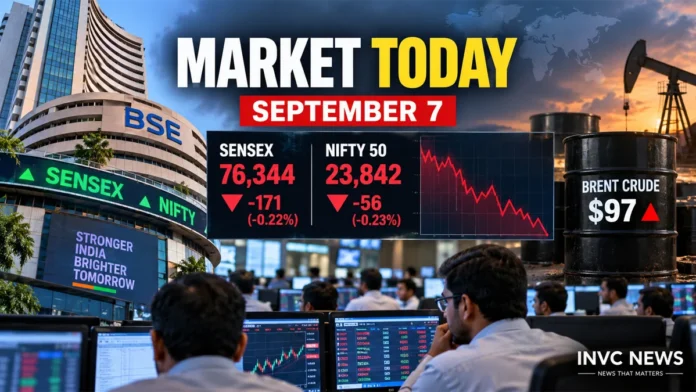
At around 9:45 AM, the BSE Sensex traded about 171 points lower near 76,344, while the NSE Nifty 50 slipped roughly 56 points to around 23,842.
Brent crude hovered close to $97 a barrel, adding pressure on Indian equities because India imports most of its crude oil requirements.
Sensex and Nifty Start Monday in the Red
Indian benchmark indices failed to hold early stability as selling emerged across several sectors.
The Nifty moved below the 23,850 mark, while the Sensex remained under pressure near 76,300.
Investors entered Monday’s session with several global risks on their radar. Higher crude oil prices created the biggest immediate concern, while stronger US economic data increased expectations that the Federal Reserve could raise interest rates again.
These factors kept risk appetite weak despite gains in some Asian technology markets.
Why Is the Stock Market Falling Today?
Three major factors are driving the market mood on September 7.
First, crude oil prices have climbed again.
Second, geopolitical tensions between the United States and Iran have intensified around the Strait of Hormuz.
Third, stronger US jobs data have increased expectations of tighter monetary policy from the Federal Reserve.
Together, these developments have increased uncertainty for emerging markets such as India.
Brent Crude Near $97 Becomes Major Risk for India
Brent crude traded near $97 per barrel on Monday after another escalation in the Middle East pushed energy markets higher.
US West Texas Intermediate crude also traded above $92 a barrel.
The latest rise matters significantly for India because expensive oil can increase the country’s import bill, raise inflation risks and put pressure on corporate margins.
Oil-sensitive sectors can feel the impact particularly quickly.
Companies in aviation, paints, tyres, logistics and several manufacturing industries may face higher input costs if crude remains elevated for a prolonged period.
Oil marketing companies can also face margin pressure depending on domestic fuel pricing and refining conditions.
US-Iran Tensions Keep Global Markets on Alert
Renewed military confrontation involving vessels around the Strait of Hormuz has pushed geopolitical risk back to the center of global financial markets.
The Strait remains one of the world’s most important energy shipping routes.
Therefore, any disruption to commercial traffic can quickly affect global crude supplies and prices.
Brent crude has gained sharply over the past several sessions as traders price in the risk of prolonged disruption.
For Indian investors, the situation creates a double challenge.
Higher oil prices can increase inflation pressure, while geopolitical uncertainty can encourage global investors to move toward safer assets.
Rupee Holds Relatively Stable Despite Oil Pressure
The Indian rupee offered some relief during Monday’s early trade.
The currency traded around 94.42 against the US dollar after closing near 94.4850 in the previous session.
Market participants continue to watch the Reserve Bank of India closely as the central bank works to contain excessive currency volatility.
A relatively stable rupee can soften part of the pressure created by expensive crude because India pays for most international oil purchases in US dollars.
However, sustained crude prices near or above $100 could make that challenge more difficult.
IT Stocks Face Pressure as US Rate-Hike Bets Rise
Information technology shares also faced pressure as investors assessed the impact of stronger US economic data.
A stronger-than-expected US jobs report has increased expectations that the Federal Reserve may raise interest rates at its September policy meeting.
Higher US interest rates can affect Indian IT companies because many of them generate a large share of their revenue from American clients.
Companies may face slower technology spending if borrowing costs remain elevated in the United States.
The IT sector emerged among the weaker areas of the market during Monday’s session.
Broader Market Also Trades Weak
Selling did not remain limited to benchmark indices.
Several broader sector indices traded lower, while small-cap and mid-cap stocks also faced pressure.
Investors appeared reluctant to make aggressive purchases as crude oil, bond yields and geopolitical risks dominated the global market narrative.
However, the market has not entered a one-way decline.
Stock-specific action continues as corporate announcements, regulatory developments, order wins and company earnings expectations create opportunities in individual counters.
Nifty 23,800 Becomes Key Level to Watch
The Nifty is now trading close to an important short-term support zone.
Market participants are closely watching the 23,800 level.
A sustained move below this zone could increase selling pressure, while a recovery above 24,000 could improve short-term sentiment.
The index ended the previous week below 24,000 after facing repeated selling pressure.
Therefore, Monday’s movement could become important for the near-term market direction.
What Investors Should Watch Today
Crude oil remains the single biggest global trigger for Indian markets during Monday’s session.
Any fresh escalation involving the Strait of Hormuz could push oil prices higher and increase pressure on equities.
Investors will also track the rupee, foreign institutional investor activity, US bond yields and expectations surrounding the Federal Reserve’s September meeting.
Meanwhile, domestic corporate developments may drive sharp moves in individual stocks.
Stock Market Today: What Comes Next?
Indian equities could remain volatile throughout September 7 as investors respond to developments in the Middle East and movements in crude oil.
A fall in Brent crude could improve sentiment quickly.
However, another move toward or above $100 per barrel could renew concerns about inflation, the rupee and India’s import bill.
For now, the Sensex and Nifty remain under moderate pressure rather than experiencing a broad market panic.
The next major direction will depend heavily on crude oil, geopolitical developments and global interest-rate expectations.