NEW DELHI, India | September 3, 2026 —
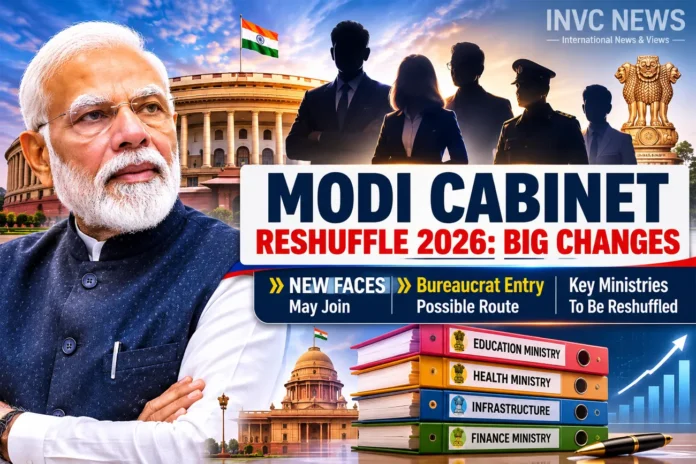
Modi Cabinet Reshuffle 2026 speculation has suddenly become one of the most closely watched political stories in New Delhi, with talk of new ministers, a major redistribution of portfolios and even the possible entry of a senior bureaucrat or technocrat into Prime Minister Narendra Modi’s team.
The buzz has intensified around one reported remark attributed to PM Modi during the August 26 Cabinet meeting: that some “new colleagues” could be present at the next meeting.
The government has not publicly confirmed that remark. Nor has the Prime Minister’s Office or Rashtrapati Bhavan announced any Cabinet expansion or swearing-in.
Yet the political silence that followed has only deepened the intrigue.
Wednesday, September 2, passed without a regular Cabinet meeting even though PM Modi had returned to Delhi after attending the Shanghai Cooperation Organisation summit in Bishkek.
He remained active in the capital and attended an official water-sector programme, but the Cabinet did not meet.
Now political attention has shifted sharply toward September 6 and September 7.
Why September 6-7 Has Suddenly Become So Important
The answer lies in PM Modi’s calendar.
External Affairs Minister S. Jaishankar is visiting Ukraine and Poland from September 3 to September 5.
India will then enter the final phase of preparations for the BRICS Summit in New Delhi on September 12 and 13.
After that, September 17 marks the beginning of a politically important period around PM Modi’s birthday and BJP outreach programmes.
That leaves September 6-7 as one of the clearest windows for a major political exercise before the BRICS Summit takes over the government’s diplomatic calendar.
No official schedule confirms a Cabinet reshuffle on either date.
But in Delhi’s political circles, both dates are now being watched closely.
If PM Modi wants to unveil a revamped team before the BRICS gathering, the coming weekend offers an obvious opportunity.
‘New Colleagues’ Remark Keeps Delhi Guessing
The biggest trigger remains PM Modi’s reported comment at the August 26 meeting.
According to political accounts surrounding that meeting, PM Modi indicated that new colleagues could join ministers at the next Cabinet meeting.
The remark did not appear in any official post-Cabinet statement.
That means it cannot be treated as a formal announcement.
But political significance often lies in timing.
The next week’s Cabinet meeting did not happen.
The Prime Minister’s international travel has ended for now.
And the government’s September calendar is narrowing.
Taken together, those developments have intensified speculation that the next Cabinet meeting could look different from the last one.
Could a Trusted Bureaucrat Join PM Modi’s Cabinet?
This is the most intriguing part of the current political chatter.
People familiar with discussions in political and administrative circles say one possibility being talked about involves PM Modi inducting an experienced bureaucrat or technocrat into the Union Council of Ministers.
One scenario under discussion involves a serving bureaucrat taking voluntary retirement before entering the government.
INVC NEWS has not independently established that any particular officer has been selected for such a move.
No serving bureaucrat has publicly announced voluntary retirement linked to a ministerial appointment.
The government has also not identified any technocrat as an incoming minister.
But constitutionally, such an appointment is entirely possible.
And PM Modi has a history of putting considerable value on administrative experience, domain expertise and professional backgrounds while selecting members of his team.
A Bureaucrat Does Not Need to Be an MP on Day One
The Constitution creates a clear route for a non-MP to become a Union minister.
Under Article 75(5), a person can enter the Council of Ministers without immediately belonging to either the Lok Sabha or Rajya Sabha.
However, that person must become a member of either House within six consecutive months.
If that does not happen, the individual must cease to be a minister at the end of that period.
That provision gives a Prime Minister the flexibility to first induct a specialist, administrator or political leader and arrange parliamentary membership later.
This is why the bureaucrat-entry theory cannot be dismissed simply because the person may not currently be an MP.
Rajya Sabha Could Provide the Parliamentary Route
The Rajya Sabha equation has added another layer to the speculation.
Several Rajya Sabha terms fall due later this year, creating potential opportunities for political parties to send new members to the Upper House.
That has fuelled discussion over whether a non-MP inducted into the Cabinet could later enter Parliament through a Rajya Sabha election.
There is no official indication that the government has selected such a route for any individual.
There is also no confirmed candidate.
But constitutionally and politically, the pathway exists.
A person inducted into the Council of Ministers in September would have six months to become an MP.
A Rajya Sabha vacancy within that period could therefore provide one possible route if the political leadership chose it.
PM Modi Has Used Specialists Before
A technocrat or former bureaucrat entering the government would not be unprecedented.
S. Jaishankar spent decades in the Indian Foreign Service and served as Foreign Secretary before PM Modi brought him into the Union Cabinet as External Affairs Minister.
He entered the Rajya Sabha after joining the government.
Hardeep Singh Puri also had a long diplomatic career before moving into politics and serving in the Union government.
Ashwini Vaishnaw served in the Indian Administrative Service before later entering business, politics and the Union Cabinet.
Those examples demonstrate that PM Modi has repeatedly mixed conventional political leadership with people who bring administrative or sector-specific expertise.
That makes the current bureaucrat speculation politically plausible even though it remains unconfirmed.
Education Ministry Could Become the Reshuffle’s Big Surprise
Among all portfolios, Education has emerged as one of the most interesting to watch.
The ministry is already operating under an unusual arrangement.
After Dharmendra Pradhan left the Union Council of Ministers in July, PM Modi assigned Pralhad Joshi additional charge of the Ministry of Education.
Joshi already handles major responsibilities connected with Consumer Affairs, Food and Public Distribution, and New and Renewable Energy.
That makes Education an obvious ministry to watch if PM Modi wants to redistribute workloads.
The political argument for a dedicated Education Minister has also become stronger because the portfolio now sits at the intersection of some of India’s biggest long-term challenges.
Artificial intelligence is changing classrooms and employment.
Competitive examination reforms remain politically sensitive.
Universities face pressure to improve research output and global rankings.
Skill development must keep pace with a rapidly changing job market.
Foreign universities are expanding their interest in India.
And millions of young Indians expect the government to connect education more directly with employment.
A Cabinet reshuffle could therefore give PM Modi an opportunity to place a more dedicated political, academic, administrative or technology-oriented face in the Education Ministry.
No such appointment has been announced.
But if the Cabinet changes, Education could become one of the most closely watched portfolios.
Ministers Handling Multiple Departments Could See Workloads Reduced
A reshuffle does not necessarily mean that PM Modi must drop a large number of senior ministers.
He can dramatically alter the government simply by redistributing portfolios.
Several Cabinet ministers currently handle more than one major responsibility.
Pralhad Joshi’s additional Education charge provides the clearest example.
Other senior ministers also oversee combinations of large ministries.
That creates room for PM Modi to bring in new faces without completely dismantling the existing Cabinet structure.
Some incoming ministers could receive portfolios carved out from ministers currently carrying multiple responsibilities.
Others could enter as Ministers of State and later receive larger assignments.
That approach would allow PM Modi to strengthen administrative bandwidth while preserving continuity.
Age and Generational Change Enter the Equation
Age has also become part of Delhi’s reshuffle conversation.
Several senior leaders in the government are above 70 or approaching an age at which the BJP has historically considered organisational transition.
There is no constitutional retirement age for Union ministers.
Nor has the BJP announced a formal rule requiring ministers to leave government after turning 70.
Still, a Cabinet reorganisation gives PM Modi an opportunity to balance experience with generational change.
Some senior leaders could continue in government.
Others could move toward party responsibilities, advisory roles or assignments connected with states.
Meanwhile, younger politicians could move upward.
PM Modi May Want More Faces Who Can Connect With Young India
The generational question goes beyond age.
Communication ability increasingly matters.
India has one of the world’s largest young populations, and a new generation consumes politics through smartphones, short-form video, social media and digital platforms rather than traditional political meetings alone.
A reshuffle could therefore favour leaders who can communicate policy to younger voters.
That factor becomes especially relevant for ministries such as Education, Skill Development, Information Technology, Youth Affairs, Employment and Entrepreneurship.
A younger face with strong administrative or intellectual credentials could fit PM Modi’s effort to connect policy delivery with India’s changing demographic profile.
Women Could Get Greater Representation
A larger reshuffle may also provide space for more women in the Council of Ministers.
Women have become an increasingly important electoral constituency for the BJP and other major parties.
Government programmes focused on housing, cooking gas, banking, health, self-help groups and welfare delivery have repeatedly targeted women as a key political and development group.
Adding more women to senior government positions could therefore carry both governance and political significance.
No final list has emerged, but gender representation will remain one of the numbers to watch if PM Modi expands his team.
NDA Allies Will Want Their Share
The Cabinet equation becomes more complicated once alliance politics enters the picture.
Several NDA partners have strengthened their parliamentary position or political leverage.
That inevitably creates expectations of greater representation in the Union government.
Eknath Shinde’s Shiv Sena has strengthened its numbers in Parliament and can make a stronger argument for greater space inside the NDA power structure.
Other allies also have regional demands and political ambitions.
Any major Cabinet expansion must therefore balance BJP representation with coalition management.
PM Modi cannot look only at individual performance.
He must also consider parliamentary strength, regional representation, social equations and the future electoral usefulness of alliance partners.
Maharashtra Could Be One of the Toughest Balancing Acts
Maharashtra remains particularly complicated.
The BJP must manage its own leaders while balancing the interests of allies and competing political groups.
Shiv Sena’s strengthened parliamentary presence gives it additional leverage.
The NCP equation creates another layer of negotiation.
Every Union ministerial berth allocated to one partner inevitably affects expectations among others.
That makes Maharashtra one of the states most likely to influence the final arithmetic of any expansion.
Bengal’s Changing Parliamentary Equation Adds Pressure
Political realignment involving former Trinamool Congress MPs has also complicated the NDA equation.
A rebel bloc claiming the support of multiple MPs has moved toward a political arrangement supportive of the NDA.
However, parliamentary recognition, party affiliation and potential disqualification questions can affect how much political weight such a bloc can immediately exercise.
Cabinet representation therefore cannot be assumed.
Still, the shifting numbers create another group whose political expectations the BJP leadership may have to consider.
Could PM Modi Produce One Completely Unexpected Name?
That possibility cannot be ruled out.
Cabinet reshuffles under PM Modi have frequently produced appointments that escaped the political prediction industry.
That element of surprise has become part of his political style.
A former bureaucrat, economist, academic, technology specialist, lawyer or administrator could therefore emerge even if that person’s name is not currently circulating publicly.
Education would offer an obvious platform for a specialist.
Technology, infrastructure, economic policy and governance reforms could provide others.
The question is not simply whether PM Modi wants more politicians in government.
It is whether he believes the next phase requires a different mix of politics, administration and expertise.
Why Pralhad Joshi’s Workload Matters
The Education Ministry question also illustrates a broader structural issue.
Pralhad Joshi currently carries Education as an additional charge while also overseeing other major portfolios.
That arrangement may work temporarily.
But if PM Modi wants sharper departmental accountability, separating Education could become an easy first step.
The same logic could apply elsewhere.
Removing one portfolio from a heavily loaded minister and giving it to a new entrant can create a meaningful reshuffle without forcing the Prime Minister to replace an established Cabinet heavyweight.
That could become the central design of the exercise.
BRICS Summit Makes Timing More Sensitive
The BRICS Summit adds another layer to the timing question.
India will host the summit in New Delhi on September 12 and 13.
PM Modi has already said he looks forward to welcoming Russian President Vladimir Putin for the meeting.
A major international summit requires extensive Cabinet-level coordination across foreign affairs, security, trade, logistics and protocol.
If PM Modi wants to reorganise his domestic team before the summit, the available window is narrow.
That is precisely why September 6-7 has attracted so much attention.
Again, the dates remain speculative.
But the political logic behind them is easy to understand.
Why Wednesday’s Silence Matters
Politics frequently turns absence into evidence.
No Cabinet meeting on September 2 proves nothing by itself.
Cabinet schedules change for many reasons.
But when viewed alongside the reported “new colleagues” remark and a narrowing September calendar, the absence takes on greater political meaning.
That is why Delhi is watching the next government schedule so closely.
A sudden Rashtrapati Bhavan announcement would immediately transform speculation into the biggest domestic political story of the week.
Until that happens, the reshuffle remains unconfirmed.
What Could the New Modi Team Look Like?
If PM Modi acts, the reshuffle could take several forms.
He could induct a small number of new ministers.
He could conduct a much broader expansion.
He could promote existing Ministers of State.
He could redistribute major portfolios.
He could reduce workloads for ministers holding multiple departments.
He could increase representation for NDA allies.
He could add more women and younger politicians.
And he could spring a surprise by bringing in a technocrat or former bureaucrat.
The most significant version would combine all of these elements.
What Is Confirmed Right Now
The current Union Council of Ministers remains in place.
Pralhad Joshi holds additional charge of the Education Ministry following Dharmendra Pradhan’s resignation in July.
S. Jaishankar is on a September 3-5 visit to Ukraine and Poland.
India will host the BRICS Summit in New Delhi on September 12-13.
The Constitution allows a non-MP to become a Union minister but requires that person to enter either House of Parliament within six months.
What Is Still Political Speculation
No Cabinet reshuffle has been officially announced.
No swearing-in has been confirmed for September 6 or September 7.
The PMO has not publicly confirmed the reported “new colleagues” remark.
No bureaucrat has been officially identified as an incoming minister.
No serving official has publicly linked voluntary retirement to a Cabinet appointment.
No final portfolio list has emerged.
No government announcement says Education will get a new dedicated minister.
Modi Cabinet Reshuffle 2026: Delhi Waits for PM Modi’s Next Move
For now, the story rests on one powerful combination: a reported remark, an unusual silence and an increasingly narrow political calendar.
If PM Modi does expand his Cabinet, the exercise could go far beyond adding a few new political faces.
It could reshape powerful ministries, reduce the workloads of senior ministers, accommodate NDA allies, accelerate generational change and potentially bring another specialist or former bureaucrat into the government.
Education could become one of the portfolios to watch most closely.
And the constitutional six-month rule means PM Modi does not necessarily need every new minister to already hold a parliamentary seat.
That gives him considerable room to surprise.
Delhi now waits for the signal that matters most: an official announcement from the government or Rashtrapati Bhavan.
Until then, September 6-7 remains a window — not a confirmed date.
The reshuffle remains speculation — not an accomplished fact.
But if the speculation proves correct, PM Modi may be preparing not simply to expand his Cabinet, but to redesign the team that carries his government into its next political and policy phase.