GREENBELT, Maryland, United States | September 3, 2026 —
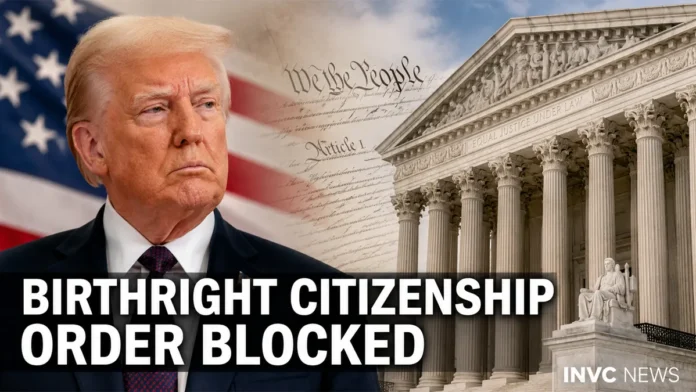
Trump Birthright Citizenship Order suffered another major legal setback after a federal judge blocked President Donald Trump’s latest attempt to restrict automatic US citizenship for certain children born in the United States.
US District Judge Deborah Boardman issued a preliminary injunction that prevents federal agencies from denying or refusing to recognise the citizenship of children covered by an ongoing class-action lawsuit.
The ruling delivers another blow to Trump’s effort to narrow birthright citizenship after the US Supreme Court rejected his earlier attempt in June.
The legal fight now places immigration policy, presidential power and the Constitution’s 14th Amendment back at the centre of America’s political debate.
Judge Blocks Trump’s New Birthright Citizenship Order
Judge Boardman acted after immigrant-rights advocates challenged Trump’s latest executive order.
Trump signed the new directive on August 6 after the Supreme Court ruled against his previous birthright citizenship policy.
Boardman concluded that the administration could not enforce the latest order against children already protected by the class action.
She pointed directly to the Supreme Court’s earlier ruling and said the children involved in the case already qualify as citizens at birth.
The injunction covers actions by major federal agencies including the Department of State, Department of Homeland Security and Social Security Administration.
Those agencies cannot deny, interfere with or refuse to recognise the citizenship of children protected by the court order.
Supreme Court Had Already Rejected Earlier Trump Plan
The latest dispute follows a major Supreme Court decision on June 30.
The Supreme Court ruled 6-3 in Barbara v. Trump that the administration could not deny citizenship to children born in the United States simply because their parents were neither American citizens nor lawful permanent residents.
The ruling centred on the citizenship clause of the 14th Amendment.
The amendment says people born or naturalised in the United States and subject to its jurisdiction qualify as US citizens.
The constitutional provision has shaped American citizenship law for generations and now sits at the heart of Trump’s renewed immigration push.
What Trump’s August 6 Order Tried to Change
President Trump responded to the Supreme Court defeat by issuing a narrower executive order on August 6.
The White House specifically targeted what it describes as “birth tourism,” in which foreign nationals travel to the United States to give birth and obtain US citizenship for their children.
The order also sought to deny citizenship in several other circumstances.
It covered certain children whose parents work for foreign governments in the United States and cases in which authorities allege fraud or a commercial arrangement designed to obtain citizenship.
The directive also addressed children whose parents fall under the legal classification of an “alien enemy.”
However, immigrant-rights lawyers quickly returned to court.
They argued that the new order threatened children whose citizenship rights the Supreme Court had already recognised.
Judge Says Supreme Court Has Already Settled Key Question
Boardman rejected the administration’s attempt to immediately apply the latest policy to the children covered by the lawsuit.
Her ruling emphasised that the Supreme Court had already determined their citizenship status.
That distinction matters.
The judge did not issue a final nationwide ruling on every possible application of Trump’s August order. Instead, she granted preliminary protection to members of the certified class while the legal battle continues.
The administration can still prepare implementation guidance for the executive order.
However, federal agencies cannot use the order to strip or question the citizenship of children protected by the injunction.
Trump Administration Called Challenge Premature
Justice Department lawyers urged the court not to intervene yet.
They argued that federal agencies had not completed detailed guidance explaining exactly how officials would apply Trump’s latest directive.
The administration expects agencies to develop those implementation rules.
Government attorneys therefore argued that opponents should wait until officials publish the guidance before challenging the policy.
Boardman disagreed.
She found enough immediate risk to justify court intervention and prevent agencies from taking action against the affected children.
US Passport Rules Could Become Next Major Flashpoint
The birthright citizenship fight could extend far beyond birth certificates.
Passport rules have also entered the dispute.
The State Department has considered procedures that could require parents seeking US passports for their children to provide evidence of their own citizenship or immigration status.
Such a policy could significantly change the documentation process for some families.
That possibility creates another major search and public-interest angle because millions of Americans rely on passports for international travel, education and employment.
Any final guidance from the administration could therefore trigger another round of litigation.
What Birthright Citizenship Means in the United States
Birthright citizenship generally grants US citizenship to people born on American soil and subject to US jurisdiction.
The 14th Amendment established the constitutional foundation for that principle.
Trump has repeatedly argued that the government should apply a narrower interpretation, particularly when parents enter the country temporarily or lack permanent legal status.
Immigration groups counter that presidents cannot rewrite a constitutional citizenship guarantee through executive action.
That disagreement has now produced repeated courtroom battles involving federal judges and the Supreme Court.
Trump Immigration Agenda Faces Another Legal Test
Immigration remains one of President Trump’s defining policy priorities.
His administration has pushed for tighter border enforcement, tougher deportation policies and stricter rules governing entry and citizenship.
Birthright citizenship represents one of the most legally difficult parts of that agenda because the dispute directly involves constitutional language and Supreme Court precedent.
The latest injunction shows how quickly federal courts can intervene when executive immigration policies collide with established citizenship rights.
However, the case remains active.
The Trump administration can continue defending the August order and could seek appellate review of Boardman’s ruling.
What Happens Next
The immediate effect of the injunction is clear: federal agencies must continue recognising the citizenship of children covered by the class action.
The government can still prepare policy guidance for the new order, which means the broader legal battle remains far from over.
Future court proceedings could determine whether any part of Trump’s narrower August directive can survive constitutional scrutiny.
That makes birthright citizenship one of the most closely watched legal and political issues in the United States heading into the November midterm elections.
For now, however, President Trump’s latest attempt to narrow automatic citizenship has encountered another powerful judicial barrier.