By Team INVC | INVC NEWS
Published: September 1, 2026 |10 : 06 AM IST
ASHEVILLE, United States | September 1, 2026 —
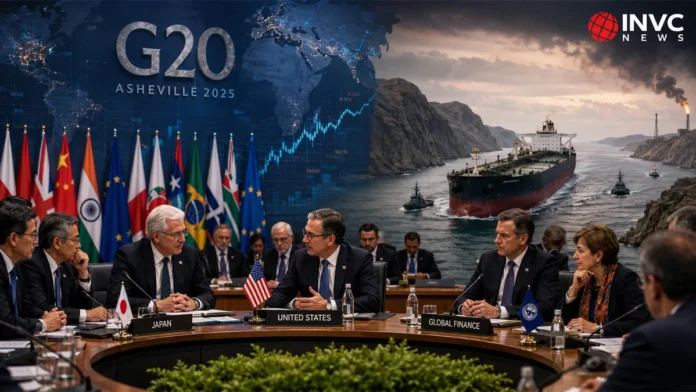
The Trump administration has turned the G20 finance meeting in Asheville into a forceful pitch for faster economic growth, tougher action on unfair trade and sweeping regulatory reform, while warning that the crisis in the Strait of Hormuz could inflict another damaging energy shock on the global economy.
The message from Washington is blunt: the world needs more investment and production—but none of that will be easy if one of the planet’s most important energy corridors remains paralysed by the US-Iran confrontation.
Shipping through the Strait of Hormuz remains severely restricted. Preliminary September 1 tracking data showed only five commodity vessels passing through the waterway on Monday, dramatically below normal traffic levels.
That makes Hormuz one of the biggest economic risks hanging over the G20 talks.
Trump Team Puts Growth Back at Centre of G20
US Treasury Secretary Scott Bessent opened the finance ministers and central bank governors’ meeting by making economic growth the central theme of the American G20 presidency.
The Trump administration wants the group to move aggressively on deregulation, investment, energy security, sovereign debt and global trade imbalances.
Washington argues that stronger private-sector investment—not ever-expanding government intervention—is the best route to raising productivity, incomes and long-term economic growth.
The United States has also urged other major economies to examine regulations that may be holding back investment and business expansion.
Federal Reserve Chair Kevin Warsh reinforced that message, arguing that the global economy may be leaving behind the era of prolonged “secular stagnation” and entering a period in which investment and productivity can drive stronger structural growth.
Hormuz Crisis Changes the Economic Conversation
But the upbeat growth message collided almost immediately with the increasingly dangerous situation around Iran.
The Strait of Hormuz carries a crucial share of global energy supplies. Any prolonged disruption can quickly lift crude oil and fuel prices, increase shipping and insurance costs, and push inflation higher across importing economies.
Commercial traffic through the waterway remains far below normal levels amid military tensions, mine threats and restrictions linked to the US-Iran confrontation.
For G20 finance ministers, that means Hormuz is no longer simply a foreign-policy issue.
It is a global inflation, energy-security and growth problem.
Washington is pushing to restore reliable navigation through the waterway while simultaneously increasing economic pressure on Tehran.
US Wants Iran Isolated Financially
Treasury Secretary Bessent has been pressing G20 partners to tighten financial pressure on Iran and reduce the revenue streams available to Tehran.
The United States has already launched a broader campaign aimed at isolating Iranian financial networks and is considering additional sanctions against institutions involved in transactions connected with Iran.
At the same time, Washington says it still wants a diplomatic outcome that prevents Iran from acquiring a nuclear weapon and restores greater stability to global energy markets.
European governments have also publicly backed continued efforts to guarantee freedom of navigation and safe transit through the Strait of Hormuz.
Why India Is Watching Hormuz Closely
The discussion has immediate consequences for India.
Finance Minister Nirmala Sitharaman is leading the Indian delegation at the August 31-September 1 G20 Finance Ministers and Central Bank Governors meeting in Asheville.
India imports most of the crude oil it consumes, making a prolonged energy shock particularly dangerous for inflation, the rupee, the current account and government finances.
India’s imports of Middle Eastern crude fell sharply during August as Hormuz disruptions constrained supplies.
That risk comes just as India has reported powerful 7.8% GDP growth in the April-June quarter, beating forecasts and strengthening expectations for FY2026-27.
A sustained oil shock, however, could complicate that growth story.
Also Read – : Trump Says Strait of Hormuz Shipping Hits Record High, Predicts Further Drop in Global Oil Prices
Trump Administration Takes Aim at ‘Unfair’ Trade
Trade is becoming the second major battlefield in Asheville.
The Trump administration says it will no longer tolerate economic policies that Washington considers unfair or structurally unbalanced.
Its strategy includes reciprocal tariffs and sector-specific tariffs, alongside domestic tax incentives, increased energy production and efforts to restrain government expenditure.
The administration argues that this combination can increase American manufacturing, investment and national savings while forcing trading partners towards what Washington considers a more balanced relationship.
Global trade imbalances—and particularly industrial overcapacity—are expected to remain among the most contentious issues at the G20.
The United States has been urging other governments to reconsider trade relationships that it believes reward state-supported excess production rather than competition based on innovation and productivity.
‘America First’ Meets Global Cooperation
Despite the aggressive trade message, Bessent’s team is trying to convince allies that the administration is not abandoning international economic cooperation.
The US position is that America First does not require America to act alone.
Instead, Washington argues that stronger domestic economic performance gives the United States more capacity to build productive economic partnerships abroad.
That message is particularly important at a G20 gathering where several countries remain uneasy about US tariffs and the direction of American trade policy.
CEOs Get a Seat at the G20 Table
The Asheville meeting also marks an unusual experiment in G20 policymaking.
Senior private-sector executives have been brought directly into discussions with finance ministers and central bankers.
Executives from banking, manufacturing, healthcare, technology, fintech and digital assets are participating in conversations about what prevents businesses from investing and expanding.
The discussions have focused on issues including:
- excessive regulation
- high operating costs
- workforce skills
- manufacturing productivity
- artificial intelligence
- healthcare innovation
- digital assets
- access to investment capital
The administration’s argument is straightforward: governments can create the environment for economic expansion, but businesses ultimately make the investments, hire the workers and produce the innovation.
AI and Digital Assets Enter the G20 Growth Debate
Artificial intelligence has emerged as another important part of the economic discussion.
Business leaders are examining how AI can improve productivity in manufacturing and healthcare, while digital-asset executives are pushing for regulatory structures that encourage financial innovation.
The US G20 agenda has already identified a more vibrant digital-assets ecosystem, modernised financial regulation and improved cross-border payments as priorities.
That gives the Asheville gathering a distinctly different economic tone—one centred heavily on private capital, deregulation, productivity and technological investment.
From Hurricane Helene to Global Economic Stage
The choice of Asheville carries political symbolism for the Trump administration.
Western North Carolina suffered severe destruction from Hurricane Helene in 2024, with homes, roads and businesses devastated across the region.
US officials are now presenting Asheville’s recovery as an example of rebuilding and economic resilience.
The administration wants that recovery story to mirror its broader message to the G20: economies facing shocks can recover if investment, infrastructure and private enterprise are allowed to move quickly.
G20 Faces a Difficult Reality
Yet the challenges confronting finance ministers are becoming harder, not easier.
The world is dealing simultaneously with high government debt, volatile bond markets, trade conflicts, the Russia-Ukraine war, the US-Iran confrontation and severe disruption to Middle Eastern energy supplies.
The Trump administration believes stronger growth can provide a way out.
But the Strait of Hormuz remains the immediate test.
If shipping normalises, energy prices could ease and the G20’s growth agenda would gain breathing room.
If the confrontation escalates again, the resulting oil and fuel shock could spread rapidly through inflation, currencies, interest rates and consumer spending.
For India and other major energy importers, that distinction could determine whether 2026 ends as a year of accelerating growth—or another year dominated by geopolitical shocks.
Also Read – : Iran Condemns US Over Renewed Oil Sanctions as Strait of Hormuz Tensions Escalate
Also Read – : Oil Shock Intensifies as Hormuz Risks Rattle Global Markets