By Team INVC | INVC NEWS
Published: August 29, 2026 | 13 : 29 PM IST
SEATTLE, UNITED STATES | August 29, 2026 —
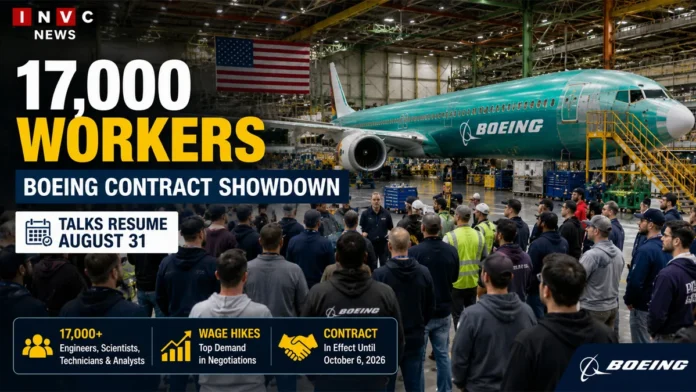
Boeing worker contract negotiations are entering a critical new phase after thousands of engineers and technical employees rejected the aerospace giant’s contract offer, forcing both sides back to the table as the possibility of a major work stoppage moves closer.
Negotiators for Boeing and the Society of Professional Engineering Employees in Aerospace (SPEEA) are scheduled to meet on Monday, August 31, to discuss the next stage of bargaining.
The union represents roughly 17,000 Boeing engineers, scientists, technicians, analysts and planners covered by two major collective bargaining agreements. SPEEA members rejected Boeing’s latest proposals on August 21.
But one distinction is crucial:
Boeing workers are not on strike today.
The existing contract remains in force until October 6, 2026, leaving several weeks for the company and union to reach a new agreement. Boeing has nevertheless activated contingency planning in case negotiations eventually result in a work stoppage.
What Boeing Workers Want
SPEEA surveyed nearly 12,800 members after the contract rejection to determine what employees wanted negotiators to prioritize.
The answer was overwhelmingly about pay.
Around 39% of Professional Unit respondents and 56.5% of Technical Unit respondents identified larger, immediate guaranteed wage increases as their top priority.
The second-biggest demand was larger annual performance-based wage pools.
Improved cost-of-living adjustments ranked third.
The message from employees is clear:
Inflation and wage growth have become the central issue in Boeing’s white-collar labor battle.
Boeing Says Its Offer Was Already Significant
Boeing argues that its rejected four-year proposal represented one of the strongest compensation packages it had offered SPEEA-represented employees in decades.
The company said its proposal included total wage funds increasing by 28.5%, with the potential for approximately 31.9% compounded wage growth over the contract period.
Boeing had also attached early-ratification incentives to the proposal.
Those incentives disappeared when employees voted the agreement down.
The company says money that would have funded those incentives is now being redirected toward contingency preparations for a potential strike.
Boeing Begins Strike Contingency Planning
This is what makes the story especially important.
Boeing says it has begun preparing to keep its operations functioning if employees eventually walk off the job.
According to Boeing, thousands of people could be involved in supporting its contingency plan if a work stoppage occurs.
The company says the objective is to protect business continuity, customers, safety and quality.
That does not mean a strike is inevitable.
But it shows both sides are now preparing for the possibility that negotiations may fail.
Also Read – : Volkswagen Layoff Showdown: 50,000 Job Cuts Already Agreed as CEO Pushes Deeper Overhaul
Why 17,000 Boeing Workers Matter
SPEEA represents some of Boeing’s most technically important employees.
Its Professional Unit covers roughly 13,000 engineers and scientists, while the Technical Unit includes about 4,000 technicians, analysts and planners.
These employees support engineering, production, aircraft development and other highly specialized operations.
A prolonged work stoppage involving such a large technical workforce could therefore become significantly more disruptive than an ordinary workplace dispute.
That is one reason Boeing is eager to reach an agreement before October.
First Full Negotiation in 14 Years
The negotiations are especially significant because Boeing says this is its first full contract negotiation with SPEEA in 14 years.
Both sides initially appeared unusually optimistic.
SPEEA’s own negotiating teams had unanimously recommended the earlier Boeing offer, describing the talks as collaborative.
Yet rank-and-file employees ultimately voted against it.
That gap between negotiators and members changed the entire situation.
SPEEA subsequently told Boeing that workers wanted substantially stronger terms and were prepared to continue fighting for improvements.
Monday Becomes the Next Big Date
The most important immediate date is now August 31.
Boeing and SPEEA representatives will meet to review the employee survey and discuss a schedule for renewed formal bargaining.
Boeing says it remains committed to reaching an agreement before the current contracts expire.
For workers, the question is whether the company will improve the wage package enough to win approval.
For Boeing, the question is how far it can go without significantly increasing long-term labor costs.
A Different Kind of Jobs Story
This story also demonstrates why INVC NEWS is expanding its Jobs & Careers coverage beyond straightforward layoffs and vacancies.
The modern employment story includes:
Layoffs
Hiring
AI-driven skill shifts
Pay disputes
Return-to-office rules
Union negotiations
Employee benefits
Workplace restructuring
Also Read – : Jobs & Careers News: Hiring, Layoffs, Exams and Opportunities
Volkswagen shows what happens when companies want fewer employees.
Ford and India’s GCC boom show where specialist hiring is expanding.
Boeing shows something different:
what happens when highly skilled employees believe companies need to pay more to keep them.
For Boeing’s roughly 17,000 SPEEA-represented professionals, Monday’s meeting could determine whether the dispute moves back toward compromise—or another step closer to a potentially disruptive strike.