WASHINGTON, D.C., United States | August 27, 2026 —
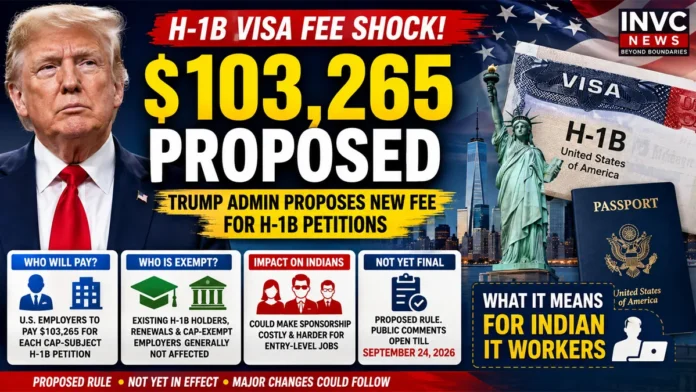
H-1B Visa Fee 2026 has become a major concern for technology companies and skilled foreign professionals after the Trump administration proposed an additional $103,265 fee on H-1B petitions subject to the annual visa cap, potentially making sponsorship dramatically more expensive for U.S. employers.
The proposal, published by the Department of Homeland Security and U.S. Citizenship and Immigration Services, is not yet a final rule. Employers do not have to start paying the $103,265 charge today.
If finalized, the fee would be collected when an employer files a cap-subject H-1B petition and would come on top of existing H-1B filing charges and other applicable payments.
For Indian technology professionals, the distinction between a new cap-subject petition and a cap-exempt filing will be crucial.
What Is the New $103,265 H-1B Fee?
DHS has proposed an additional fee of $103,265 for every H-1B cap-subject petition filed with USCIS.
The annual H-1B cap generally covers:
- 65,000 visas under the regular H-1B limit
- 20,000 additional places for qualifying applicants with a U.S. master’s degree or higher
Importantly, the proposed fee would also apply to petitions selected under the 20,000 advanced-degree allocation.
That means obtaining a U.S. master’s degree would not itself exempt a new cap-subject petition from the proposed $103,265 fee.
Who Would Actually Pay the $103,265 Fee?
The proposed fee is imposed on the H-1B petitioner, meaning the U.S. employer filing the petition.
It is therefore primarily an employer sponsorship cost rather than a visa charge that an Indian professional would simply pay personally while applying at a U.S. consulate.
DHS says the payment would be due when the cap-subject H-1B petition is filed.
For employers recruiting large numbers of overseas workers, that could dramatically change the economics of H-1B sponsorship.
A company filing 10 qualifying petitions, for example, could face more than $1 million in additional filing costs if the proposal becomes final in its current form.
Are Existing H-1B Workers Exempt?
This is one of the most important questions for Indians already working in the United States.
The proposed $103,265 charge applies only to cap-subject petitions. DHS explicitly states that it would not apply to all H-1B filings.
Generally, petitions filed to extend the stay of an existing H-1B worker, change the terms of employment or allow an H-1B worker who has already been counted against the cap to change employers do not count again against the annual H-1B cap.
As a result, many ordinary H-1B extensions and employer-transfer cases would generally fall outside this proposed cap-subject fee.
However, individual immigration circumstances can differ, so workers should not assume exemption without checking the specific petition category.
Universities and Research Organizations Could Also Be Exempt
Certain employers have traditionally been exempt from the H-1B numerical cap.
These can include qualifying:
- Institutions of higher education
- Nonprofit entities affiliated with higher-education institutions
- Nonprofit research organizations
- Government research organizations
Because the new fee is proposed only for cap-subject petitions, qualifying cap-exempt filings would not face the $103,265 charge under the current proposal.
DHS specifically says the proposed additional fee would not apply to H-1B petitions that are not subject to the cap.
Small Companies Would Not Automatically Escape the Fee
One potentially significant part of the proposal is that the charge would apply uniformly to cap-subject petitioners.
DHS says the additional fee would apply irrespective of employer size and nonprofit status when the petition itself is cap-subject.
The department estimates that more than half of the entities that filed cap-subject petitions in fiscal 2025 qualified as small entities.
Its regulatory analysis also estimates that the proposed charge could represent a significant cost increase for thousands of smaller employers.
Why Is the US Proposing Such a Large Fee?
According to DHS, the money would help fund costs associated with administration of the broader lawful immigration system across several federal agencies.
The government estimates that applying the fee to around 85,000 cap-subject H-1B petitions annually could generate approximately $8.8 billion per year.
DHS also argues that the higher sponsorship cost could encourage employers to hire highly skilled U.S. workers when suitable domestic talent is available, while reserving H-1B sponsorship for situations where specialized foreign skills are genuinely needed.
Why Indian IT Workers Could Feel the Biggest Impact
Indian professionals have historically represented a major share of the H-1B talent pipeline, especially in software engineering, consulting, cloud computing, artificial intelligence, data science and other specialized technology roles.
The proposed fee does not directly ban Indian professionals from obtaining H-1B status.
However, it could make employers far more selective about whom they sponsor.
A six-figure additional cost could particularly affect:
- Entry-level technology jobs
- Smaller U.S. employers
- Startups with limited recruitment budgets
- Outsourcing and consulting companies
- International students seeking to move from F-1/OPT status into H-1B employment
- Roles where an employer has several comparable domestic candidates
Higher-paid and highly specialized workers could potentially remain more attractive to employers because companies may be more willing to absorb a large sponsorship cost when the skill is difficult to replace.
Also Read – : H-1B Visa Crackdown Proposed: Trump Allies Push 3-Year Ban Bill — What It Means for Indian Workers
Read the INVC H-1B crackdown explainer
H-1B Selection Has Already Become More Skill-Focused
The proposed fee arrives during a broader restructuring of the H-1B system.
Earlier changes for fiscal 2027 introduced a more wage-sensitive selection framework designed to give greater weight to higher-paid and highly skilled positions.
Combined with the proposed $103,265 fee, the direction of U.S. policy is becoming clearer: employers could face stronger incentives to reserve H-1B sponsorship for highly specialized and higher-value roles.
Also Read – : US Changes H-1B Visa Rules: Selection May Now Prioritize Higher Salaries Instead of Pure Lottery
Read the INVC H-1B selection-rule explainer
Is the $103,265 H-1B Fee Already in Effect?
No.
This is a Notice of Proposed Rulemaking, not a final regulation.
The Federal Register lists September 24, 2026 as the deadline for written public comments.
After the comment period, DHS can review responses, modify the proposal and decide whether to issue a final rule.
Until that process is completed and an effective date is officially announced, employers should not treat the proposed $103,265 charge as an existing USCIS filing requirement.
What Indian H-1B Aspirants Should Watch Next
Indian students, technology professionals and employers should closely watch four developments:
Final rule: The fee amount or scope could change after public comments.
Effective date: No final implementation date exists yet.
Legal challenges: Any final rule involving such a large immigration fee could face court scrutiny.
Employer response: Technology companies may adjust hiring, salaries, offshore staffing and sponsorship strategies if the proposal becomes final.
The proposal therefore represents a serious potential change to the cost of high-skilled immigration, but it is not yet a $103,265 bill that every H-1B worker must pay.
For now, the key takeaway is simpler: the Trump administration wants employers filing new cap-subject H-1B petitions to shoulder a dramatically larger cost, while many existing-worker and cap-exempt petitions would remain outside the proposed charge.
Official U.S. Government Source:
Federal Register — Fee for Certain H-1B Petitions
Immigration rules can depend on an applicant’s individual circumstances. This article provides general information and should not be treated as legal or immigration advice.