DHAKA, Bangladesh | August 25, 2026 —
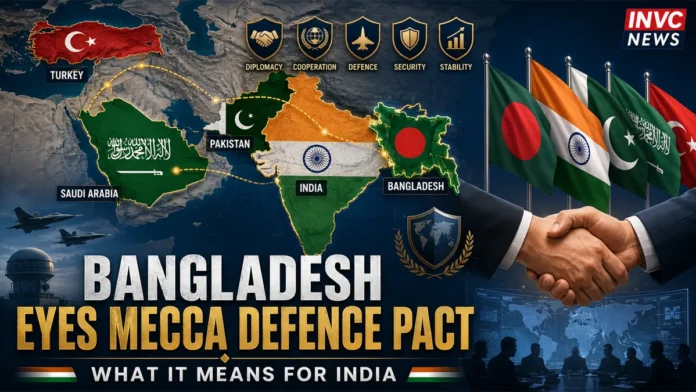
Bangladesh Mecca Defence Pact discussions have opened a potentially important new chapter in South Asian geopolitics, with Dhaka publicly expressing interest in the collective-defence framework involving Saudi Arabia, Türkiye and Pakistan.
Bangladesh State Minister for Foreign Affairs Humaiun Kobir has said the government views the arrangement positively and could consider participation if it serves Bangladesh’s national interests.
However, Bangladesh has not joined the pact, and no final decision on membership has been announced.
That distinction is critical as speculation grows over whether the three-country defence framework could eventually expand into a broader regional security grouping.
What Bangladesh Has Actually Said
Bangladesh has indicated that it is looking positively at the Mecca Defence Pact and is evaluating whether closer participation in the security initiative would be consistent with its foreign-policy interests.
Dhaka’s position remains exploratory.
The government has not announced that it has signed the agreement, accepted collective-defence obligations or formally joined an alliance involving Saudi Arabia, Türkiye and Pakistan.
For now, the accurate description is:
Bangladesh is considering the Mecca Pact — it has not joined it.
That difference matters because interest in a security arrangement is not the same as treaty membership.
What Is the Mecca Joint Defence Agreement?
Saudi Arabia, Türkiye and Pakistan established the new defence framework in Mecca in August 2026, creating a mechanism for deeper military and strategic cooperation among the three countries.
One of its most significant elements is the concept of collective defence.
Under the framework described by participating governments, an armed attack against one member could be treated as an attack against all participating members.
The countries have presented the agreement as a defensive arrangement intended to strengthen deterrence, military coordination and security cooperation.
Pakistan has maintained that the pact is not directed against any specific country.
Why Bangladesh Joining Would Be Significant
Bangladesh would represent a strategically important expansion of the grouping.
Saudi Arabia, Türkiye and Pakistan already maintain extensive military and political relationships across the Middle East and the wider Muslim world.
Bangladesh, however, occupies a very different geopolitical position.
It sits on the Bay of Bengal, shares a border of more than 4,000 kilometers with India and maintains important relationships with India, China, the United States, Pakistan, Türkiye and Gulf countries.
If Dhaka eventually enters a formal collective-defence arrangement, the move would therefore carry implications beyond routine military cooperation.
Why India Will Watch Closely
There is currently no evidence that the Mecca Defence Pact is an anti-India alliance.
That should be stated clearly.
New Delhi would nevertheless monitor any Bangladeshi move toward the pact because Pakistan is one of its principal members.
India and Pakistan remain strategic rivals, while Bangladesh is one of India’s most important neighbors along its eastern frontier.
A formal Bangladesh-Pakistan defence relationship inside a larger collective-security framework could therefore change the strategic context in which India assesses Dhaka’s military partnerships.
That would not automatically make Bangladesh hostile toward India.
But it would add another important layer to the regional security equation.
India-Bangladesh Relations Already Face Sensitive Issues
The defence-pact discussion comes at a delicate moment in India-Bangladesh relations.
Bangladesh Prime Minister Tarique Rahman’s proposed India visit has remained an important diplomatic issue, while Dhaka has continued to raise the question of former Prime Minister Sheikh Hasina.
INVC NEWS has previously examined the wider diplomatic challenge in its report on Tarique Rahman’s India visit and the Sheikh Hasina extradition row.
Both governments have reasons to maintain a stable relationship, particularly because of trade, connectivity, border management, energy links and security cooperation.
A Bangladesh decision on the Mecca Pact would therefore be viewed against this already complicated bilateral backdrop.
Saudi Arabia Changes the Strategic Equation
The agreement cannot simply be viewed as a Pakistan-centered bloc.
Saudi Arabia has developed a significant strategic partnership with India.
India and Saudi Arabia cooperate in areas including:
- Energy security
- Investment
- Infrastructure
- Trade
- Defence
- Counterterrorism
- Technology
This relationship makes the Mecca Pact more complex from New Delhi’s perspective.
If Bangladesh eventually considers membership, India would need to assess not only Pakistan’s role but also how Saudi Arabia and Türkiye expect an expanded defence framework to operate.
Türkiye Adds Military and Defence-Industry Weight
Türkiye gives the grouping another important dimension.
As a NATO member with a large military and an increasingly influential defence industry, Türkiye has expanded its international role in drones, aircraft, naval systems and defence exports.
Closer coordination among Türkiye, Pakistan and Saudi Arabia could therefore extend beyond political symbolism.
It could eventually involve:
- Joint military exercises
- Defence-industry cooperation
- Training
- Intelligence coordination
- Military technology
- Strategic consultations
Even so, describing the arrangement automatically as an “Islamic NATO” would be premature.
It does not currently possess NATO’s integrated command system, treaty history, institutional depth or military infrastructure.
Could the Mecca Pact Expand Further?
This is one of the most important questions surrounding the agreement.
Bangladesh’s interest suggests that the framework could potentially attract additional countries.
Whether Dhaka actually joins would depend on negotiations over:
- Collective-defence obligations
- Military commitments
- Strategic benefits
- Decision-making mechanisms
- Compatibility with Bangladesh’s existing foreign relationships
For Bangladesh, that calculation is especially complicated because the country has important economic and security ties with multiple competing powers.
Bangladesh’s Foreign-Policy Balancing Act
Dhaka has traditionally attempted to maintain working relationships with different geopolitical blocs.
Its foreign-policy relationships include:
India: Trade, connectivity, energy and regional security.
China: Infrastructure investment and defence equipment.
Saudi Arabia and Gulf states: Investment, energy and employment for Bangladeshi workers.
United States and Europe: Major export markets and economic relationships.
Türkiye and Pakistan: Expanding political and defence engagement.
Joining the Mecca Defence Pact would therefore test Bangladesh’s ability to maintain this balancing strategy.
The central question is whether Dhaka sees participation as compatible with its existing relationships or as part of a deeper strategic realignment.
Why the Bay of Bengal Matters
Bangladesh’s location makes the story especially relevant to India.
The Bay of Bengal has become increasingly important to Indo-Pacific strategy, maritime security, trade routes and naval competition.
India has invested heavily in strengthening its eastern maritime capabilities and regional partnerships.
Bangladesh also sits close to India’s northeastern states and important transportation corridors.
Any major change in Dhaka’s defence relationships would therefore attract attention not only in New Delhi but across the wider Indo-Pacific strategic community.
What India Should Watch Next
Four developments will matter most.
First, whether Bangladesh formally applies to join.
Expressions of interest are important, but formal membership negotiations would represent a much more significant step.
Second, the exact collective-defence obligations.
India will want clarity on what participating countries would be required to do during a military crisis.
Third, Bangladesh-Pakistan military cooperation.
Any increase in joint exercises, intelligence cooperation, defence procurement or military training could draw closer scrutiny.
Fourth, Saudi Arabia’s role.
Riyadh’s strong partnership with India could become an important factor if the grouping expands.
Mecca Pact: What It Means for India
Bangladesh’s interest in the Mecca Defence Pact does not mean that a hostile military alliance has suddenly appeared on India’s eastern border.
There is no evidence supporting such a conclusion.
But the development deserves attention because it connects Bangladesh, Pakistan, Saudi Arabia and Türkiye within a potentially expanding security framework.
For New Delhi, the real question is not simply whether Bangladesh expresses interest.
It is whether Dhaka formally joins, what military obligations membership creates and whether the arrangement changes the long-term strategic balance in South Asia and the Bay of Bengal.
That is what India will be watching next.