
KYIV, Ukraine | August 25, 2026 —
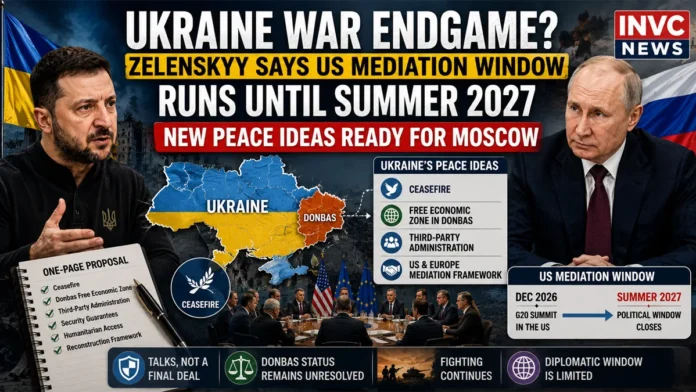
Ukraine peace proposal talks have entered a potentially important new phase, with President Volodymyr Zelenskyy saying Kyiv has worked with U.S. and European officials on a one-page set of negotiating ideas that could be presented to Moscow.
The document is not a final peace agreement. Instead, it brings together possible elements for renewed negotiations, including a ceasefire and a U.S.-backed idea for a free economic zone in parts of the eastern Donbas region under some form of third-party administration.
Zelenskyy also believes there is a limited political window for intensive U.S. mediation — stretching from the G20 summit in the United States in December 2026 until roughly the end of summer 2027.
After that, he suggested, Washington’s attention could increasingly turn toward the 2028 U.S. presidential election campaign.
What Is in Ukraine’s One-Page Peace Proposal?
Zelenskyy said the short document was developed with American and European officials rather than being a purely Ukrainian initiative.
Its central element is a ceasefire.
Another idea concerns a possible free economic zone in Donbas, based on a proposal previously discussed by the United States.
Under the concept described by Zelenskyy, Ukrainian and Russian forces could potentially move back from designated areas, creating a buffer-like economic zone administered by a third party.
The exact territory, governing authority, security mechanism and legal status of such a zone remain unresolved.
That means the proposal is better understood as a negotiating concept, not an agreed roadmap.
Why Donbas Remains the Biggest Obstacle
Donbas continues to sit at the center of the dispute.
Russia claims the Donetsk and Luhansk regions as part of the Russian Federation, along with the Kherson and Zaporizhzhia regions, although Moscow does not control all of the territory it claims.
Ukraine rejects Russia’s annexation claims and insists that its internationally recognized territory cannot simply be surrendered through military pressure.
Moscow has also questioned the feasibility of allowing a third party to administer territory that Russia considers its own.
That fundamental disagreement means even an apparently practical idea such as a free economic zone immediately collides with questions of sovereignty.
Moscow Pushes Back on Free Economic Zone Idea
Kremlin spokesman Dmitry Peskov has questioned how an internationally administered Donbas economic zone could work, given Russia’s claim that the territory forms part of the Russian Federation.
That response illustrates why the new proposal should not be interpreted as evidence that a peace settlement is close.
Russia has repeatedly said that any settlement must take account of what it calls the current territorial and military realities.
Ukraine, meanwhile, continues to seek a ceasefire without formally surrendering sovereignty over occupied territory.
The gap remains substantial.
Why Zelenskyy Sees Summer 2027 as a Deadline
The timing may be almost as important as the proposal itself.
Zelenskyy believes there is a political opportunity for American mediation beginning around the December 2026 G20 summit in the United States and lasting through summer 2027.
The logic is linked partly to U.S. domestic politics.
As the 2028 presidential election campaign approaches, foreign-policy attention and political calculations in Washington could change.
Kyiv therefore appears to believe that the coming year may provide a stronger opportunity for sustained U.S. diplomatic pressure than the period that follows.
This is a political assessment, not a formal deadline agreed by Washington or Moscow.
Why the United States Is Central
Washington remains one of the few actors capable of engaging Ukraine, Russia and major European governments while also combining diplomacy with economic and military leverage.
Previous U.S.-led efforts have struggled largely because the two sides remain far apart over territory, security guarantees and Ukraine’s future relationship with NATO.
The new proposal appears designed to reduce the number of unresolved issues into a smaller negotiating framework.
But even a one-page proposal cannot eliminate the core political problem:
What happens to territory currently occupied or claimed by Russia?
NATO and EU Roles Are Also Part of the Discussion
Zelenskyy said the ideas also address possible roles for the European Union and NATO.
Those details have not yet been fully disclosed.
Ukraine has long sought reliable security guarantees designed to prevent a future Russian attack after any ceasefire.
Russia, however, has consistently opposed Ukrainian NATO membership and has treated the alliance’s eastward role as a central security concern.
Any serious settlement would therefore have to address not only where forces stop fighting, but also what Ukraine’s long-term security architecture looks like.
Official updates from the Ukrainian presidency are available at:
https://www.president.gov.ua/en
Fighting Continues Despite Diplomatic Push
The new diplomatic ideas are emerging while the military confrontation remains intense.
Ukraine continues targeting Russian military, industrial and energy infrastructure, including increasingly deep strikes.
INVC NEWS recently reported how Ukraine said its strike capability had reached more than 2,500 kilometers into Russia.
Russia, meanwhile, continues missile, drone and battlefield attacks across Ukraine.
This creates a familiar contradiction in the war: diplomatic activity can intensify at the same time as both sides try to improve their military positions before any serious negotiation.
Ukraine Peace Proposal: Are We Near the End of the War?
Not yet.
Three developments would signal that the diplomacy is becoming much more serious:
First, Moscow formally engages with the one-page proposal.
Second, Russia and Ukraine begin negotiating an actual ceasefire mechanism rather than only discussing broad principles.
Third, the sides narrow their differences over Donbas and security guarantees.
Until those steps occur, talk of an imminent end to the war would be premature.
What has changed is that Kyiv, Washington and European partners now appear to be trying to compress the dispute into a smaller set of negotiating ideas.
The next test is whether Moscow is willing to negotiate around them.
After nearly four and a half years of full-scale war, summer 2027 may now be emerging as an important diplomatic horizon — but it is not yet a peace deadline.





Comments are closed.