CUPERTINO, California | August 25, 2026 —
Apple M6 Mac mini has officially arrived, giving Apple’s smallest desktop its biggest performance-focused upgrade in nearly two years and placing artificial intelligence firmly at the center of the Mac mini strategy.
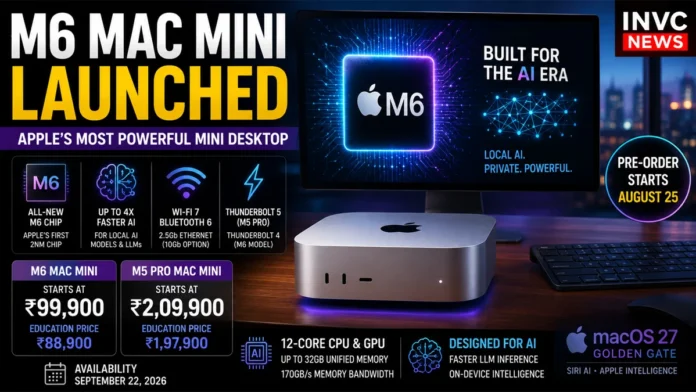
Apple on Tuesday unveiled the new Mac mini with two processor choices — the all-new M6 and the more powerful M5 Pro. In India, the M6 Mac mini starts at ₹99,900, while the M5 Pro version starts at ₹2,09,900.
Pre-orders opened on August 25, with availability scheduled to begin on September 22, 2026.
M6 Is Apple’s First 2nm Chip
The biggest change is inside the machine.
Apple’s new M6 is the company’s first chip manufactured using an advanced 2-nanometer process. It features a 12-core CPU, 12-core GPU and a new Dual 16-core Neural Engine designed to accelerate artificial intelligence workloads.
Apple says the M6 Mac mini delivers up to:
- 4x faster AI performance
- 2x faster graphics
- 2x faster storage
- 40% faster CPU performance
compared with the previous M4 Mac mini in Apple’s specified tests.
The M6 supports up to 32GB of unified memory and provides memory bandwidth of up to 170GB/s.
Apple’s official M6 announcement is available here.
Apple Is Clearly Targeting Local AI
Perhaps the most interesting part of the new Mac mini is not raw CPU speed but Apple’s emphasis on running AI locally.
Each GPU core in the M6 includes a Neural Accelerator, while the upgraded Neural Engine is designed to handle AI processing without sending every workload to a remote data center.
Apple says the M6 Mac mini can deliver up to 4.8 times faster LLM prompt processing in LM Studio than the M4 Mac mini, depending on configuration and workload.
That matters for developers, researchers and businesses that want to run smaller language models and AI agents directly on their machines.
It can also offer privacy and latency advantages for workloads where data is better kept on-device.
M5 Pro Mac mini Targets Professionals
Users needing more power can choose the M5 Pro version.
The M5 Pro Mac mini can be configured with up to an 18-core CPU, 20-core GPU and 64GB unified memory, with memory bandwidth reaching 307GB/s.
Apple is positioning this model for demanding workloads such as:
- Software development
- Video production
- 3D rendering
- Scientific simulations
- Large local AI models
- ProRes RAW editing
- Game development
The M5 Pro model also supports Thunderbolt 5, making it possible to connect extremely fast storage and other high-bandwidth devices.
Wi-Fi 7 and Bluetooth 6 Arrive
Connectivity has also received a significant upgrade.
Both versions now support:
Wi-Fi 7, Bluetooth 6 and 2.5Gb Ethernet, with a configurable 10Gb Ethernet option.
The M6 version includes three Thunderbolt 4 ports on the rear, while the M5 Pro model gets three Thunderbolt 5 ports.
The familiar compact Mac mini design remains largely unchanged, meaning Apple has concentrated this generation’s major improvements inside the machine rather than redesigning the enclosure.
macOS 27 and Siri AI
The new Mac mini will work with macOS 27 Golden Gate, which includes Apple’s next-generation Apple Intelligence features and Siri AI.
Apple says users will be able to use Siri with personal context across information such as messages, emails and photos, while AI tools will also become more deeply integrated into apps and system workflows.
Some Apple Intelligence and Siri AI capabilities will roll out according to language, region and software availability, so every advertised AI feature may not be available everywhere immediately.
India Price and Availability
The M6 Mac mini starts at ₹99,900 in India, while education pricing begins at ₹88,900.
The M5 Pro Mac mini starts at ₹2,09,900, with education pricing beginning at ₹1,97,900.
Customers can pre-order the new Mac mini now. Apple says the machines will become available beginning September 22.
The current India configurations and pre-order information can be checked directly on the Apple India Mac mini store.
What Changed From the Previous Mac mini?
The upgrade is especially notable because Apple has moved the base model directly from the M4 generation to M6.
The biggest changes include a newer 2nm processor, stronger AI hardware, faster graphics, higher memory bandwidth, faster storage and upgraded wireless connectivity.
For normal web browsing and office work, owners of relatively recent Apple silicon Macs may not need to rush to upgrade.
But for developers running local AI models, creative professionals and businesses experimenting with AI agents, the performance gains could make the new machine significantly more attractive.
M6 Mac mini Also Changes Apple’s Mac Roadmap
The launch is particularly interesting in light of Apple’s wider M6 roadmap.
INVC NEWS previously reported that Apple’s next-generation MacBook Pro overhaul with OLED displays and M6-series chips could arrive later than initially expected.
Today’s announcement changes one important part of that picture: the base M6 chip itself is no longer a future product. It is now official and shipping in the Mac mini generation.
That gives Apple an early platform for demonstrating how its next generation of silicon handles local AI before more M6-powered Macs arrive.
For the Mac mini, the message is clear: Apple’s tiny desktop is evolving from an affordable compact computer into something much more ambitious — a small, always-on machine built increasingly for the AI era.