NEW DELHI, INDIA | AUGUST 25, 2026 —
Raksha Bandhan and a lunar eclipse are falling on the same date this year — Friday, August 28, 2026 — creating one obvious question for millions of families: Will Chandra Grahan affect the Rakhi ceremony, and will Sutak apply in India?
The short answer is reassuring:
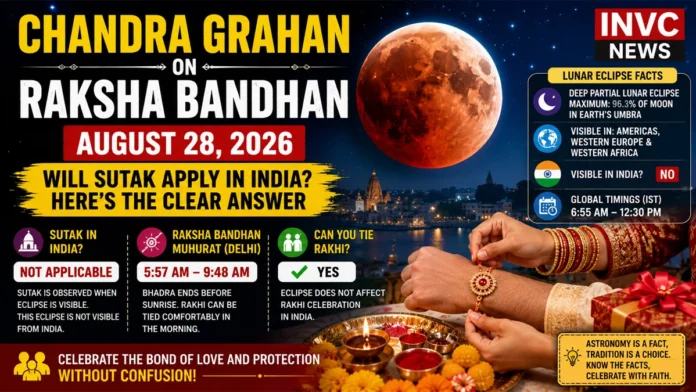
The August 28 lunar eclipse will not be visible from India. Under commonly followed Hindu Panchang tradition, Sutak therefore does not apply in India, and Raksha Bandhan celebrations can continue normally.
NASA confirms that August 28 will bring a deep partial lunar eclipse, with the Moon passing dramatically through Earth’s shadow. At maximum eclipse, about 96.3% of the Moon’s disk will be inside Earth’s umbra, although it will never become completely eclipsed.
Why India Will Not See the August 28 Chandra Grahan
The eclipse occurs while the Moon is below the horizon for India.
NASA lists the main visibility region across the Americas, Europe and Africa, with the dramatic deepest phase visible particularly from the Americas, western Europe and western Africa. India is outside the viewing zone.
On the Indian clock, the global eclipse phases occur approximately between:
Penumbral phase begins: 6:55 AM IST
Partial eclipse begins: 8:04 AM IST
Maximum eclipse: 9:43 AM IST
Partial eclipse ends: 11:21 AM IST
Penumbral phase ends: around 12:30 PM IST
These are the global astronomical event times converted to IST. They are not viewing times for India.
That distinction matters because social-media posts showing a “9:43 AM eclipse” can make it sound as though people in India will actually see the Moon darken during the morning. They will not.
So, Will Sutak Apply in India?
According to commonly followed Hindu Panchang practice, Sutak is observed when an eclipse is visible at the location concerned.
Drik Panchang’s eclipse calculations for Indian locations show the August 28 eclipse as not locally visible and list Sutak as “Not Applicable.”
It is important to separate the two ideas:
The eclipse itself is an astronomical event.
Sutak is a religious and traditional observance associated with eclipses.
Science determines where the eclipse can be seen; religious traditions determine how devotees choose to observe it.
Will Chandra Grahan Change Raksha Bandhan Timing?
For families celebrating in India, the eclipse does not require a change in Rakhi plans under the visibility-based Sutak tradition.
For Delhi, the Raksha Bandhan morning window discussed in the Panchang runs approximately 5:57 AM to 9:48 AM, with Bhadra ending before sunrise.
So even though the global eclipse is technically underway during part of that period, it is not visible from India and does not create a Sutak restriction here under that traditional rule.
That is probably the single most important clarification for readers.
Also Read – : Aaj Ka Rashifal August 25, 2026: Horoscope Today for All 12 Zodiac Signs
Why This Eclipse Is Still Special
Even though India misses the spectacle, astronomically this is an impressive eclipse.
NASA describes it as a deep partial lunar eclipse. At maximum, only a small part of the Moon will remain directly illuminated outside Earth’s dark central shadow.
Observers in favorable locations could therefore see a dramatically darkened Moon, with portions potentially taking on a coppery or reddish appearance.
Unlike a solar eclipse, a lunar eclipse is also safe to watch with the naked eye.
Raksha Bandhan and Chandra Grahan on the Same Day — Coincidence?
There is a simple astronomical reason lunar eclipses occur around Purnima.
A lunar eclipse can happen only when Earth comes between the Sun and the full Moon.
Raksha Bandhan is traditionally celebrated on Shravana Purnima, so an eclipse occurring on the festival date is unusual for celebrations but completely consistent with the astronomy of a lunar eclipse.
Also Read – : Third Sawan Somwar 2026: Nine Auspicious Alignments Form on August 17
The Bottom Line for Families
If you’re celebrating Raksha Bandhan in India, there is no need to panic over viral claims that the August 28 Chandra Grahan will stop the Rakhi ceremony.
Raksha Bandhan: August 28, 2026
Lunar Eclipse: Yes
Visible in India: No
Sutak in India: Not applicable under commonly followed visibility-based Panchang tradition
Rakhi celebration affected by eclipse: No
The eclipse may share the calendar with Raksha Bandhan — but for families in India, it does not need to overshadow the festival.