BENGALURU, KARNATAKA, INDIA | AUGUST 25, 2026 —
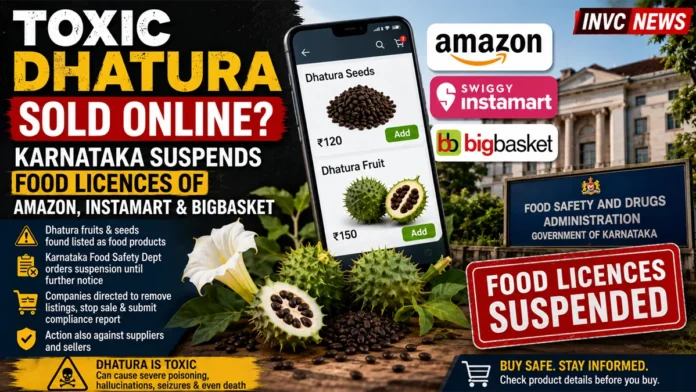
Dhatura online sale has triggered a major food-safety crackdown in Karnataka, with authorities suspending food licences and registrations linked to Amazon, Swiggy Instamart and BigBasket after Dhatura fruits and seeds were found listed as food products for human consumption.
The Karnataka Food Safety and Drugs Administration has directed the companies to remove the disputed products and related advertisements, stop their sale or distribution as food and submit compliance reports. The suspensions will remain in force until further orders.
The action does not mean Amazon, Instamart or BigBasket have been completely banned in Karnataka. It specifically concerns food licences and registrations affected by the regulatory order.
The case has nevertheless raised a larger question for India’s rapidly expanding e-commerce and quick-commerce industry: how did a toxic botanical product get classified and offered as food on major digital platforms?
What Karnataka Found in the Dhatura Case
The regulatory action followed an investigation into the online listing and distribution of Dhatura fruits and seeds.
Authorities said products were being offered for human consumption even though Dhatura is poisonous. Some packets reportedly carried food licence or registration details, bringing the listings directly within the food-safety regulatory framework.
The companies were ordered to immediately:
- Remove Dhatura food listings
- Withdraw related advertisements
- Stop sale for human consumption
- Stop distribution through affected food channels
- Submit compliance reports to the department
The issue therefore goes beyond an incorrect product description. It concerns whether potentially dangerous products were allowed to enter a regulated food supply chain.
What Is Dhatura and Why Can It Be Dangerous?
Dhatura—botanically associated with the Datura genus—is a plant familiar across India and is also used in certain traditional and religious contexts.
That does not make it an ordinary edible plant.
Dhatura contains naturally occurring tropane alkaloids, including atropine, scopolamine and hyoscyamine. Ingestion can affect the nervous system and may cause symptoms including confusion, blurred vision, dilated pupils, rapid heartbeat, agitation and hallucinations.
Serious poisoning can require urgent medical care.
The important distinction in the Karnataka case is therefore intended use.
A botanical product may have non-food uses, but it cannot simply be classified and sold as an ordinary food item if its consumption poses a public-health risk.
India has been seeing wider scrutiny of what reaches consumers through processed and packaged-food channels as well.
Also Read – : New Study Links Food Preservatives in Packaged Foods to Higher Blood Pressure and Heart Disease Risk
Are Amazon, Instamart and BigBasket Completely Banned?
No.
This is one area where headlines need particular care.
The current action should not be described as:
“Amazon banned in Karnataka”
or
“Instamart and BigBasket shut down.”
The order concerns relevant food licences and registrations.
That may have operational consequences for affected food businesses, but it is different from a blanket prohibition on every service operated by these companies.
For consumers, the distinction matters because Amazon sells products across numerous categories, while Swiggy operates businesses beyond Instamart.
What Have the Companies Said?
Company responses have varied.
According to the regulatory order cited in current reports, BigBasket said it had stopped the online sale of the affected fruits and indicated that any future permitted listing would be clearly marked as not intended for human consumption.
Swiggy Instamart sought additional time to provide documents explaining the steps it had taken.
Amazon had not submitted a response at that stage, according to the order.
The next phase will depend on whether regulators consider the corrective measures sufficient.
Can the Food Licences Be Restored?
Yes, potentially.
A suspension is not the same as permanent cancellation.
Authorities can examine the companies’ compliance reports, product-removal measures, supplier controls and future safeguards before deciding whether affected licences or registrations can be restored.
That makes one question particularly important:
Can the platforms show that the problem has been fixed at the system level, rather than simply deleting one product?
If the weakness originated in product classification or seller verification, regulators may expect safeguards capable of preventing similar listings from appearing again.
FSSAI Rules Already Cover Online Food Businesses
India’s food-safety framework does not treat online food sales as an unregulated space.
FSSAI’s rules and guidance cover e-commerce Food Business Operators, including platforms that facilitate food transactions between sellers and consumers.
FSSAI has also emphasized that product claims shown online should align with the information provided on physical labels and that valid food licence or registration details should be displayed for sellers covered by the framework.
Official FSSAI Guidelines:
https://www.fssai.gov.in/upload/advisories/2018/02/5a968f14cc994189.pdf
The regulatory principle is straightforward:
Selling food through an app does not remove the food-safety obligations that apply offline.
The Bigger Problem: Who Checks What Sellers Upload?
India’s large online marketplaces can carry thousands or millions of product listings.
The commercial chain may involve:
manufacturer → seller → marketplace → warehouse → logistics network → consumer
That creates scale, speed and convenience.
It also creates a regulatory challenge.
Platforms need systems capable of identifying whether an unfamiliar product is:
- Food
- Medicine
- Botanical material
- Religious merchandise
- Gardening material
- Cosmetic ingredient
- Non-consumable product
A wrong classification can become much more serious when a product is poisonous.
The Dhatura case therefore raises questions not only about one seller, but about catalogue moderation, automated screening and marketplace accountability.
Why This Matters for India’s Fast-Growing Digital Economy
Online commerce is becoming an increasingly important part of India’s wider digital economy.
E-commerce regulation is therefore moving beyond questions of payments and logistics toward areas such as online safety, consumer protection, product authenticity and platform accountability.
Those issues are also becoming important internationally as governments develop new digital-trade frameworks.
Also Read – : ASEAN DEFA Could Offer India a Powerful Digital Trade Blueprint as Southeast Asia Builds a Connected Economy
For India, the challenge will be supporting rapid digital-commerce growth without weakening the protections consumers expect when buying regulated products.
Quick Commerce Makes the Safety Challenge Harder
Quick-commerce companies promise groceries and household products within minutes.
That business model depends on:
- Large digital catalogues
- Local dark stores
- Rapid inventory movement
- Automated fulfilment
- Multiple suppliers
- High-frequency deliveries
Speed is the advantage.
But speed can also make robust compliance systems more important.
A dangerous or incorrectly classified product can potentially become available to thousands of customers almost instantly.
That makes preventive screening much more valuable than removing a product only after a complaint.
Why Food Regulation Matters Even More as Consumer Costs Rise
Indian households are already paying close attention to packaged food and everyday consumer goods because input, freight and commodity costs have placed pressure on prices.
Food safety and affordability are therefore increasingly overlapping consumer issues.
Also Read – : FMCG Companies Prepare for Fresh Inflation Wave as Rising Fuel Costs Threaten Price Hikes on Daily Essentials
As more daily essentials move through apps and rapid-delivery networks, regulators will have to oversee not merely pricing and availability but also storage, labelling, seller compliance and product safety.
What Consumers Should Check Before Buying Unfamiliar Products Online
Consumers cannot be expected to independently verify every product on a major shopping app.
However, unfamiliar herbs, fruits, roots, seeds and botanical products deserve additional caution.
Before consuming such a product, buyers should check:
Intended use: Is it actually described as edible?
Manufacturer and seller: Are they clearly identified?
Food licence information: Is applicable registration displayed?
Packaging: Does the physical label match the online claims?
Warnings: Does it state “not for human consumption” or identify another intended use?
Product identity: Is the common name potentially being confused with another plant?
A familiar app interface should not automatically be interpreted as a medical or food-safety guarantee.
Could Other States Now Examine Similar Listings?
That is one of the developments worth watching.
Amazon, BigBasket and Swiggy Instamart operate beyond Karnataka.
If identical or similar Dhatura products were available through national catalogues, food-safety authorities elsewhere could examine how they were listed and distributed.
The platforms may therefore have an incentive to conduct a broader review rather than limiting corrective action to Karnataka.
What Happens Next?
Three developments now matter most.
Compliance by the Platforms
Authorities will examine whether the listings and advertisements have been removed and whether affected stock remains in warehouses.
Action Against Sellers and Suppliers
Responsibility may extend beyond marketplaces to businesses that supplied, packaged or classified the products.
Stronger Platform Screening
The long-term consequence could be tighter checks for unusual botanical and food listings across e-commerce platforms.
For the quick-commerce industry, that final point may prove more important than the immediate suspension itself.
Dhatura Online Sale FAQ
Why were the food licences suspended?
Karnataka authorities acted after Dhatura fruits and seeds were found listed as food products for human consumption.
Is Dhatura poisonous?
Dhatura contains toxic compounds and can cause serious poisoning if consumed improperly.
Are Amazon, Instamart and BigBasket banned in Karnataka?
No. The order concerns affected food licences and registrations, not a blanket ban on all company operations.
Can the licences be restored?
Potentially yes, after regulators review corrective action and compliance.
What should someone do after suspected Dhatura consumption?
Suspected poisoning requires prompt professional medical attention.
Bottom Line
The Dhatura online sale controversy exposes a much larger challenge facing India’s booming e-commerce and quick-commerce industry.
The core issue is no longer simply whether an app can deliver groceries in 10 or 20 minutes.
It is whether the systems behind that app can reliably determine what is safe to sell as food in the first place.
Karnataka’s suspension of food licences linked to Amazon, Swiggy Instamart and BigBasket puts that responsibility sharply in focus.
For the companies, removing the disputed listings may be the easy part.