MUMBAI, INDIA | AUGUST 25, 2026 | UPDATED 9:55 AM IST —
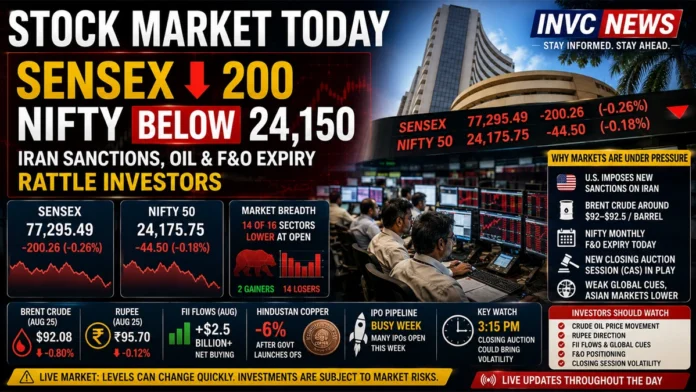
Stock Market Today opened under pressure on Tuesday as the Sensex fell around 200 points in early trade and the Nifty slipped below 24,150, with investors weighing tougher U.S. sanctions on Iran, elevated crude oil prices and volatility surrounding the monthly derivatives expiry.
At the opening bell, the Nifty 50 fell 0.18% to 24,175.75, while the BSE Sensex declined 0.10% to 77,295.49.
Selling widened shortly after the open, pushing the Sensex roughly 200 points lower and taking the Nifty below the psychologically important 24,150 level.
Market breadth was weak at the start, with 14 of the 16 major sectoral indices trading lower, while mid-cap and small-cap shares also struggled for momentum.
The weakness comes after Indian benchmarks ended Monday modestly lower and as investors prepare for the Nifty 50’s first monthly derivatives expiry under India’s new Closing Auction Session framework.
Stock Market Today: Key Levels at the Opening
| Market Indicator | Early Market Reading |
|---|---|
| Nifty 50 open | 24,175.75 |
| Sensex open | 77,295.49 |
| Early Sensex move | Down around 200 points |
| Early Nifty move | Below 24,150 |
| Major sectors lower at open | 14 of 16 |
| Brent crude | Around $92–$92.5/barrel |
| Rupee zone | Around ₹95.70–₹95.75/$ |
| Key event today | Nifty monthly F&O expiry |
These are intraday figures and can change rapidly during market hours.
Why Is the Stock Market Falling Today?
There is no single trigger.
Investors are dealing with several risks simultaneously:
- New U.S. sanctions targeting Iran
- Iran’s threat of retaliation
- Brent crude still above $92
- Nifty monthly F&O expiry
- New Closing Auction Session dynamics
- Weak Asian markets
- Rupee pressure
- Caution ahead of major global technology earnings
For an oil-importing economy such as India, geopolitical tensions in West Asia are particularly important because they can affect crude prices, inflation, the rupee and corporate earnings at the same time.
Iran Sanctions Keep Investors Cautious
Washington has expanded economic sanctions targeting Iran, increasing uncertainty over trade, shipping and energy flows.
Tehran has responded by warning of retaliation, keeping geopolitical risk elevated even though crude oil prices have eased from some recent peaks.
The immediate question for markets is whether sanctions materially restrict Iranian commerce and energy flows—or whether major trading partners find ways to continue doing business.
Any escalation involving Gulf shipping routes would be more significant for Indian markets because of India’s high dependence on imported crude.
Also Read – : Sensex, Nifty Struggle as Crude Nears $94; Welspun Corp Jumps Nearly 12%
Brent Crude Around $92 Remains a Major India Risk
Brent crude was around $92–$92.5 a barrel during Tuesday’s Asian session.
Oil prices had fallen more than 2% in the previous session but remain high enough to keep Indian investors cautious.
Higher crude matters because India imports most of the oil it consumes.
Sustained expensive oil can:
- Increase India’s import bill
- Weaken the rupee
- Raise inflation
- Increase transport costs
- Pressure corporate profit margins
- Reduce RBI’s room for rate cuts
Oil-sensitive sectors such as aviation, paints, chemicals, logistics and some consumer businesses can face higher costs when crude remains elevated.
Upstream oil producers can react differently because higher crude can improve realizations.
Also Read – : Crude Oil Price Impact on Sensex and Nifty: Which Indian Sectors Gain and Lose When Oil Rises?
Rupee Near ₹95.7 Adds Pressure
The Indian rupee remains another important variable.
The currency was expected to trade around ₹95.70–₹95.75 against the dollar after ending Monday near ₹95.7450.
Expensive oil tends to increase dollar demand because Indian refiners and other importers need foreign currency to pay for overseas purchases.
A weaker rupee can then increase the local cost of:
- Crude oil
- Electronics
- Machinery
- Chemicals
- Imported components
- Overseas education
- Foreign travel
That is why currency weakness can eventually influence stock-market valuations as well as household finances.
Foreign portfolio inflows are providing some support. Overseas investors have bought more than $2.5 billion of Indian equities during August, helping offset part of the pressure.
Also Read – : Indian Rupee Could Slide Toward 99 per Dollar by 2028—Could an Oil Shock Push It to 101?
Today’s F&O Expiry Could Increase Volatility
Tuesday is also important because monthly Nifty derivatives contracts are expiring.
Expiry sessions can produce sharp movements as traders:
- Close existing positions
- Roll contracts into the next series
- Hedge options exposure
- Adjust index futures
- Manage large institutional positions
That can create intraday volatility even without a major fundamental change in the economy.
The situation is particularly interesting today because this is the first monthly Nifty expiry operating under India’s recently introduced Closing Auction Session, or CAS.
What Is the New Closing Auction Session?
India introduced the new closing-price mechanism in August for eligible F&O stocks.
Instead of relying entirely on the previous closing-price methodology, the system uses an auction process toward the end of the trading session.
The new framework is intended to improve price discovery and bring India’s closing mechanism closer to practices used in several major global markets.
But the early rollout has also produced unusual late-session moves.
That means investors should pay particular attention between 3:15 PM and the final close today.
Expiry-related positions combined with the auction mechanism could produce unusually sharp closing moves.
Why Today’s Closing Bell Could Be More Important Than the Opening
Normally, morning movements dominate headlines.
Today could be different.
The interaction of:
monthly expiry + institutional positioning + Closing Auction Session
means significant index movement could occur late in the day.
A sharp move near the close would not automatically indicate a sudden change in India’s economic fundamentals.
It could partly reflect derivatives positioning and price discovery through the new auction mechanism.
For that reason, today’s final Sensex and Nifty levels deserve particular attention.
Asian Markets Are Also Weak
Indian equities are not falling in isolation.
Asian markets were broadly under pressure Tuesday.
The wider MSCI Asia-Pacific index declined around 0.5%, while Japan’s Nikkei fell about 0.9% and South Korea’s Kospi dropped roughly 2.7%.
Technology shares were particularly sensitive ahead of Nvidia’s upcoming earnings.
Investors globally are trying to determine whether enormous spending on artificial intelligence can continue producing earnings growth strong enough to justify elevated technology-sector valuations.
Weak international sentiment can reduce risk appetite in India even when domestic fundamentals remain relatively strong.
Hindustan Copper Falls as Government Launches OFS
Among individual stocks, Hindustan Copper came under sharp pressure after the government launched an Offer for Sale.
The stock fell by around 6% in early trade.
The government is initially selling a 3% stake, with an option to sell another 3% if demand is strong.
The OFS floor price has been set at:
₹514 per share
That is significantly below Monday’s market closing price.
The discount naturally creates pressure on the listed stock because investors can compare the market price with the government’s offer price.
This deserves a separate investor-utility story because an OFS works differently from a normal secondary-market purchase.
Primary Market Activity Is Also Competing for Investor Money
Indian investors are simultaneously facing one of the busiest IPO periods of the month.
Two fresh public issues opened on August 25, while several other offerings are scheduled during the week.
Heavy primary-market activity can absorb part of the liquidity that would otherwise flow into listed equities.
That effect becomes particularly relevant when markets are already volatile.
Also Read – : IPO Today August 25: Annu Projects and Sumax Engineering Open for Subscription
India’s broader IPO calendar is also unusually crowded.
Also Read – : IPO This Week: ₹3,300 Crore-Plus Rush as 10 Companies Hit Dalal Street
Is This a Stock Market Crash?
No.
A 200-point Sensex decline or a modest Nifty fall does not by itself constitute a market crash.
The benchmarks are currently experiencing volatility rather than a disorderly market collapse.
Investors should distinguish between:
normal market correction
and
systemic market stress.
Today’s weakness is currently being driven by a combination of geopolitical risk, oil, derivatives positioning and weak global sentiment.
That can change rapidly during the trading session.
India’s Economic Fundamentals Remain an Important Counterweight
Markets are also waiting for fresh information about India’s economic growth.
A poll of economists points to approximately 7.1% GDP growth in the April-June quarter, compared with 7.8% in the previous quarter.
Official data is scheduled for August 31.
If growth remains around 7%, India would continue to expand at a rate considerably above most major economies.
Strong consumer demand and government spending are providing support, although private investment, crude oil and currency risks remain concerns.
For equity investors, that creates a mixed environment:
Domestic growth remains strong.
External risks remain elevated.
That combination helps explain why the market is volatile without entering a full risk-off collapse.
What Could Help Sensex and Nifty Recover Today?
Several developments could improve sentiment.
Crude Oil Falls Further
A sustained decline below recent levels would reduce pressure on India’s inflation, rupee and import outlook.
Rupee Stabilizes
A relatively stable currency could reassure foreign and domestic investors.
Financial Stocks Recover
Banks and financial companies carry significant weight in Indian benchmark indices.
Global Markets Improve
A recovery in Asian or European equities could support risk appetite.
Foreign Investors Continue Buying
Persistent FPI inflows could provide a domestic market cushion.
What Could Push the Market Lower?
The opposite scenario would involve:
- Renewed rise in Brent crude
- Fresh Iran-related escalation
- Sharp rupee weakness
- Large expiry-related selling
- Weakness in global technology stocks
- Broader foreign-investor selling
Any combination of these factors could push Nifty toward lower support zones during the day.
What Should Long-Term Investors Do?
A single volatile market session should rarely determine a long-term investment strategy.
Investors should separate short-term index moves from changes in company fundamentals.
Factors worth watching include:
- Earnings growth
- Valuations
- Debt
- Cash flow
- Management quality
- Industry outlook
- Portfolio diversification
Expiry-day volatility can create dramatic intraday prices that may have little connection with a company’s long-term value.
Investors should therefore avoid making decisions solely because the Sensex moves 200 or 300 points in either direction.
Traders Face a Different Risk Today
Short-term traders face additional challenges because derivatives expiry can amplify price moves.
Stop-loss discipline becomes particularly important when intraday volatility rises.
The new closing-auction system also means traders should understand their broker’s order-handling rules and closing-session timings rather than assuming the market behaves exactly as it did before August.
Leveraged positions carry significantly higher risk during volatile sessions.
Stock Market Today: What to Watch Until 3:30 PM
For the rest of Tuesday, five indicators matter most:
1. Nifty 24,150–24,200 Zone
Whether the benchmark can reclaim and hold this region will help determine immediate sentiment.
2. Brent Crude
Another move toward $94–$95 could hurt risk appetite.
3. Rupee
A sharp fall beyond the recent trading range would increase macro concerns.
4. F&O Rollover Activity
Large derivative-position adjustments could create intraday swings.
5. Closing Auction Session
Today’s final 20 minutes could be more volatile than usual because of monthly expiry.
Stock Market Today FAQ
Why is Sensex falling today?
Investors are reacting to Iran-related geopolitical risks, elevated crude oil, monthly F&O expiry and weak Asian markets.
Where did Nifty open today?
Nifty opened at 24,175.75 on August 25.
Where did Sensex open?
Sensex opened at 77,295.49.
Why is crude oil important for Indian stocks?
India imports most of its crude. Higher prices can pressure inflation, the rupee, corporate margins and the current account.
Is today an F&O expiry day?
Yes. Nifty monthly derivatives expire today, which can increase volatility.
What is the Closing Auction Session?
CAS is India’s new auction-based closing-price mechanism for eligible securities. It can affect price discovery during the final part of the trading session.
Is the stock market crashing?
Current moves represent a relatively modest market decline rather than a crash. Conditions can change during live trading.
Bottom Line
Stock Market Today opened cautiously, with the Sensex falling around 200 points in early trade and the Nifty dropping below 24,150 as investors reacted to geopolitical uncertainty, expensive crude oil and derivatives expiry.
Fourteen of 16 major sectors began the session in negative territory.
But today’s opening move may not tell the complete story.
The first monthly Nifty expiry under the new Closing Auction Session framework means the final phase of trading could be unusually important.
Investors should therefore keep watching:
Brent crude, the rupee, foreign flows, expiry positioning and the 3:15 PM closing-auction window.
For now, Dalal Street is caught between two powerful forces:
India’s relatively strong domestic growth story and increasingly uncomfortable global macro risks.