MUMBAI, INDIA / STUTTGART, GERMANY | AUGUST 25, 2026 —
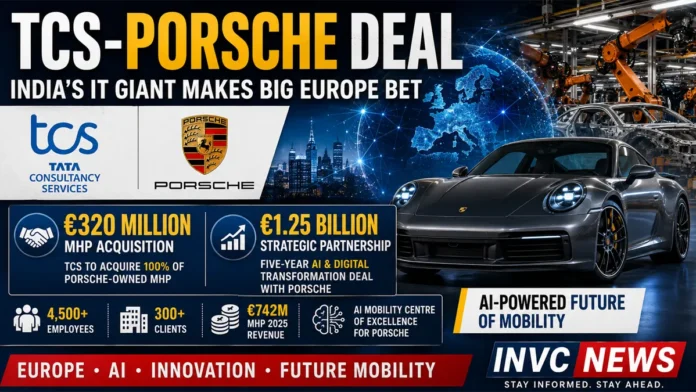
TCS-Porsche Deal has become one of the biggest India-Europe technology transactions of 2026, with Tata Consultancy Services agreeing to acquire Porsche-owned management and IT consulting company MHP for an enterprise value of €320 million, while Porsche has separately committed to a five-year strategic agreement worth €1.25 billion with TCS and MHP.
The partnership places artificial intelligence, software-defined mobility, automotive engineering and digital manufacturing at the center of a major new relationship between India’s largest IT services company and one of Germany’s most recognized luxury-car manufacturers.
Under the agreement, TCS will establish a dedicated AI Mobility Centre of Excellence for Porsche. The companies plan to use AI across engineering, manufacturing, operations, customer experience and enterprise transformation.
The acquisition will also give TCS control of MHP Management- und IT-Beratung GmbH, a major European automotive and industrial consultancy with around 4,500 employees, more than 300 clients and €742 million in 2025 revenue.
TCS-Porsche Deal: What Has Actually Been Announced?
There are two major financial components, and they should not be confused.
First, TCS Netherlands B.V. has agreed to acquire 100% of MHP from Porsche AG for an enterprise value of approximately €320 million.
Second, Porsche has entered into a separate five-year €1.25 billion strategic agreement with TCS and MHP.
That €1.25 billion services agreement alone is worth roughly ₹14,000 crore, depending on the exchange rate.
The acquisition and the strategic contract are connected, but the €320 million purchase price should not simply be added to the €1.25 billion contract and described as a single acquisition value.
What Is MHP and Why Does TCS Want It?
MHP is one of Europe’s established automotive and industrial consulting businesses.
The Germany-headquartered company works across areas including:
- Artificial intelligence
- Automotive engineering
- Digital transformation
- SAP transformation
- Manufacturing digitalization
- Connected mobility
- Software-defined vehicles
- Supply-chain management
- Cybersecurity
- Industrial technology
MHP generated approximately €742 million in revenue in 2025 and employs more than 4,500 people globally.
Its customer base exceeds 300 organizations and stretches beyond automotive into manufacturing, aerospace, defense, energy and the public sector.
For TCS, acquiring MHP provides something that would take years to build organically: deep automotive consulting expertise, thousands of specialists and established relationships with European industrial companies.
Also Read – : Global Automotive Market Trends 2026: EVs, AI and Mobility Are Reshaping the Industry
Porsche Signs €1.25 Billion Five-Year AI Deal
The larger revenue opportunity comes from Porsche’s five-year strategic commitment.
According to TCS’s regulatory disclosure, the agreement is worth €1.25 billion and will become effective from the closing date of the MHP acquisition.
The partnership is intended to industrialize artificial intelligence across Porsche.
Key areas include:
Engineering
AI could accelerate product engineering, simulation, development and testing.
Manufacturing
Artificial intelligence, automation and data analytics can improve factory productivity, quality control and predictive maintenance.
Operations
TCS and MHP will work on enterprise transformation and digital operations.
Customer Experience
Software and data can enable increasingly personalized experiences for Porsche customers.
Software-Defined Mobility
Vehicles are increasingly becoming computing platforms whose capabilities can evolve through software, connectivity and over-the-air updates.
This is where the deal moves well beyond traditional IT outsourcing.
TCS to Build AI Mobility Centre of Excellence for Porsche
A dedicated AI Mobility Centre of Excellence will form one of the central pillars of the relationship.
Its purpose will be to turn AI concepts into scalable solutions across Porsche’s automotive value chain.
TCS says the center will combine Porsche’s automotive engineering capabilities with TCS’s strengths in AI, product engineering, technology and business transformation.
The initiative could cover intelligent manufacturing, engineering, operations and customer-facing systems.
For TCS, Porsche therefore becomes a high-profile showcase for its ambition to evolve from a traditional IT-services company into an AI-led technology and engineering partner.
Why Porsche Is Selling MHP
Porsche’s decision is part of its wider effort to sharpen its strategic focus.
The sports-car manufacturer says the sale supports its Sportwagenschmiede 35 strategy and allows Porsche to concentrate more strongly on its core automotive business.
At the same time, Porsche does not want to lose access to MHP’s technology and consulting expertise.
That explains the unusual structure:
Porsche sells MHP to TCS but simultaneously enters into a large long-term agreement with TCS and MHP.
MHP gains access to a global IT and consulting network, while Porsche continues working closely with the company it previously owned.
MHP Will Keep Its Own Brand
MHP is expected to continue operating as a distinct consulting brand within TCS after the acquisition closes.
That is strategically important.
MHP already has relationships with hundreds of industrial customers, and preserving its brand could help maintain client confidence while allowing the company to use TCS’s much larger global delivery network.
TCS can then potentially introduce its AI, cloud, cybersecurity, engineering and enterprise-technology services to MHP customers.
MHP’s automotive expertise can also be offered to existing TCS clients around the world.
Porsche’s Technology Strategy Is Changing
The deal comes at a critical period for Porsche.
The company is confronting slower growth in parts of the premium electric-vehicle market while simultaneously investing heavily in software, artificial intelligence and next-generation vehicle technology.
Its Taycan electric sports car illustrates the challenge.
Global Taycan deliveries fell substantially from their 2023 peak, leading to questions about Porsche’s longer-term EV product strategy even as the company continues to upgrade the model.
Also Read – : Porsche Taycan Could Face 2030 Phase-Out as Global Sales Decline Sharply
The new TCS partnership suggests that even as Porsche adjusts its vehicle portfolio, it is accelerating investment in the software and AI capabilities that will increasingly define future automobiles.
Why Software-Defined Cars Matter
Modern vehicles are rapidly becoming software platforms.
A premium vehicle today increasingly depends on:
- Connected services
- Artificial intelligence
- Advanced driver-assistance systems
- Digital cockpits
- Cybersecurity
- Cloud connectivity
- Over-the-air updates
- Predictive maintenance
- Data analytics
- Intelligent manufacturing
In the past, automakers competed mainly on engines, design, handling and mechanical engineering.
Those factors still matter.
But software performance, digital services and AI capabilities are becoming major competitive differentiators.
That creates a huge opportunity for technology companies such as TCS.
Why Germany and Europe Matter to TCS
The acquisition also gives TCS a deeper position in Europe’s largest industrial economy.
German companies are spending heavily on:
AI + cloud + SAP modernization + industrial automation + cybersecurity + digital engineering.
MHP provides TCS with a local consulting organization that already understands German automotive manufacturers, suppliers and industrial businesses.
That combination can be more powerful than attempting to serve the European market entirely through offshore delivery centers.
MHP Has More Than 300 Clients
The 300-plus client base could become one of the most commercially valuable parts of the acquisition.
TCS can potentially offer those companies additional services in:
- Generative AI
- Cloud transformation
- Cybersecurity
- Data analytics
- Engineering
- Enterprise software
- Digital manufacturing
At the same time, MHP can benefit from TCS’s global reach and delivery infrastructure.
That creates opportunities beyond Porsche itself.
MHP Revenue Fell in 2025
The acquisition also carries execution risk.
MHP’s revenue declined to around €742 million in 2025, compared with approximately €830 million in 2024.
That reflects the difficult environment facing Europe’s automotive and manufacturing industries.
TCS is therefore not simply buying a fast-growing consultancy.
It is betting that its global scale, AI capabilities and customer relationships can help MHP return to stronger growth.
Is €320 Million a Cheap Price for MHP?
The headline numbers naturally raise this question.
MHP generated €742 million in annual revenue, while the agreed enterprise value is €320 million.
But revenue alone cannot establish whether an acquisition is cheap or expensive.
Investors also need to consider:
- Profit margins
- Cash generation
- Customer concentration
- Employee costs
- Liabilities
- Growth prospects
- Integration expenses
What makes the transaction particularly interesting is that TCS is gaining MHP while also receiving a major five-year strategic commitment from Porsche.
Indian IT Is Moving Beyond Traditional Outsourcing
The TCS-Porsche relationship demonstrates how India’s IT-services industry is changing.
For years, large Indian IT companies grew by helping Western corporations reduce technology costs.
Artificial intelligence is now changing that model.
Clients increasingly want partners capable of redesigning operations rather than simply supplying large technology teams.
The new growth equation is increasingly:
AI + Consulting + Engineering + Industry Expertise
The Porsche relationship fits that transformation almost perfectly.
TCS will operate much closer to Porsche’s engineering, manufacturing and mobility-development processes than in a conventional outsourcing contract.
TCS Is Building a Wider AI Strategy
The Porsche agreement is not an isolated AI push.
TCS has been expanding its AI capabilities across multiple industries, including healthcare, telecom, manufacturing and engineering.
The company has publicly stated an ambition to become one of the world’s largest AI-led technology-services companies.
The Porsche partnership gives that strategy a prominent European automotive reference point.
Indian IT’s European Expansion Has Another Advantage
The wider regulatory and talent environment is also becoming important as Indian IT companies expand across Europe.
Improved arrangements for Indian professionals working temporarily in major European markets can reduce operational friction and employment costs.
Also Read – : India-UK Social Security Agreement Offers Major Relief to Indian Professionals and IT Companies
This matters because global consulting increasingly depends on combining local European specialists with engineering and technology teams based in India.
What Does Porsche Gain From the Deal?
Porsche receives several potential benefits.
It can concentrate capital and management attention on its core automotive business.
At the same time, it continues receiving MHP’s specialized knowledge.
It also gains access to TCS’s much larger global technology operation.
In effect, Porsche is shifting MHP from an internally owned consultancy into part of a much larger external technology ecosystem while securing a long-term partnership with it.
What Does TCS Gain?
For TCS, the strategic benefits are substantial.
A Major New Porsche Relationship
Porsche becomes an important marquee automotive client.
Stronger German Presence
MHP provides local consulting scale in Europe’s biggest economy.
4,500 Specialized Employees
TCS gains significant automotive and industrial expertise.
300-Plus Client Relationships
MHP creates cross-selling opportunities across Europe and beyond.
AI Mobility Credentials
Porsche provides a major platform for demonstrating TCS’s AI and engineering capabilities.
Long-Term Contract Visibility
The five-year €1.25 billion agreement provides substantial committed business once the acquisition closes.
When Will TCS Complete the MHP Acquisition?
The deal is not yet completed.
It remains subject to regulatory and government approvals.
Current disclosures indicate that completion is expected within roughly three to four months, subject to the necessary clearances and conditions.
Until that happens, Porsche remains MHP’s owner.
For that reason, the accurate formulation is:
“TCS has agreed to acquire MHP.”
It would be premature to state that TCS already owns MHP.
Could TCS-Porsche Become a Model for Future Deals?
Possibly.
The transaction combines several things Indian technology companies increasingly want:
- European consulting talent
- Industry specialization
- Artificial-intelligence expertise
- Local customer relationships
- Engineering capabilities
- Long-term strategic contracts
Rather than acquiring scale for its own sake, future IT deals may increasingly target specialized companies that provide access to high-value industries.
Automotive technology is particularly attractive because cars are becoming increasingly dependent on software and AI.
TCS-Porsche Deal: Key Questions Answered
How much is TCS paying for MHP?
TCS has agreed to acquire MHP at an enterprise value of approximately €320 million.
Is the €1.25 billion figure the MHP purchase price?
No. The €1.25 billion figure relates to the separate five-year strategic agreement involving Porsche, TCS and MHP.
How much revenue does MHP generate?
MHP reported approximately €742 million in 2025 revenue.
How many people work for MHP?
MHP employs more than 4,500 people globally.
What will TCS do for Porsche?
The partnership will focus on artificial intelligence across Porsche’s engineering, manufacturing, operations, customer experience and enterprise transformation, as well as next-generation automotive technology and software-defined mobility.
Is the acquisition complete?
No. It remains subject to regulatory approvals and other closing conditions.
Bottom Line
The TCS-Porsche Deal is much more significant than a straightforward €320 million acquisition.
TCS is gaining a major European automotive consultancy with around 4,500 employees, more than 300 customers and €742 million in annual revenue.
At the same time, Porsche is committing €1.25 billion over five years to a strategic relationship with TCS and MHP centered on AI and future mobility.
For Porsche, the arrangement allows it to sharpen its focus on automobiles while retaining access to advanced consulting and technology capabilities.
For TCS, it provides a much larger position in Germany, European automotive consulting and AI-driven mobility.
And for India’s IT industry, it demonstrates where the next generation of large technology deals may increasingly come from:
Artificial intelligence, engineering, industrial transformation and software-defined vehicles — rather than traditional outsourcing alone.