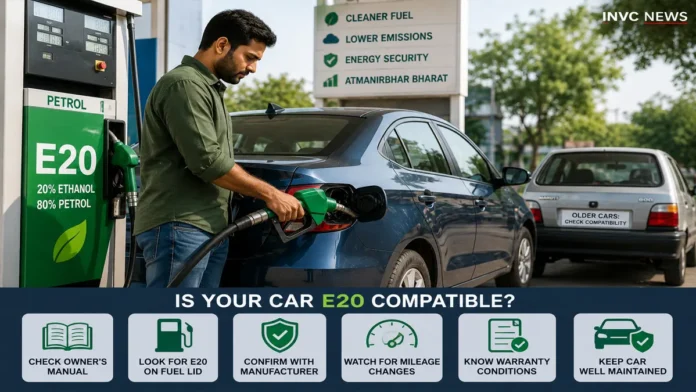
NEW DELHI, India | August 24, 2026 —
E20 Petrol in India is once again at the center of a major car-buyer debate as motorists question whether older petrol vehicles are fully compatible with the country’s higher-ethanol fuel, how much mileage may change and whether long-term engine or fuel-system durability should be a concern.
The debate gained fresh momentum on Monday after BMW Group India President and CEO Hardeep Singh Brar said the company’s current petrol vehicles are compliant with fuel containing up to 25% ethanol, or E25.
That means BMW’s current petrol lineup is engineered beyond India’s present E20 requirement.
But that does not mean every petrol vehicle already on Indian roads—from every manufacturer and every model year—should automatically be described as E25-ready.
For owners of older vehicles, the safest answer remains far more practical:
Check your owner’s manual, fuel-filler label and manufacturer guidance for your exact model and year rather than relying on viral social-media claims.
What Exactly Is E20 Petrol?
E20 petrol is conventional petrol blended with approximately:
80% petrol + 20% ethanol.
Ethanol is an alcohol-based fuel component that can be produced from feedstocks including sugarcane, grains and other biomass.
India has progressively increased ethanol blending as part of its strategy to:
- Reduce dependence on imported crude oil
- Improve energy security
- Support domestic ethanol production
- Reduce certain emissions
- Create additional demand for agricultural feedstocks
Government data show that average ethanol blending rose from roughly 1.5% in 2013-14 to 20% in 2025-26.
India therefore reached its 20% blending objective years ahead of the country’s original timetable.
BMW Says Its Current Petrol Cars Are E25-Ready
BMW’s latest statement is significant because it goes beyond E20.
Hardeep Singh Brar has said BMW’s current petrol vehicles in India are E25 compliant, meaning they are engineered to operate with petrol containing up to 25% ethanol.
For prospective BMW buyers, that provides additional headroom over India’s present 20% blend.
However, owners of older BMWs should not automatically assume that a vehicle sold many years ago has the same certification.
Compatibility depends on the specific vehicle generation, engine, fuel-system materials and homologation standard.
Also Read: BMW X1 Long Wheelbase Arrives in India: Bigger Cabin, Petrol Power and New Luxury-SUV Push
Is E20 Safe for Petrol Cars?
The Government of India’s current position is clear.
The Ministry of Petroleum and Natural Gas says extensive laboratory and field testing involving ARAI, SIAM, Indian Oil, the Indian Institute of Petroleum and vehicle manufacturers has found no significant widespread adverse impact on engine durability, drivability or material compatibility when E20 is used under prescribed standards.
The government has also said that millions of older vehicles have already operated on ethanol-blended petrol without verified evidence of widespread E20-attributable engine failures.
That is important because online discussion can sometimes make it sound as if every older petrol vehicle is about to suffer immediate engine damage.
The available evidence does not support such a sweeping conclusion.
At the same time, E20 compatibility and E20 optimization are not necessarily identical things.
A car can operate on a fuel without being optimized to achieve exactly the same mileage it delivered on a lower-ethanol blend.
Will E20 Petrol Reduce Mileage?
This is where the discussion becomes more nuanced.
Ethanol contains less energy per litre than petrol.
India’s original NITI Aayog–Ministry of Petroleum ethanol roadmap estimated that E20 could reduce fuel efficiency approximately by:
- 6–7% in four-wheelers originally designed for E0 and calibrated for E10
- 3–4% in two-wheelers designed for E0 and calibrated for E10
- 1–2% in four-wheelers designed for E10 but calibrated for E20
The same roadmap noted that engine hardware and calibration changes could reduce this efficiency penalty.
These figures are planning estimates from the earlier transition roadmap, not a guarantee that every vehicle will experience exactly that loss.
Actual mileage depends on:
- Vehicle design
- Engine calibration
- Traffic
- Driving style
- AC usage
- Tire pressure
- Road conditions
- Fuel quality
- Vehicle maintenance
That is why one driver’s reported mileage change cannot automatically be applied to every vehicle.
Why Newer Cars Are Better Prepared for E20
India’s ethanol roadmap gave automakers several years to prepare their products.
The roadmap envisaged E20 material-compatible vehicles from April 2023, followed by vehicles with engines optimized for E20 from April 2025.
Material compatibility matters because ethanol interacts differently with certain:
- Rubber seals
- O-rings
- Fuel hoses
- Gaskets
- Fuel pumps
- Metals and coatings
Modern E20-compatible fuel systems use materials selected and validated for the higher ethanol concentration.
This is also why the discussion around genuinely older cars cannot always be reduced to “the engine runs, therefore everything is identical.”
What Should Owners of Older Cars Check?
Do not panic and do not immediately assume the vehicle is unsafe.
Instead, check four things.
1. Look at the Fuel-Filler Area
Many newer vehicles carry a label indicating compatibility such as:
E20
or a related ethanol-blend specification.
If the label explicitly says E20, the answer is straightforward.
2. Check the Owner’s Manual
Search the fuel section for terms such as:
- E20
- Ethanol
- Gasohol
- Alcohol-blended petrol
- Maximum ethanol percentage
The owner’s manual is more reliable than a generic online list because compatibility can vary between generations of the same model.
3. Contact the Manufacturer Using Your VIN
For an older vehicle, the manufacturer or authorized service center may be able to determine compatibility from the VIN/chassis number.
Ask specifically:
“What maximum ethanol blend is this exact vehicle approved to use?”
That is better than simply asking whether “this model” supports E20.
4. Check Manufacturer Advisories
Several automakers have released E20-related guidance as consumer questions have increased.
Use the manufacturer’s official website or customer-care channel wherever possible.
Can an Old E10 Car Simply Be Converted to E20 or E30?
Not necessarily.
Higher ethanol compatibility can involve more than changing software.
Fuel-system components and materials may also differ.
BMW’s India chief previously highlighted this problem while discussing potential future higher blends, noting that existing vehicles cannot necessarily be converted to a much higher ethanol standard simply through a minor upgrade.
That becomes even more relevant if India ever considers moving beyond E20.
For now, however, the government says no decision has been taken to increase the nationwide standard blend beyond 20%.
Is India Moving to E30 Petrol?
There is no confirmed nationwide E30 rollout decision at present.
This is important because social-media posts often blur the difference between:
- Technical studies
- Industry discussion
- Future possibilities
- An actual government mandate
The Petroleum Ministry said in July that any move beyond E20 would require additional scientific and technical studies and consultation with automakers, oil companies and other stakeholders.
India has introduced E85 fuel for specially designed flex-fuel vehicles, but E85 availability for those vehicles does not mean ordinary petrol is being changed nationwide to E85.
E20 Concerns Are Influencing New-Car Buyers
The public discussion is already affecting buying behavior.
Recent automobile-market data showed CNG, hybrid and electric passenger vehicles moving close to petrol cars in market share, with industry participants pointing to uncertainty around E20 as one factor influencing consumer consideration of alternative powertrains.
That does not mean E20 alone is causing buyers to abandon petrol.
Other factors include:
- Petrol prices
- EV running costs
- Government incentives
- Improving charging infrastructure
- More CNG models
- New hybrid launches
- Wider EV choice
But fuel compatibility has clearly entered the purchase conversation.
Also Read: India Electric Vehicle Boom: Passenger EV Registrations Jump 90% as Rising Fuel Prices Drive Demand
Should You Avoid Buying a Petrol Car Because of E20?
Not automatically.
For a new petrol vehicle sold in 2026, E20 compatibility should be part of the normal engineering and regulatory environment.
The more useful question is whether the model is merely compatible with E20 or specifically optimized for it.
Before buying, ask the dealership:
- Is this exact variant E20 certified?
- Is E20 optimization confirmed?
- What mileage is claimed using the current certification fuel?
- Does E20 use affect warranty conditions?
- Is a higher blend such as E25 supported?
- Is the compatibility printed in the owner’s manual?
Get important representations in writing wherever possible.
BMW’s E25 Readiness Could Become a Competitive Advantage
BMW’s claim that its current petrol cars are already E25-ready could become an increasingly useful marketing point.
Consumers are now considering future fuel compatibility alongside traditional factors such as:
- Power
- Mileage
- Safety
- Resale value
- Maintenance cost
If India’s ethanol policy evolves further over the lifetime of a new car, additional compatibility could give buyers greater confidence.
Other manufacturers may therefore face pressure to communicate their own ethanol limits more clearly.
Will E20 Damage Rubber Seals and Fuel Lines?
This is one of the most common fears surrounding older vehicles.
Ethanol can interact differently with certain older elastomers and fuel-system materials, which is one reason vehicle manufacturers developed material-compatibility specifications as ethanol levels increased.
The government’s current testing position is reassuring: it says widespread real-world use has not produced evidence of systematic E20-related failures in India’s legacy fleet.
However, owners of significantly older vehicles should still follow manufacturer recommendations, particularly if they notice:
- Fuel smell
- Visible leakage
- Difficult starting
- Irregular idle
- Check-engine warning
- Unexplained performance changes
Such symptoms can have many causes and should not automatically be blamed on ethanol.
Have the vehicle inspected rather than diagnosing it through social media.
What About Fuel Quality and Contamination?
This is separate from ethanol percentage.
Recent industry discussions have included concerns around contaminants such as excessive moisture or chloride in fuel samples.
SIAM later clarified that numbers circulating from an industry communication required broader authentication and nationwide data collection.
It also emphasized that fuel testing covers more than 150 parameters.
State-run oil companies have separately said their testing showed E20 fuel meeting prescribed quality requirements.
For consumers, the distinction matters:
A problem caused by contaminated or off-specification fuel is not automatically proof that E20 itself is inherently unsafe.
What Should You Do After Suspected Bad Fuel?
If a vehicle suddenly develops problems immediately after refueling:
- Keep the fuel receipt.
- Note the filling-station location and pump number if possible.
- Do not continue driving if there is serious knocking, leakage or a safety warning.
- Contact the vehicle manufacturer’s authorized service center.
- Ask for diagnostic findings in writing.
- Contact the fuel retailer if contamination is suspected.
Documentation matters if a warranty or fuel-quality dispute later arises.
Does E20 Affect Your Car Warranty?
There is no single answer that can substitute for the warranty terms of your exact vehicle.
The government says manufacturers continue to honor warranty obligations for vehicles using E20 and cites that as evidence supporting confidence in the fuel rollout.
Still, vehicle owners should check their manufacturer’s warranty wording.
For a vehicle explicitly certified for E20, using fuel that meets the required E20 specification should ordinarily be consistent with its approved operating fuel.
For an older vehicle, consumers should obtain manufacturer guidance if compatibility is unclear.
Do not rely on a dealer’s verbal statement for an expensive warranty-sensitive issue.
Should You Add Fuel Additives to Protect the Engine?
Do not add aftermarket additives merely because an online video says they are required for E20.
Some additives can be unnecessary or unsuitable.
Use only products specifically approved by your vehicle manufacturer.
The same applies to changing:
- Fuel hoses
- Seals
- Pumps
- Injectors
- ECU software
Do not retrofit components unless the manufacturer or a technically competent authorized source recommends it.
How to Check Whether Mileage Really Changed
If you think your mileage has dropped after E20, test it systematically.
Use the tank-to-tank method across several fill-ups:
- Fill the tank fully.
- Reset the trip meter.
- Drive normally.
- Fill the tank again.
- Divide kilometres traveled by litres filled.
- Repeat across three or more tanks.
One journey is not enough.
Traffic, idling and air-conditioning can create a larger difference than the fuel itself.
Should Older Car Owners Sell Their Vehicles?
E20 alone is not a reason to panic-sell a functioning petrol car.
Consider instead:
- Manufacturer compatibility guidance
- Vehicle age
- Current maintenance condition
- Repair history
- Fuel economy
- Expected remaining ownership period
- Resale value
- Cost of replacement
A 12-year-old car with several approaching repairs may already make a replacement financially sensible.
A well-maintained older car that its manufacturer considers suitable for current fuel may present a very different case.
Also Read: 100% Ethanol Fuel Gets Legal Approval Push as India Accelerates Alternative-Fuel Strategy
E20 vs CNG vs Hybrid vs EV: What Should a New Buyer Choose?
Fuel compatibility is only one part of the purchase decision.
Petrol/E20
Best suited to buyers who value wide fuel availability, simple refueling and lower upfront complexity.
CNG
Can provide lower running costs where CNG stations are convenient, although boot space and performance characteristics vary by model.
Hybrid
Offers improved efficiency without depending entirely on charging infrastructure, but purchase prices can be higher.
EV
Can deliver low per-kilometre energy cost and quiet operation, especially for users with reliable home charging.
There is no universally best powertrain.
Your annual mileage, route, parking arrangement, city infrastructure and ownership horizon matter more than social-media trends.
E20 Petrol in India: Quick Compatibility Checklist
Before worrying about your car, check:
- Fuel-filler label: Does it say E20?
- Owner’s manual: What maximum ethanol percentage is permitted?
- Model year: Was it designed during the E20 transition period?
- Manufacturer guidance: Has the OEM issued an advisory?
- VIN confirmation: Can the service center confirm compatibility?
- Warranty terms: Is current ethanol-blended petrol covered?
- Mileage: Have you actually measured a change over multiple tanks?
- Symptoms: Is there any genuine drivability or fuel-system issue?
If all indicators are normal, avoid replacing components purely out of fear.
E20 Petrol in India: The Bottom Line
The debate around E20 Petrol in India has become louder because the transition affects one of the country’s largest consumer assets: privately owned vehicles.
BMW’s statement that its current petrol cars are already E25-ready shows how automakers are increasingly preparing for fuels with higher ethanol content.
For newer cars, E20 compatibility should generally be straightforward.
For older vehicles, however, the answer should come from the manufacturer and the specific model’s documentation, not from a viral post or one-size-fits-all chart.
The Government of India says extensive testing and real-world service experience have found no evidence of widespread E20-linked engine failure or abnormal wear. At the same time, India’s original ethanol roadmap acknowledged that vehicles not optimized for E20 could experience some fuel-efficiency reduction.
That distinction is the key.
Compatibility does not necessarily mean identical mileage.
Owners should verify their vehicle, monitor actual fuel economy and investigate genuine symptoms properly.
And buyers considering a new petrol car should now add one more question to the showroom checklist:
“What ethanol percentage is this exact vehicle engineered to handle?”