NEW DELHI, India | August 21, 2026
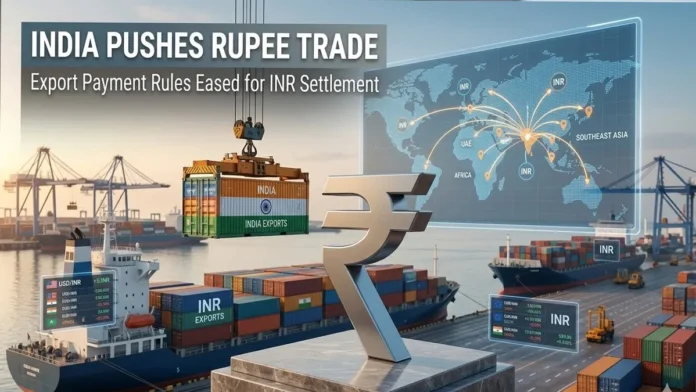
Rupee trade settlement is getting a fresh policy push as India eases rules governing export payments in Indian currency, potentially making it easier for businesses to conduct cross-border trade without relying exclusively on the U.S. dollar.
The latest changes expand the circumstances in which exporters can receive payments in rupees and still qualify for benefits available under India’s foreign trade framework.
The move is part of a broader effort to increase the international use of the Indian currency while making payment arrangements more flexible for exporters dealing with overseas markets.
For Indian companies, the practical importance lies in whether the changes make INR-based transactions easier, cheaper and more attractive to foreign buyers.
What Has India Changed?
Under the revised framework, exporters dealing with countries outside the Asian Clearing Union can invoice and settle eligible trade transactions in Indian rupees.
Importantly, qualifying rupee-denominated export receipts can now be considered for benefits under India’s foreign trade policy.
That addresses a practical issue for exporters.
A payment mechanism becomes much less attractive if using it prevents a company from receiving incentives or benefits that would otherwise apply to the transaction.
By recognizing eligible INR settlements, authorities are attempting to remove one such obstacle.
Why India Wants More International Trade in Rupees
Most international trade is conducted in major global currencies, particularly the U.S. dollar.
That system works efficiently because the dollar is highly liquid and widely accepted.
However, heavy reliance on a foreign currency can create vulnerabilities.
When the dollar strengthens sharply, import costs can rise for countries whose currencies weaken against it.
Companies can also face exchange-rate risk between the time a transaction is agreed and the time payment is completed.
Greater use of the rupee in bilateral trade could reduce some of those risks for Indian companies.
Does This Mean India Is Abandoning the Dollar?
No.
The policy should not be interpreted as India abandoning the U.S. dollar or immediately replacing it in international trade.
The dollar remains the dominant global reserve and trade-settlement currency.
India’s objective is better understood as expanding payment options.
If two trading partners find rupee settlement commercially convenient, the new framework can make it easier to structure the transaction in INR.
Dollar-denominated trade will continue alongside those arrangements.
How Rupee Trade Settlement Works
A cross-border trade transaction normally requires the buyer to pay the exporter in an agreed currency.
Under an INR-based arrangement, overseas trade can be settled through banking mechanisms designed to handle rupee payments.
India has previously developed Special Rupee Vostro Account arrangements to facilitate international trade settlement in INR.
Such mechanisms allow foreign banks to maintain rupee accounts with Indian banks and use those balances for permitted transactions.
The effectiveness of the system ultimately depends on whether trading partners have practical uses for the rupees they receive.
Why Foreign Companies Need a Reason to Hold Rupees
This is one of the biggest challenges facing internationalization of any currency.
An overseas exporter accepting rupees needs to be able to spend, invest or convert those rupees efficiently.
If a country sells substantially more goods to India than it buys, it can accumulate large INR balances.
Without attractive ways to use those balances, exporters may prefer dollars or another internationally liquid currency.
For rupee settlement to grow significantly, India therefore needs not only regulatory permission but also deeper trade relationships and investment opportunities.
What Indian Exporters Could Gain
For some exporters, rupee settlement can reduce exposure to exchange-rate fluctuations.
If production costs, salaries and other expenses are primarily denominated in rupees, receiving export revenue in INR can simplify financial planning.
It may also reduce the need for certain foreign-exchange conversions.
However, the benefit will vary by company.
Businesses must consider exchange rates, banking charges, liquidity and the payment preferences of overseas customers before choosing the settlement currency.
Could Rupee Trade Help the Indian Currency?
Greater international use can increase structural demand for a currency.
If more overseas businesses need rupees to purchase Indian products, services or investments, demand for INR could gradually deepen.
However, it would be misleading to suggest that the latest trade rules alone will significantly strengthen the rupee.
Currency values are influenced by many larger forces, including inflation, interest rates, capital flows, crude-oil prices, economic growth and global demand for the U.S. dollar.
International trade settlement is only one component.
Oil Prices Make the Debate More Important
The timing of the policy is notable because India continues to face uncertainty from elevated global energy prices.
India imports most of the crude oil it consumes, and those purchases traditionally create substantial demand for foreign currency.
When oil prices rise, the country’s import bill can increase and place pressure on the rupee.
Expanding INR settlement in other areas of trade cannot eliminate that exposure, but broader use of the domestic currency can contribute to India’s longer-term effort to reduce unnecessary foreign-exchange dependence.
India’s Rupee Internationalization Will Take Time
Internationalizing a currency is a gradual process.
Companies need confidence that they can easily use, invest or exchange the currency they receive.
Financial markets need sufficient depth and liquidity.
Banking systems also need reliable mechanisms for handling cross-border settlements.
The latest rule changes address one piece of that larger puzzle by making rupee payments more compatible with India’s export-policy framework.
What Happens Next?
The most important test will be adoption.
If exporters and foreign buyers increasingly choose INR settlement because it offers genuine commercial advantages, rupee-denominated trade volumes could grow.
Banks will also play a critical role by making the process efficient and helping companies understand the available settlement mechanisms.
For India, the policy represents another incremental step toward giving the rupee a larger role in international commerce.
The dollar will remain dominant for the foreseeable future, but New Delhi is making it increasingly clear that Indian exporters should have more than one currency option when they do business with the world.