MUMBAI, India | August 21, 2026
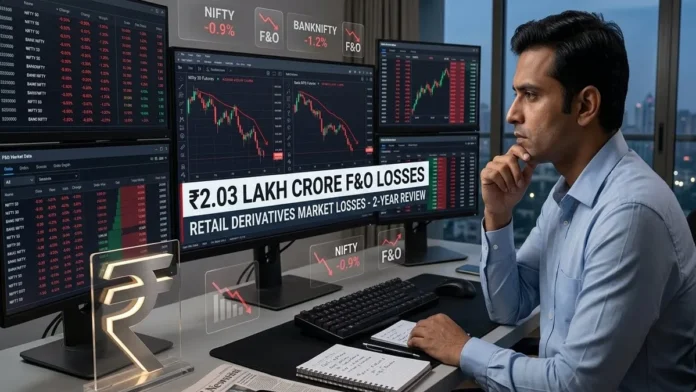
F&O traders losses in India have reached about ₹2.03 lakh crore over the past two financial years, highlighting the enormous risks individual investors face in the country’s fast-moving equity derivatives market as millions of participants step away from futures and options trading.
The latest regulatory assessment of individual participation in equity derivatives shows that losses among retail traders remain substantial despite measures aimed at reducing excessive speculation.
The findings are particularly significant because India has developed one of the world’s most active derivatives markets, with options trading attracting a large number of individual investors in recent years.
However, the scale of losses has repeatedly raised concerns about whether inexperienced traders fully understand the financial risks associated with leveraged and short-duration derivative products.
₹2.03 Lakh Crore Lost Over Two Years
Individual traders collectively recorded losses of around ₹2.03 lakh crore across the latest two financial years covered by the assessment.
The figure represents aggregate losses rather than the amount lost by every trader.
That distinction is important because individual outcomes vary significantly. Some participants make profits, while a much larger group can suffer losses after trading costs and other expenses are considered.
Nevertheless, the overall figure illustrates the scale of money moving through India’s derivatives ecosystem and the financial consequences for retail participants.
Millions of Traders Step Away From F&O Market
Another major development is the decline in the number of individual derivatives traders.
Participation fell significantly during the latest financial year, indicating that tighter regulations, repeated losses and greater awareness of derivatives risks may be changing investor behavior.
Around 46 lakh previous participants did not return to the market during the period under review.
The decline is notable because India’s F&O market had experienced explosive growth in retail participation in previous years.
Easy access through smartphone trading platforms, relatively small upfront amounts for some options trades and the attraction of potentially rapid profits helped draw millions of individuals into derivatives.
The same characteristics, however, can expose inexperienced participants to rapid losses.
Why F&O Trading Can Become So Risky
Futures and options are fundamentally different from simply buying shares and holding them for the long term.
Derivative contracts derive their value from an underlying asset or index and often involve leverage, time-sensitive pricing and rapid changes in value.
Options can be particularly challenging because their prices depend on several variables, including the movement of the underlying asset, volatility and the amount of time remaining before expiry.
A trader can therefore correctly predict the general direction of a stock or index and still lose money if the timing or structure of the trade is wrong.
Short-duration contracts can amplify these risks because their values can change dramatically within minutes.
Small Trades Can Turn Into Large Losses
Leverage is another major reason derivatives require careful risk management.
It allows traders to take market exposure that can be much larger than the amount initially committed.
That can increase potential returns when a trade moves in the expected direction, but it can also magnify losses when the market moves against the position.
Repeated short-term trading can create another problem.
Brokerage charges, taxes and other transaction costs may appear small on an individual trade but can become substantial when someone trades frequently.
Therefore, gross trading performance does not necessarily reflect the amount a trader ultimately earns or loses.
Why Regulators Have Tightened F&O Rules
India’s market regulator has introduced a series of measures aimed at reducing excessive speculation and improving investor protection in equity derivatives.
Regulatory attention has focused particularly on index derivatives and short-duration contracts, where retail participation became exceptionally high.
Measures have included changes involving contract sizes, expiry structures and trading requirements.
The objective has been to reduce excessive speculative activity without eliminating legitimate derivatives use by investors and institutions for hedging and risk management.
The decline in individual participation suggests those interventions are beginning to reshape the market.
Derivatives Are Not the Same as Long-Term Investing
The findings also underline an important distinction for retail investors.
Buying diversified investments for long-term wealth creation is fundamentally different from repeatedly taking leveraged short-term positions in derivatives.
Futures and options are legitimate financial instruments and are widely used by professional investors to manage risk.
But they can be highly complex.
Traders need to understand not only market direction but also leverage, volatility, liquidity, contract expiry, position sizing and the possibility of losing substantial amounts of capital.
What Retail Investors Should Learn From the Numbers
The ₹2.03 lakh crore aggregate loss figure does not mean derivatives should never be used.
Instead, it highlights the importance of understanding the product before trading it.
Investors considering F&O should assess whether they can financially withstand losses, understand how the contract works and avoid using money needed for essential expenses or financial goals.
Risk management is especially important when leverage is involved.
Promises of guaranteed profits, fixed daily returns or supposedly foolproof trading strategies should also be treated with extreme caution.
No legitimate market strategy can guarantee profits from derivatives trading.
India’s F&O Boom Enters a New Phase
India’s derivatives market is now entering a potentially important transition.
Retail participation expanded dramatically during the previous phase of the market’s growth. Regulators are now attempting to ensure that rapid trading activity does not translate into widespread financial harm among individual investors.
The latest participation decline suggests that the balance may already be shifting.
Whether retail traders continue moving away from high-frequency derivatives activity — or eventually return as market conditions change — will be closely watched by brokers, exchanges, regulators and investors.
For individual traders, however, the central message remains straightforward: the possibility of rapid profits in F&O comes with an equally real possibility of rapid and substantial losses.