Dateline: Beijing, China — August 20, 2026
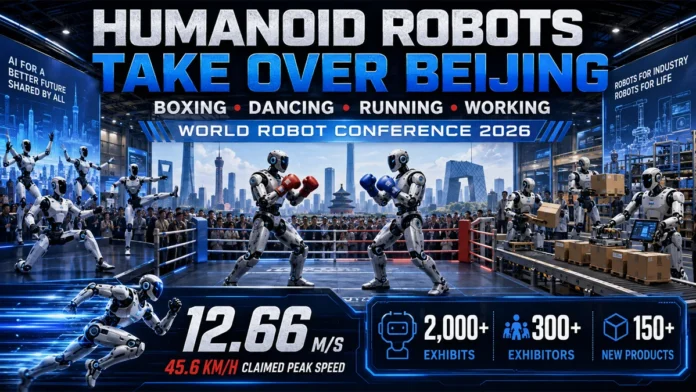
World Robot Conference 2026 has turned Beijing into a showcase for the rapidly advancing humanoid-robot industry, with machines boxing, dancing, performing martial-arts-style movements and demonstrating increasingly sophisticated workplace skills before large crowds.
The five-day event opened on August 19 and runs through August 23 at the Beiren Etrong International Exhibition & Convention Center in Beijing’s Economic-Technological Development Area. Official organizers say more than 300 exhibitors, over 2,000 exhibits and more than 150 new product launches are expected during this year’s conference.
Humanoid robots are once again among the biggest attractions, but this year’s conference is also putting greater emphasis on whether the machines can move beyond eye-catching demonstrations and perform useful jobs in factories, logistics centers, retail, healthcare and homes.
Humanoid Robot Boxing Draws Huge Crowds
One of the most attention-grabbing demonstrations comes from Chinese robotics company Unitree, whose humanoid machines have been showcasing combat-style movement.
Unitree’s official G1 boxing system is designed to perform straight punches, hooks and front kicks using motion-capture training and sophisticated balance-control systems. The company says the robot can recover after heavy external impacts and can be controlled through motion sensing, a controller or voice commands.
Videos of combat demonstrations have spread rapidly across social media, reinforcing the impression that humanoid robots are developing much more natural and coordinated body movement.
Some viral clips circulating online have been described as robots wrestling or sparring with people. However, the best-documented official Unitree combat demonstrations center on robot boxing and controlled interactive demonstrations, so viral footage should be identified carefully before being presented as a formal human-versus-robot match.
Dancing Robots Show How Fast Motion Control Is Improving
Combat is not the only spectacle.
Humanoid robots at the conference are also demonstrating dance routines, coordinated movement and other entertainment-focused skills.
Unitree has increasingly used public performances to demonstrate its motion-control technology. The company says its humanoid robots have previously completed autonomous group martial-arts routines and other complex synchronized movements.
Such displays may look like entertainment, but they test engineering challenges that also matter in practical applications.
A robot that can maintain balance during a kick, rapid turn or dance sequence is developing capabilities that could eventually help it navigate factories, stairs, uneven terrain and unpredictable human environments.
WRC 2026 Features More Than 2,000 Exhibits
Official conference material describes the 2026 edition as significantly larger than previous events.
The World Robot Expo is expected to feature:
- more than 300 exhibitors;
- over 2,000 exhibits;
- more than 150 products making their debut;
- more than 60 parallel robotics events; and
- thousands of competitors in the accompanying World Robot Contest.
The exhibition is divided into four major zones focusing on robot innovation, integration, manufacturing and entertainment.
Applications range from factory automation and warehouse logistics to healthcare, eldercare, catering, retail and emergency response.
Are There Really No Foreign Participants?
One claim circulating around the event requires clarification.
While some reports have described the exhibition floor as overwhelmingly or entirely Chinese, official World Robot Conference material emphasizes substantial international participation at the broader event.
Organizers say international guests make up roughly 30% of participants in the main forum, while nearly 30 international organizations are supporting the conference. Official materials also say Chinese and foreign component manufacturers are participating in the exhibition ecosystem.
The guest list includes robotics and engineering experts from the United States, Germany, the United Kingdom, Canada, the United Arab Emirates and other countries.
It is therefore safer to describe WRC 2026 as heavily dominated by Chinese robotics companies while retaining international guests, organizations and technology participants, rather than simply saying no foreign presence exists.
Unitree’s New ‘Superman’ Robot Adds to the Buzz
The conference comes days after Unitree unveiled a new high-speed humanoid prototype nicknamed “Superman.”
The robot has been reported with a peak running speed of 12.66 meters per second, equivalent to roughly 45.6 km/h, along with the ability to make a standing jump of around 2 meters.
That performance has led to comparisons with elite human athletes, including Usain Bolt.
But such comparisons need context.
A robot reaching a brief mechanical peak speed is not the same as a human athlete completing a regulated 100-meter race under competition conditions. The demonstration is better viewed as evidence of rapid progress in motors, power systems, control algorithms and balance.
Has Unitree Really Built 18,000 Humanoid Robots?
Unitree has rapidly expanded production across its humanoid lineup.
Current industry information puts cumulative production and deliveries across its bipedal humanoid models at around 18,000 units by July 2026.
The company currently markets several humanoid platforms, including the G1, H1, H2 and R1, aimed at research, education and emerging commercial uses. Unitree’s official product catalog shows the G1 starting around $13,500, the R1 from about $4,900 and the H2 at around $29,900 before shipping and taxes.
The important question now is not simply how many robots companies can build, but how many can perform commercially valuable work reliably.
China Wants Robots to Move Beyond Stage Performances
This is the deeper theme running through World Robot Conference 2026.
Robot companies have become extremely good at creating viral demonstrations.
Humanoids can:
run,
dance,
kick,
box,
perform coordinated routines,
pick up objects, and
respond to voice commands.
But useful commercial deployment requires something harder: robots must repeat tasks accurately for hours, work safely around humans, operate with limited supervision and provide an economic return compared with conventional machines or human labor.
That is why the conference includes demonstrations involving manufacturing, logistics, household services and retail alongside the more spectacular boxing and dancing displays.
Why China Is Investing So Heavily in Humanoid Robots
Humanoid robotics has become a strategic technology sector for China.
The country has advantages in electronics manufacturing, electric motors, batteries, sensors, supply chains and large-scale industrial production.
These are many of the same capabilities that helped Chinese companies become major players in electric vehicles and consumer electronics.
Humanoid robots could eventually be deployed in industries facing labor shortages or repetitive and dangerous tasks.
Manufacturing is one of the most obvious possibilities.
A robot capable of navigating spaces built for humans could potentially perform jobs without requiring factories to redesign every workstation around conventional fixed automation.
US Restrictions Add a Geopolitical Dimension
The Beijing conference is also unfolding against intensifying technology competition between China and the United States.
On July 28, 2026, the U.S. Federal Communications Commission added foreign-produced advanced robotic devices and power inverters to its Covered List following national-security assessments.
The restrictions affect new foreign-produced models requiring FCC equipment authorization, including categories such as humanoid and quadruped robots.
Previously authorized products are treated differently, and exemptions can be possible through conditional government approval.
The FCC’s concern centers on risks involving data collection, remote control, cybersecurity and critical infrastructure.
That makes robotics increasingly part of the wider U.S.-China technology rivalry rather than simply an industrial competition.
Official FCC Covered List:
https://www.fcc.gov/supplychain/coveredlist
Robot Vacuums and Robot Dogs Can Also Be Affected
The U.S. framework is broader than humanoid robots alone.
Depending on their design, connectivity, sensors and other technical characteristics, the definition of advanced robotic devices can extend to quadruped robot dogs and other autonomous mobile machines.
That demonstrates how robotics policy is becoming intertwined with cybersecurity.
Modern robots are essentially mobile computers equipped with cameras, microphones, sensors, wireless connections and AI software.
The same capabilities that make them useful can also raise questions about who controls their data and software.
Boxing Robot Is More Than Just Entertainment
The Unitree boxing demonstration provides a useful example of where humanoid technology currently stands.
Throwing a punch requires much more than simply moving an arm.
The robot must simultaneously calculate:
body position,
foot placement,
balance,
joint torque,
movement timing, and
recovery from impact.
If the robot is pushed or struck, the control system must rapidly compensate to prevent a fall.
These are exactly the kinds of engineering problems that must be solved before humanoids can safely operate alongside people in factories and homes.
What Comes After Viral Robot Videos?
The next major phase of the industry will likely be less visually dramatic but more economically important.
Robot makers need to demonstrate that their machines can work for long periods without frequent human intervention.
Battery life remains a major limitation.
So does dexterity.
Picking up a box in a controlled demonstration is relatively easy. Handling hundreds of differently shaped objects in a busy warehouse without mistakes is far harder.
The same applies to household robots, where environments are unpredictable and filled with delicate objects, pets and people.
World Robot Conference 2026: The Bigger Picture
The World Robot Conference 2026 is showing two versions of the robotics future at the same time.
One is spectacular: humanoids boxing, dancing and running at extraordinary speeds.
The other is practical: machines packing products, assisting workers and attempting ordinary household or commercial tasks.
The second may ultimately matter much more.
China’s robotics companies have already demonstrated impressive mechanical capabilities. The next competition will be over intelligence, reliability, cost and real-world usefulness.
If companies can combine advanced AI with the increasingly impressive bodies being demonstrated in Beijing, humanoid robots could move from technology exhibitions into workplaces and everyday environments far faster than many expected.
For now, however, WRC 2026 remains a glimpse of both the enormous promise — and the remaining limitations — of a technology racing toward commercialization.
Official Links
World Robot Conference 2026:
https://www.worldrobotconference.com/en
Beijing Government — WRC 2026 Event Information:
https://english.beijing.gov.cn/beijinginfo/sci/event/
Unitree Robotics:
https://www.unitree.com/
Unitree G1 Boxing:
https://www.unitree.com/boxing/
FCC Covered List:
https://www.fcc.gov/supplychain/coveredlist