Bengaluru, India — August 20, 2026
Ather Konarc Launch is shaping up to be one of the most closely watched electric two-wheeler debuts of 2026, as Ather Energy prepares to unveil its first production scooter based on the new EL platform at Ather Community Day on August 29.
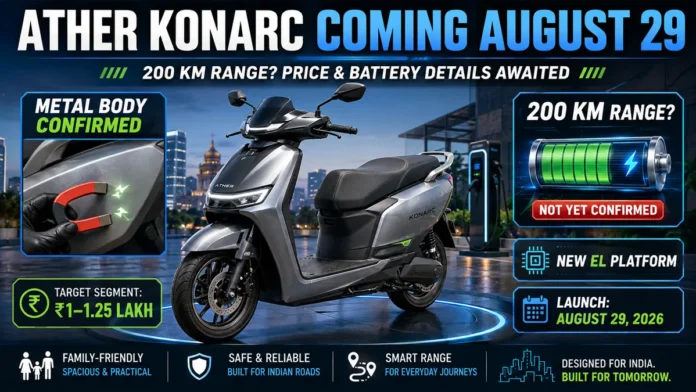
The latest teaser has added another important detail: the upcoming family-focused electric scooter will use metal body panels, a move that could give the Konarc a stronger, more substantial feel than many scooters relying heavily on plastic exterior panels.
But several of the specifications generating the most excitement — including a claimed 200 km range, as many as six variants, a new battery family and a possible Battery-as-a-Service option — have not yet been officially confirmed by Ather.
That makes the nine days before launch particularly interesting.
Ather itself has officially confirmed that its first production scooter based on the all-new EL architecture will be unveiled on August 29, 2026, describing the platform as its first entirely new vehicle architecture since the 450.
Ather Konarc Metal Body Confirmed in New Teaser
One of the clearest clues about the upcoming scooter comes from a teaser featuring Ather co-founder and CEO Tarun Mehta.
The video shows magnets sticking to sections of the scooter’s exterior, strongly confirming the use of metal body panels.
What remains unclear is whether the entire exterior body will use metal or whether Ather has chosen metal only for specific sections.
That difference matters.
Using metal selectively could allow Ather to improve durability and perceived quality without adding unnecessary weight across the entire scooter.
The approach could also help distinguish the Konarc in a crowded electric scooter market where build quality, panel durability and long-term ownership experience are increasingly important purchase considerations.
Will the Metal Body Make Ather Konarc Heavier?
Potentially, but the answer will depend on how extensively Ather uses metal.
Metal panels generally weigh more than comparable plastic or fiber components, which could increase the scooter’s overall kerb weight.
For a family-oriented scooter, Ather will need to balance durability with easy maneuverability, especially for riders using the vehicle in congested urban conditions.
That makes the production Konarc’s final weight another important specification to watch at the August 29 reveal.
The underlying EL architecture has itself been developed with manufacturing efficiency, scalability and cost optimization in mind.
Ather’s FY2025-26 annual report says the EL platform includes a steel frame, enclosed gearbox, multiple wheel options, onboard charger and the company’s Advanced Electronic Braking System, or AEBS.
Konarc Will Be Ather’s First Production Scooter on New EL Platform
The Konarc represents more than another model in Ather’s lineup.
It will be the first production vehicle developed on the company’s new-generation EL platform.
Ather says the architecture has been engineered for greater versatility and scalability and will underpin a new family of products.
That could make the Konarc strategically important for the company.
Ather currently has two principal scooter families: the performance-oriented 450 series and the comfort-focused Rizta.
The EL platform is intended to help the company address a considerably larger portion of India’s scooter market.
Will Ather Konarc Really Offer 200 Km Range?
This is currently the biggest unanswered question.
Pre-launch reports have suggested multiple possible range configurations, with figures of roughly 100 km, 125 km, 160 km and as much as 200 km IDC appearing in unofficial information.
However, Ather has not officially confirmed a 200 km Konarc variant.
That distinction is important.
If Ather does offer an IDC-certified range close to 200 km, it would place the Konarc above the maximum claimed range of several existing mass-market scooters and could become one of its strongest selling points.
But buyers should not treat the 200 km figure as final until Ather publishes the homologated specifications on August 29.
Real-world riding range would also normally be lower than an IDC laboratory figure and would depend on speed, riding mode, load, traffic, terrain and weather.
New Battery Options Expected, but Ather Has Not Confirmed Details
The battery configuration is similarly under wraps.
Unofficial pre-launch information points toward multiple battery capacities that could allow Ather to offer the Konarc at different price and range levels.
There has also been speculation about a new battery family associated with the scooter.
None of those capacity figures has yet been officially announced.
A multi-battery strategy would nevertheless make commercial sense.
A smaller battery could deliver a lower starting price for city commuters, while larger packs could target customers prioritizing range.
It would also allow Ather to compete across a wider pricing band with a single platform.
Could Konarc Get Six Variants?
Reports have also suggested that Ather could offer as many as six Konarc variants, potentially divided across different trim and battery combinations.
Again, that information remains unofficial.
Ather’s existing approach to the 450 and Rizta families demonstrates that the company is comfortable offering multiple variants with different software, battery and equipment combinations.
Whether the Konarc follows an even broader strategy will become clear at launch.
What About Battery-as-a-Service?
A Battery-as-a-Service, or BaaS, option is another feature being discussed ahead of the launch.
Under such a structure, the cost of the battery can be separated from the scooter’s initial purchase price, potentially allowing a significantly lower upfront price in exchange for recurring battery-related payments.
But Ather has not officially announced BaaS for Konarc.
Until it does, buyers should regard it as a possibility rather than a confirmed feature.
This is especially relevant because a lower headline price enabled by BaaS would not be directly comparable with the conventional full-purchase price of another scooter.
The total cost of ownership would depend on subscription fees, usage terms and the period of ownership.
How Much Could Ather Konarc Cost?
This is where Ather’s own corporate disclosures provide a useful clue.
While some pre-launch estimates have suggested that the Konarc could start near ₹90,000 to ₹1 lakh, Ather’s FY2025-26 annual report says the broader EL platform is targeted at the ₹1 lakh-₹1.25 lakh price segment, where the company estimates roughly half of India’s scooter volumes are concentrated.
That official positioning suggests a conventional purchase price somewhere around this band may be more realistic, depending on variant and battery size.
A lower entry price could still be possible if Ather introduces a smaller battery, financing structure or BaaS-style model.
But the final ex-showroom pricing will only be known at launch.
Ather Is Targeting the Heart of India’s Scooter Market
The pricing strategy is important because Ather wants the EL platform to address a much larger customer base.
India’s electric scooter market has expanded well beyond early adopters.
Buyers increasingly compare EVs not only on performance and technology but also on:
- purchase price,
- family practicality,
- storage,
- seat comfort,
- real-world range,
- charging convenience,
- reliability,
- service costs, and
- resale confidence.
The Konarc therefore appears likely to prioritize mainstream usability rather than the overtly sporty personality associated with Ather’s 450 range.
Which Scooters Could Ather Konarc Compete With?
Depending on its final price and specifications, the Konarc could enter direct competition with some of India’s most established family-oriented electric scooters.
Potential rivals include the TVS iQube, Bajaj Chetak, Hero Vida models and other mass-market electric scooters.
The Bajaj Chetak comparison may be particularly interesting because metal bodywork has become one of the Chetak’s recognizable selling points.
If Ather combines similar build solidity with its software ecosystem, charging network and competitive pricing, the Konarc could give mainstream EV shoppers another compelling option.
Why the EL Platform Is Important for Ather
The Konarc’s significance extends beyond sales of one scooter.
Ather describes EL as a new architecture capable of supporting future models and helping it enter market segments where it currently has limited presence.
The company has also completed homologation work and has been conducting high-volume production trials.
Ather’s August investor presentation said production was expected to begin at Hosur during Q2 FY27, with manufacturing capacity intended to scale significantly as the new platform expands.
Its larger Factory 3.0 project at AURIC in Chhatrapati Sambhajinagar is also intended to support the company’s future growth.
What Is Officially Confirmed About Ather Konarc?
Ahead of the August 29 unveiling, separating confirmed information from leaks is essential.
Confirmed or officially established:
- Ather will unveil its first production EL-platform scooter on August 29, 2026.
- It will be based on Ather’s new-generation EL architecture.
- The platform has been engineered for scalability, versatility and manufacturing efficiency.
- EL includes a steel frame, onboard charging architecture, enclosed gearbox and other engineering changes.
- Ather is targeting the broader ₹1 lakh-₹1.25 lakh scooter segment with the EL platform.
- Recent teaser material indicates the Konarc will use metal exterior panels.
Still unconfirmed ahead of launch:
- 200 km IDC range.
- Exact battery capacities.
- Six-variant lineup.
- S and Q trim structure.
- Battery-as-a-Service.
- Exact starting price.
- Whether every exterior body panel is metal.
When Will Ather Konarc Launch?
Ather will unveil its new EL-based production scooter at Ather Community Day 2026 on August 29 in Bengaluru.
The event should finally answer the biggest questions around battery capacity, certified range, features, variants and pricing.
Ather has called the EL vehicle an important part of its next phase of growth and says it is intended to serve a significantly larger customer base than the company’s existing portfolio currently reaches.
Ather Konarc Launch: What Buyers Should Watch on August 29
Five details could determine whether the Konarc becomes a major success:
1. Real battery options: Battery size will determine both range and pricing.
2. Certified range: A confirmed 200 km variant would dramatically strengthen the scooter’s positioning.
3. Starting price: The ₹1 lakh region is intensely competitive.
4. Kerb weight: Metal panels could improve durability but must not compromise everyday usability.
5. Ownership model: Any BaaS or innovative financing program could substantially change the effective entry price.
The Bottom Line
The Ather Konarc Launch could be one of Ather Energy’s most important product introductions yet.
Metal body panels have already given the upcoming scooter a clear talking point, while its new EL architecture signals a move toward higher volumes and broader family appeal.
But the headline-grabbing 200 km range and sub-₹1 lakh pricing remain unconfirmed.
Ather’s own disclosures instead indicate that the EL platform is aimed broadly at India’s ₹1 lakh-₹1.25 lakh scooter segment.
That makes August 29 the key date.
If Ather can combine strong range, durable construction, family practicality and aggressive pricing, the Konarc could become one of the company’s most consequential products in India’s rapidly expanding electric scooter market.
Official Ather Links
Ather Energy:
https://www.atherenergy.com/
Ather Investor Relations / Official Media:
https://media.atherenergy.com/