Dateline: New Delhi, India — August 20, 2026
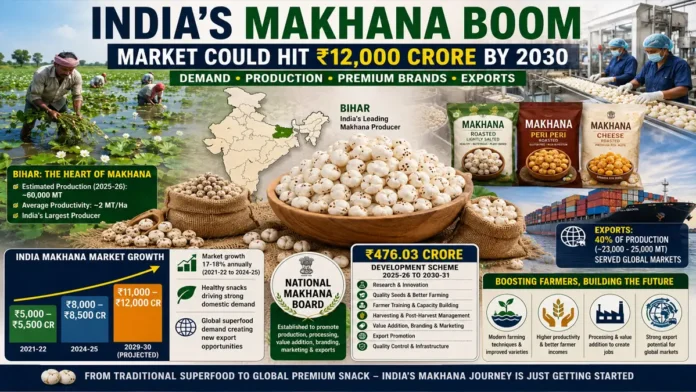
India Makhana Market is emerging as one of the fastest-growing segments of the country’s premium food and agricultural economy, with the domestic fox nut industry projected to reach ₹11,000 crore to ₹12,000 crore by 2029-30 as demand for healthy snacks, premium branding and exports continues to rise.
An official APEDA market dashboard estimates that India’s makhana market, valued at roughly ₹5,000 crore to ₹5,500 crore in 2021-22, expanded to about ₹8,000 crore to ₹8,500 crore by 2024-25. The market registered annual growth of around 17% to 18% during this period and could climb to ₹11,000-12,000 crore by the end of the decade.
The growth story is particularly striking because production volumes have increased far more slowly than market value. According to the official assessment, output grew only around 4% to 5% between FY2021-22 and FY2024-25, indicating that much of the sector’s rapid expansion has been driven by higher prices, growing consumer demand and premiumization.
Why Is India’s Makhana Market Growing So Fast?
Once viewed largely as a traditional food consumed during fasting and religious occasions, makhana — also known internationally as fox nut or gorgon nut — has increasingly moved into the mainstream healthy-snack category.
Consumers are seeking foods perceived as lighter alternatives to fried snacks, while branded food companies are introducing flavored, roasted and ready-to-eat makhana products across supermarkets, e-commerce platforms and quick-commerce channels.
The transition has helped transform makhana from a largely regional agricultural commodity into a premium packaged-food category.
Growing health awareness, clean-label food preferences and demand for plant-based snacks have further strengthened the market.
Makhana Prices Have Risen Sharply
One of the biggest drivers of the sector’s value growth has been the increase in makhana prices.
APEDA’s assessment points to strong price appreciation alongside limited growth in production. The combination of supply constraints and rising demand has helped keep prices firm.
Premium branding has also changed the economics of the product.
Instead of being sold primarily as a loose commodity, makhana is now increasingly marketed in branded packets with flavoring, grading, improved packaging and nutritional positioning.
That allows premium-quality products to command considerably higher retail prices.
Production Expected to Increase in 2025-26
India produced around 63,910 metric tons of makhana in 2024-25, with average productivity estimated at about 2.03 metric tons per hectare, according to the government data provided for the sector.
Under the second advance estimate for 2025-26, production is projected to increase to around 80,590 metric tons, while productivity could rise to approximately 2.34 metric tons per hectare.
If achieved, the improvement would mark an important increase in supply at a time when both domestic and overseas demand are strengthening.
Higher yields will be particularly important because market expansion cannot continue to rely primarily on rising prices.
Bihar Remains the Heart of India’s Makhana Industry
Bihar is by far the most important makhana-producing state in India.
Production in the state is estimated at around 60,000 metric tons in 2025-26, making Bihar the dominant contributor to national supply.
Makhana cultivation is particularly concentrated in the Mithilanchal region, where ponds, wetlands and traditional knowledge have supported production for generations.
The geographical concentration of cultivation, however, has historically limited how quickly national output can expand.
APEDA has identified this supply concentration as one of the sector’s main challenges and an important reason productivity improvements and better water management will be crucial for future growth.
Modern Farming Techniques Could Transform Production
Makhana has traditionally been cultivated in ponds and other water bodies, requiring specialized skills and labor-intensive harvesting.
That system is gradually changing.
The adoption of field-system cultivation is allowing makhana to be grown under more controlled agricultural conditions and can reduce some of the risks associated with traditional pond farming.
Improved varieties such as Swarn Vaidehi and Sabour Makhana-1 are also being promoted to increase productivity.
The government’s strategy now focuses on expanding cultivation into traditional as well as non-traditional areas while improving seed quality and farming techniques.
National Makhana Board Becomes Central to Growth Strategy
Recognizing the crop’s growing economic potential, the central government announced the establishment of a National Makhana Board in Bihar in the Union Budget 2025-26.
The Budget said the board would support improvements in production, processing, value addition and marketing, while organizing people involved in the sector into Farmer Producer Organizations and helping farmers gain access to relevant government schemes.
The board was formally launched in Bihar on September 15, 2025. Its first meeting was subsequently held at Krishi Bhawan in New Delhi in December 2025.
This institutional support is intended to modernize what has traditionally been a fragmented agricultural value chain.
Government Backs Sector With ₹476.03 Crore Scheme
The government has approved a ₹476.03 crore Central Sector Scheme for Development of Makhana covering the period from 2025-26 to 2030-31.
The program focuses on:
- research and innovation;
- production of quality seeds;
- farmer capacity building;
- improved harvesting methods;
- better post-harvest management;
- value addition;
- branding and marketing;
- export promotion; and
- stronger quality-control systems.
The government also plans to strengthen infrastructure for grading, drying, popping and packaging — processes that can substantially affect the final quality and market value of fox nuts.
Better Seeds and Farmer Training Could Raise Yields
A major priority of the National Makhana Board is making high-quality planting material available to farmers.
The government has said seed requirements from states will be consolidated, with institutions including agricultural universities and specialist research centers supporting production and training.
Training programs are also expected to extend modern cultivation techniques beyond traditional production zones.
Higher productivity is critical because the sector faces a structural challenge: demand has grown much faster than physical supply.
Unless cultivation expands and yields improve, rising demand could continue to translate into high consumer prices rather than significantly larger volumes.
Why Global Demand for Makhana Is Growing
Internationally, makhana is increasingly being marketed as a premium plant-based snack.
The broader global movement toward clean-label foods, vegetarian diets and less heavily processed snacking products has created opportunities for Indian exporters.
Makhana can be sold plain, roasted, flavored or processed into ingredients such as flour and powder.
India’s 2025 Finance Bill also created specific tariff classifications for popped makhana, makhana flour and powder, and other makhana products, helping establish clearer trade identification for the category.
This could support more organized trade as export volumes increase.
Exports Could Become the Next Major Growth Engine
India already supplies makhana to overseas consumers, but industry planners see considerable potential for further expansion.
The United States, Middle East, United Kingdom, Canada and other health-food markets are increasingly important destinations for Indian fox nuts.
As international awareness grows, exporters have an opportunity to move away from commodity sales and toward branded premium products.
That could generate greater value even without dramatic increases in export tonnage.
However, success will depend on consistent quality, food-safety standards, traceability, professional packaging and reliable supply.
Domestic Demand Remains the Sector’s Biggest Strength
Exports are important, but India’s domestic market remains the foundation of the makhana growth story.
APEDA’s dashboard says domestic demand has helped insulate the sector from fluctuations in export markets, contributing to the 17-18% annual market growth recorded between 2021-22 and 2024-25.
That gives makhana producers an advantage over agricultural commodities that depend heavily on overseas buyers.
Even if international conditions weaken temporarily, domestic consumers can continue supporting demand.
Premiumization Is Changing the Makhana Business
A major structural change is the rise of branded makhana.
Traditional supply chains often involved raw makhana moving through multiple intermediaries before reaching consumers.
Modern food companies are adding value through sorting, flavoring, roasting, packaging and brand positioning.
Popular varieties now range from traditional salted makhana to cheese, peri-peri, mint and other flavored options.
This shift increases the potential value generated from each kilogram of raw produce.
As processing capacity expands, a larger share of that value could potentially remain within producing regions.
Can Makhana Become India’s Next Global Superfood?
India has several advantages.
It already possesses a dominant production base, generations of cultivation expertise, the Mithila Makhana geographical indication, a rapidly expanding domestic consumer market and growing institutional support.
The government has described makhana as a product with growing global recognition as a superfood and sees international markets as an important future opportunity.
But achieving that ambition will require more than higher production.
The sector will need globally competitive processing, standardized quality, export-ready packaging, traceability, branding and reliable year-round supply.
What Could Drive the Market to ₹12,000 Crore?
Four factors are likely to determine whether the India Makhana Market reaches the projected ₹11,000-12,000 crore size by 2029-30.
First, production must rise. Expanding cultivation and improving productivity will be necessary to meet growing consumption without excessive price inflation.
Second, processing must modernize. Better popping, grading, drying and packaging can increase quality and reduce wastage.
Third, premium brands will remain important. Consumers are increasingly willing to pay for convenient, hygienically packaged and flavored healthy snacks.
Fourth, exports could provide the next major layer of growth. Positioning Indian makhana as a premium global snack could expand revenue far beyond the domestic market.
Bihar Farmers Could Be Among the Biggest Beneficiaries
Because Bihar dominates national makhana production, the state stands to gain disproportionately from the sector’s expansion.
Improved seeds and yields could increase farm output, while local processing facilities could create additional employment beyond cultivation.
Grading, popping, flavoring, packaging, logistics and export processing can all generate economic activity in production clusters.
The National Makhana Board is therefore not only a food-market initiative but also a rural value-chain development program.
The Bigger Picture
The India Makhana Market is undergoing a transition from a traditional regional crop to a modern premium food industry.
Its next phase will depend less on price increases alone and more on expanding production, improving productivity, building processing capacity and creating stronger brands.
The projected ₹11,000-12,000 crore market by 2029-30 demonstrates the scale of the opportunity.
With the National Makhana Board now in place and a ₹476.03 crore development program extending through 2030-31, India is attempting to build an integrated value chain capable of supporting farmers at home while turning fox nuts into a much larger export-oriented food category.