New Delhi, India — August 20, 2026
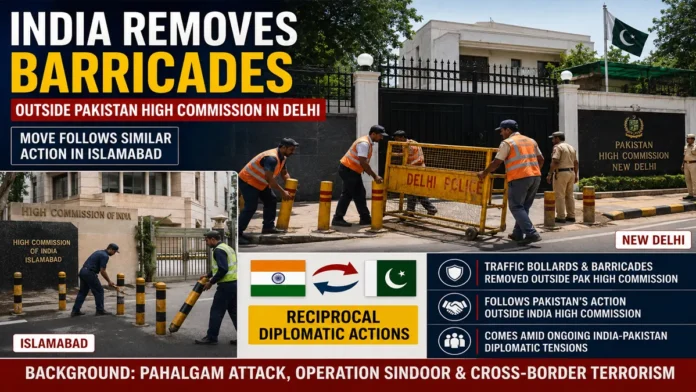
Pakistan High Commission Delhi Security arrangements have undergone a noticeable change after authorities removed traffic bollards, queue barriers and other structures positioned outside the diplomatic mission in New Delhi, days after Pakistan took a similar step outside the Indian High Commission in Islamabad.
The structures had long formed part of the outer security arrangement around the Pakistan High Commission. Their removal comes at a sensitive moment in India-Pakistan relations, which remain strained following last year’s Pahalgam terrorist attack, Operation Sindoor and a series of diplomatic measures taken by both sides.
The timing has led the move to be widely viewed as reciprocal. However, it is important to distinguish that interpretation from an officially announced reduction in diplomatic security. There has been no indication that India has withdrawn the core protection required for the Pakistani diplomatic mission.
What Changed Outside the Pakistan High Commission in Delhi?
Authorities removed traffic bollards, barricades and other roadside structures installed outside the Pakistan High Commission compound in New Delhi.
Some of these structures were positioned beyond the mission’s approved compound boundary and had been used to regulate vehicles, visitors and movement around the diplomatic premises.
The action does not mean that security at the mission has ended. Diplomatic premises continue to receive protection under established security arrangements.
Instead, the visible outer perimeter around the mission has been altered.
Why Is the Timing Significant?
The Delhi action followed a similar development in Islamabad, where Pakistani authorities recently removed parking poles and security-related barriers outside the Indian High Commission.
That sequence has fueled speculation that New Delhi’s action was a reciprocal response.
India and Pakistan have a long history of mirroring administrative and diplomatic decisions during periods of strained relations.
Such measures have previously included reducing diplomatic staff, restricting the movement of officials, withdrawing specific facilities and imposing tighter rules around missions.
For that reason, even a seemingly minor change involving roadside structures can acquire diplomatic significance.
India-Pakistan Diplomatic Relations Remain Strained
Relations between the two neighbors have remained under considerable pressure, with cross-border terrorism continuing to be one of New Delhi’s central security concerns.
The relationship deteriorated sharply following the April 22, 2025 terrorist attack in Pahalgam, Jammu and Kashmir, in which 26 people were killed.
India responded with a series of diplomatic measures, including reducing the strength of the two countries’ high commissions. The government also suspended the Indus Waters Treaty and announced restrictions affecting Pakistani nationals.
The crisis subsequently escalated into Operation Sindoor.
Pahalgam Attack Changed the India-Pakistan Equation
The Pahalgam attack became one of the most consequential security incidents in India-Pakistan relations in recent years.
Twenty-six people were killed in the attack on April 22, 2025. India said the assault was linked to Pakistan-backed terrorism and subsequently took diplomatic and military measures.
The attack was followed by a sharp deterioration in bilateral engagement.
India’s Cabinet Committee on Security announced several steps, including reducing the overall strength of the high commissions from 55 personnel to 30 and declaring Pakistani defense, military, naval and air advisers persona non grata.
Those decisions significantly narrowed an already limited diplomatic relationship.
What Was Operation Sindoor?
India launched Operation Sindoor in May 2025 in response to the Pahalgam attack.
According to the Indian government, the operation was designed to punish those responsible for terrorism and destroy infrastructure used to support cross-border attacks.
India said nine terrorist camps and related facilities were identified and targeted during the operation, including sites in Pakistan and Pakistan-administered territory.
The military confrontation further deepened the diplomatic freeze between New Delhi and Islamabad.
That history provides the wider backdrop to the latest developments outside the two high commissions.
Why Do Small Diplomatic Measures Matter?
Diplomatic relationships are often shaped by more than formal statements from governments.
Access arrangements, staffing levels, security cordons, visas, movement restrictions and facilities available to diplomatic personnel can all become indicators of the state of bilateral ties.
India and Pakistan have repeatedly used reciprocal measures when disagreements intensify.
For example, if one country places restrictions on another’s diplomatic mission, the other side may introduce a similar measure to maintain what it considers parity.
The removal of barriers outside the missions therefore carries symbolic importance even though it is a comparatively small administrative action.
Does Removing Barricades Mean Security Has Been Withdrawn?
No.
The removal of external barricades or bollards should not be interpreted as the withdrawal of all security from the Pakistan High Commission.
India has international obligations concerning the protection of foreign diplomatic missions.
The latest action relates to physical structures outside the compound and should be distinguished from police deployment, surveillance, access controls and other protective arrangements that may remain in place.
The same distinction applies to Pakistan’s earlier removal of structures outside India’s mission in Islamabad.
Kashmir Diplomacy Adds Another Layer
The development has also come amid renewed international attention on Jammu and Kashmir.
U.S. Ambassador to India Sergio Gor visited Srinagar on August 19 and described Jammu and Kashmir as an “important part of India.”
He also indicated that Washington could reconsider its current travel advisory for the Union Territory after taking into account improvements in the security environment.
His comments drew a formal diplomatic protest from Pakistan, demonstrating how sensitive Kashmir-related language remains in India-Pakistan diplomacy.
The U.S. envoy’s comments and the India-Pakistan mission developments are separate events, but together they illustrate the unusually active diplomatic environment surrounding the region.
Pakistan Faces a Changing Diplomatic Environment on Kashmir
Pakistan has historically sought international attention for its position on Kashmir, while India maintains that Jammu and Kashmir and Ladakh are integral parts of the country and rejects third-party mediation.
Gor’s comments attracted attention precisely because they were made by a senior U.S. official during a visit to Srinagar.
Pakistan subsequently summoned the senior U.S. diplomat in Islamabad to protest the statement.
For New Delhi, the comments were broadly consistent with India’s position on the Union Territory.
Could the High Commission Move Lead to Further Diplomatic Action?
There is currently no indication that the removal of barricades by itself will trigger a larger diplomatic escalation.
However, India-Pakistan relations remain vulnerable to new security incidents and reciprocal administrative actions.
Formal diplomatic engagement between the two countries remains limited, while disputes over terrorism, Kashmir and bilateral agreements continue to weigh heavily on relations.
Any further restrictions involving diplomatic personnel, visas, mission access or security arrangements would therefore be closely watched.
What Happens Next?
The immediate focus will be on whether the change outside the two diplomatic missions remains an isolated reciprocal measure or is followed by additional steps.
For now, the Pakistan High Commission Delhi Security change appears to be a limited alteration to the mission’s outer arrangements rather than a withdrawal of diplomatic protection.
Yet the timing underscores the fragile state of bilateral relations.
More than a year after the Pahalgam attack and Operation Sindoor, even relatively small administrative actions around the Indian and Pakistani high commissions continue to carry political and diplomatic weight.