NEW DELHI, August 18, 2026 —
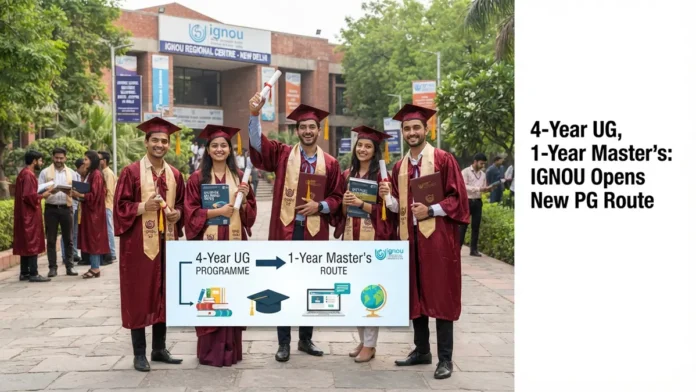
IGNOU One-Year Master’s Degree programs are opening a faster postgraduate pathway for eligible students who have completed a four-year undergraduate degree, allowing them to earn a master’s qualification in one year instead of following the conventional two-year route.
Indira Gandhi National Open University has introduced nine postgraduate pathways in 2026 across social sciences, commerce, journalism and the humanities, in line with the changing higher-education framework envisioned under the National Education Policy 2020.
The development could be particularly significant for students completing four-year undergraduate Honours or Honours with Research programs who want to continue postgraduate education without committing to another two academic years.
The University Grants Commission’s postgraduate curriculum and credit framework formally provides for a one-year postgraduate program after a four-year undergraduate degree, while students entering after a conventional three-year bachelor’s degree generally follow a two-year postgraduate structure.
Which One-Year Master’s Programs Are Being Offered?
Under the new pathway, IGNOU is offering programs covering several major disciplines.
Social Sciences
Eligible students can pursue one-year Master of Arts programs in:
- Economics
- Sociology
- History
These pathways are aimed particularly at students who have completed a four-year undergraduate Honours with Research track in the relevant academic framework.
Commerce
Students with an appropriate four-year BCom Honours background will have access to a one-year Master of Commerce, or MCom, pathway.
Journalism and Mass Communication
A one-year MA in Journalism and Mass Communication has also been included, expanding the accelerated postgraduate structure into media and communication studies.
Humanities
The humanities category includes one-year MA pathways in:
- English
- Hindi
- Sanskrit
- Urdu
Eligibility and academic tracks can differ depending on whether a candidate completed a four-year UG Honours degree or a four-year UG Honours with Research program.
Students should therefore check the specific program eligibility rules before applying rather than assuming that every four-year bachelor’s qualification automatically qualifies for every one-year master’s course.
What Has Changed for Students?
Traditionally, students completing a bachelor’s degree in India generally entered a two-year master’s program.
The newer higher-education framework creates a different academic route.
Students completing a three-year undergraduate degree may continue into a two-year postgraduate program, while eligible students who complete a four-year bachelor’s degree can move into a one-year postgraduate structure. The UGC framework specifies a 40-credit one-year postgraduate route after a four-year undergraduate qualification.
The change reflects one of the central goals of NEP 2020: creating a more flexible higher-education system with different academic pathways, multidisciplinary opportunities and multiple entry and exit options. The UGC says its undergraduate framework was designed around these principles.
Why the One-Year Master’s Option Matters
For eligible four-year UG graduates, the biggest advantage is time.
Instead of spending two additional years completing a postgraduate degree, qualifying students may be able to finish the required master’s-level curriculum in one academic year.
That can allow students to move more quickly toward research, competitive examinations, professional opportunities or further higher education.
The structure also brings postgraduate education into closer alignment with the four-year undergraduate system being expanded under NEP 2020.
However, the shorter duration does not mean that every graduate can simply choose a one-year master’s degree. Admission will depend on the candidate’s undergraduate structure, subject background, credits and the eligibility conditions laid down for the individual program.
Four-Year Undergraduate Degrees Become More Important
The development also strengthens the role of four-year undergraduate programs in India’s changing higher-education system.
UGC’s undergraduate framework gives institutions greater flexibility through multidisciplinary study, credit-based learning and multiple entry-exit arrangements, while recognizing the four-year bachelor’s degree as an important pathway for advanced postgraduate study.
IGNOU already offers four-year undergraduate programs aligned with NEP 2020, while its current prospectus covers undergraduate and postgraduate study through open and distance-learning structures.
Who Should Check Eligibility Before Applying?
Students interested in the new one-year postgraduate route should pay particular attention to:
- Whether their bachelor’s degree was a four-year UG Honours or Honours with Research program
- Whether their undergraduate discipline matches the master’s program
- Required credits and subject-specific prerequisites
- Whether the particular program is offered through Open and Distance Learning, online mode, or another approved delivery format
- Admission-cycle rules issued by IGNOU
Eligibility can differ between Economics, History, Sociology, Commerce, Journalism and language programs.
Applicants should therefore rely on the latest official IGNOU admission notification and program-specific prospectus before completing registration or paying fees.
What It Means for Higher Education in India
The move represents a broader shift away from a single fixed undergraduate-to-postgraduate route.
Under the emerging system, a student’s postgraduate duration can depend on the structure and length of the bachelor’s degree already completed.
For students graduating from four-year undergraduate programs, the IGNOU One-Year Master’s Degree pathway could reduce the overall time required to earn both undergraduate and postgraduate qualifications while preserving the credit-based academic structure established by the UGC.
As four-year undergraduate programs become more widespread, one-year master’s degrees could consequently become an increasingly important part of India’s postgraduate education landscape.