New Delhi | July 16, 2026
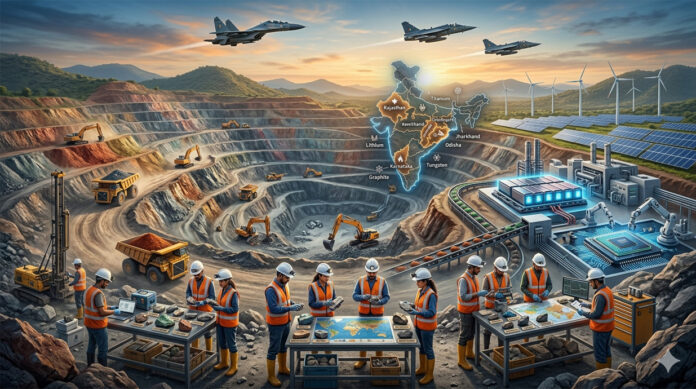
Strategic Minerals Auction India has entered a new phase as the Central Government launched the eighth round of auctions for 20 critical mineral blocks, aiming to boost domestic production, reduce import dependence, and strengthen India’s position in global supply chains. The auction covers key minerals including lithium, titanium, tungsten, rare earth elements, gallium, graphite, vanadium, molybdenum, and several other strategic resources essential for defence, clean energy, and advanced manufacturing.
The initiative comes amid increasing geopolitical competition over critical minerals and growing efforts by countries worldwide to secure reliable supplies for future technologies.
Auction Covers 20 Critical Mineral Blocks Across Nine States
The Ministry of Coal and Mines has opened bidding for 20 strategic mineral blocks located across nine Indian states.
According to the government, the auction is intended to:
- Expand domestic mineral production.
- Strengthen India’s strategic supply chain.
- Support advanced manufacturing.
- Enhance national energy security.
- Reduce reliance on imported critical minerals.
The auction marks the eighth phase of India’s critical minerals development programme.
Government Aims to Reduce Import Dependence
Launching the auction process, Union Minister for Coal and Mines G. Kishan Reddy said increasing domestic production of strategic minerals would help reduce India’s dependence on imports while strengthening the country’s role in global supply chains.
He noted that these minerals are essential for several strategic industries, including:
- Defence manufacturing
- High-technology industries
- Semiconductor production
- Renewable energy
- Electronics
- Aerospace
The government expects domestic mining to improve long-term resource security for these sectors.
Key Minerals Included in the Auction
The latest auction includes several high-value minerals that play an important role in modern industry and defence technologies.
The mineral blocks include:
- Lithium
- Titanium
- Tungsten
- Rare Earth Elements (REEs)
- Gallium
- Graphite
- Vanadium
- Molybdenum
- Phosphorite
- Potash
- Cesium
- Rubidium
Many of these minerals are considered critical because of their limited global availability and strategic importance.
Supporting India’s Defence Manufacturing
According to the government, these minerals are widely used in advanced defence systems, including:
- Fighter aircraft
- Missiles
- Submarines
- Armoured vehicles
- Radar systems
- Military communication equipment
- Night vision devices
- Defence satellites
- Stealth technologies
Officials say increased domestic availability could support indigenous defence programmes, including platforms such as the LCA Tejas, by strengthening the supply chain for essential raw materials.
Boost for Clean Energy and High-Tech Industries
Beyond defence, strategic minerals are increasingly important for India’s clean energy transition.
They are used in manufacturing:
- Electric vehicle batteries
- Renewable energy equipment
- Semiconductors
- Advanced electronics
- Energy storage systems
- Fertilizer production
The government believes greater domestic production will improve India’s competitiveness in future-oriented industries.
Reducing Supply Chain Risks
India currently imports several strategic minerals required by critical industries.
Officials say expanding domestic mining could:
- Improve supply chain resilience.
- Reduce exposure to international disruptions.
- Strengthen industrial security.
- Support long-term manufacturing growth.
- Reduce vulnerability during geopolitical crises.
The initiative also aligns with India’s broader objective of achieving greater self-reliance in strategic sectors.
China’s Dominance in Critical Minerals
The auction comes at a time when China remains a major global processor and supplier of several critical minerals, including rare earth elements, gallium, and graphite.
Governments around the world have been seeking to diversify supply chains following concerns over export restrictions and geopolitical tensions affecting access to strategic raw materials.
India’s latest auction is part of its broader effort to expand domestic resource development and strengthen long-term mineral security.
Strategic Importance of Key Minerals
Several of the minerals included in the auction serve specialized industrial applications:
- Titanium – Aircraft structures, aerospace engineering, submarines, and defence equipment.
- Tungsten – Missile systems, armour, high-temperature industrial components, and precision engineering.
- Gallium – Semiconductor manufacturing, radar systems, and electronic devices.
- Vanadium – Advanced steel alloys, batteries, and defence applications.
- Rare Earth Elements – Defence satellites, precision-guided systems, electric motors, and advanced electronics.
- Graphite – Lithium-ion batteries and clean energy technologies.
- Lithium – Electric vehicles, energy storage, and battery manufacturing.
The government expects expanded domestic mining to support both national security objectives and industrial development.
Strengthening India’s Future Industrial Strategy
Officials believe the eighth round of strategic mineral auctions represents another step toward building resilient domestic supply chains for industries that will drive future economic growth.
By expanding exploration and production, India aims to:
- Strengthen indigenous manufacturing.
- Promote advanced technologies.
- Improve energy security.
- Increase export potential.
- Build a more competitive critical minerals sector.
The auction process is expected to attract participation from domestic and international mining companies interested in developing India’s strategic mineral resources.