TEHRAN, IRAN | AUGUST 23, 2026 —
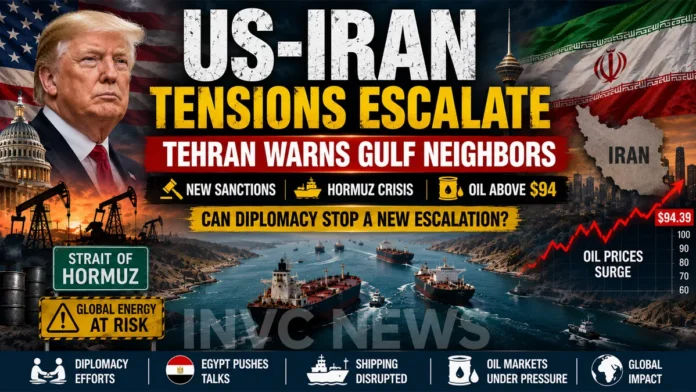
US-Iran tensions have entered another dangerous phase after Tehran warned neighboring countries against participating in Washington’s expanding economic pressure campaign, while the United States prepares another major sanctions push and diplomatic efforts intensify to revive stalled negotiations.
At the center of the confrontation is once again the Strait of Hormuz, the strategic waterway through which a significant share of global oil and liquefied natural gas supplies normally moves.
Iran’s newly appointed top security official, Mohsen Rezaei, has warned neighboring countries that cooperation with U.S. economic measures against Tehran could lead Iran to treat them as enemies and target their interests.
The warning raises the stakes considerably because Tehran is not limiting its threat to the Strait of Hormuz itself. Rezaei has suggested Iran could also target alternative oil-shipping routes used by neighboring Gulf countries if they join Washington’s economic campaign.
At the same time, Egypt is trying to bring Iran and the United States back to the negotiating table, while Iraq has secured permission for some oil tankers to pass through Hormuz.
The result is an increasingly complicated mix of economic warfare, maritime pressure, sanctions and diplomacy.
Iran Warns Gulf Neighbors Against Joining US Economic Pressure
Rezaei, secretary of Iran’s Supreme National Security Council, has delivered one of Tehran’s strongest warnings to neighboring states since taking the position.
His message was straightforward: countries surrounding Iran should not participate in what Tehran describes as America’s economic war.
Iran says states assisting Washington in tightening economic pressure could be treated as hostile actors.
The warning is particularly important for Gulf countries because Washington is attempting to isolate Iran economically while regional governments simultaneously search for ways to keep oil and trade moving.
Rezaei also indicated that Iran could retaliate against alternative energy routes outside the Strait of Hormuz.
That expands the potential economic impact well beyond a single maritime chokepoint.
Trump Administration Prepares Tougher Iran Sanctions
The warning follows President Donald Trump’s pledge to dramatically increase economic pressure on Iran.
Washington is preparing another sanctions escalation targeting Tehran’s economic lifelines and potentially the international companies and countries that continue significant commercial relationships with Iran.
U.S. Treasury Secretary Scott Bessent is scheduled to hold a press conference on Monday, August 24, after signaling what Washington has described as an exceptionally aggressive sanctions effort against Iran.
The United States has already been expanding pressure on Iranian oil exports, financial networks, shipping operations and businesses accused of assisting sanctions evasion.
Recent Treasury actions have targeted Iranian shadow-banking networks, shipping entities and maritime structures connected with the Strait of Hormuz.
The latest confrontation suggests Washington now intends to make doing business with Iran increasingly costly not only for Tehran but also for outside partners.
China Could Become a Major Target of US Pressure
Any broad secondary-sanctions strategy immediately brings China into the picture.
Chinese buyers have historically been the largest destination for Iran’s shipped oil exports.
Washington therefore faces a strategic challenge.
Pressure on Iranian crude buyers could reduce Tehran’s oil revenue, but aggressive secondary sanctions involving Chinese businesses or financial entities could create another source of friction between the world’s two largest economies.
Beijing has opposed unilateral U.S. sanctions and called for diplomacy.
That means the Iran confrontation has the potential to become connected with the wider US-China economic rivalry.
Strait of Hormuz Shipping Remains Severely Disrupted
The Strait of Hormuz remains the most immediate danger to the global economy.
Before the current conflict, the narrow waterway handled roughly one-fifth of global oil and LNG supplies.
Traffic is now dramatically below normal levels.
Recent ship-tracking data showed only a handful of commodity vessels moving through the strait on some days, with large crude carriers and LNG tankers particularly affected.
That represents an extraordinary disruption for a maritime corridor linking the Persian Gulf with global markets.
The problem is not simply the amount of Iranian oil reaching buyers.
Major exporters including Iraq, Saudi Arabia, Kuwait and other Gulf producers depend heavily on regional shipping routes.
A prolonged disruption therefore has the potential to constrain supplies far beyond Iran.
Also Read
Iran-Oman Near Deal on New Hormuz Shipping Route; Tehran Says Strait Will Not Fully Reopen Yet
Oman has played a particularly important role because it sits on the opposite side of the Strait of Hormuz and has repeatedly been involved in efforts to create workable maritime arrangements.
Iran Allows Some Iraqi Oil Tankers Through Hormuz
Despite the confrontation, Tehran has granted permission for some Iraqi oil tankers to pass through the strait.
The move followed repeated requests from Baghdad.
Iraq relies heavily on oil exports for government revenue and has been among the countries most exposed to disruption in Gulf shipping.
The special permission demonstrates that Iran is still exercising selective influence over maritime traffic.
It also highlights the unusual reality surrounding Hormuz: commercial access is becoming increasingly connected to political negotiations and special arrangements rather than predictable maritime movement.
Iraq has simultaneously been examining alternative export routes, including options involving Turkey, Syria and Jordan.
Egypt Tries to Bring Washington and Tehran Back to Talks
While Tehran and Washington exchange threats, Egypt is trying to revive diplomacy.
Egyptian Foreign Minister Badr Abdelatty has discussed the possibility of restarting negotiations with Iranian Foreign Minister Abbas Araghchi.
The discussions also included Iran-Oman negotiations over Strait of Hormuz traffic.
Egypt’s intervention is important because the previous negotiating framework failed to produce a final settlement.
The temporary agreement signed earlier this summer created a window for negotiations, but that period expired without a comprehensive breakthrough.
Also Read
US-Iran Talks: UN Calls for Fresh Negotiations After 60-Day Deal Deadline Expires
The United Nations has also urged both sides to return to negotiations, warning that continued confrontation increases the risk of another dangerous military escalation.
Why Earlier US-Iran Negotiations Failed
The disagreement extends across several major issues.
Washington wants stronger limits on Iran’s nuclear capabilities and insists on secure international shipping through the Strait of Hormuz.
Iran wants sanctions relief and changes to U.S. military and naval pressure around the country.
Both sides also disagree over responsibility for the conflict and the sequencing of concessions.
The result has been a familiar diplomatic problem: each government wants the other side to act first.
Until that changes, mediators face an extremely difficult task.
Iran’s President Also Talks About Ending the War
Interestingly, Tehran is not speaking with one voice.
While Rezaei has issued aggressive warnings, Iranian President Masoud Pezeshkian has publicly argued that ending the conflict through diplomacy could be preferable.
His position reflects the enormous economic pressure Iran is experiencing.
Months of conflict, sanctions, disruption to oil exports and damage to infrastructure have imposed severe costs.
This creates an important divide in the message coming from Tehran.
One part of the leadership is emphasizing deterrence and retaliation.
Another is signaling that a negotiated exit remains possible.
Whether diplomacy or confrontation ultimately dominates could determine the direction of the conflict.
Oil Prices Have Already Reacted
Energy markets are treating the confrontation seriously.
Brent crude settled Friday at approximately $94.39 per barrel, while U.S. West Texas Intermediate closed around $87.06.
Brent gained more than 6% over the week as traders priced in the possibility of tighter supply and additional sanctions.
The next major psychological level is $100 per barrel.
Crude has not reached that level yet, but prolonged shipping disruption or further military escalation could intensify upward pressure.
Conversely, a credible diplomatic breakthrough or normalization of Hormuz traffic could quickly reduce the geopolitical risk premium.
Why India Should Watch the Hormuz Crisis Closely
For India, this is not a distant geopolitical confrontation.
India is one of the world’s largest energy importers and relies heavily on overseas crude oil and natural gas.
Higher global oil prices can increase India’s import bill.
A sustained increase in crude prices can also put pressure on the rupee, transportation costs, inflation and the finances of oil-marketing companies.
Gas is another major concern.
Disruption to LNG cargoes moving from the Gulf has already pushed Indian buyers toward expensive alternatives.
Also Read
India Buys Costliest LNG Since 2022 as Iran War Chokes Supplies Through Strait of Hormuz
Indian state-backed energy companies have recently paid more than $23 per million British thermal units for some spot LNG cargoes, highlighting how quickly geopolitical instability can translate into higher energy procurement costs.
Could Petrol and Diesel Get More Expensive in India?
Another prolonged jump in crude prices would revive concern over retail fuel costs.
India imports most of the crude oil it consumes.
When oil becomes more expensive internationally, refiners and fuel retailers face higher input costs.
The impact becomes even stronger if the rupee weakens against the U.S. dollar.
However, motorists should not assume that every increase in Brent immediately produces an identical increase at petrol pumps.
Retail prices also depend on taxation, refining economics, marketing margins and pricing decisions by oil companies.
Also Read
The longer crude remains elevated, however, the greater the pressure on the broader Indian energy economy.
Hormuz Is No Longer Only a Military Story
One of the most significant developments in the current crisis is how strongly economic warfare has become connected with physical control of shipping.
Washington is using sanctions, naval pressure and financial restrictions.
Tehran is using its geographical position and ability to threaten shipping.
Gulf countries are searching for alternative pipelines, ports and logistics routes.
China is watching the risk to Iranian crude supplies.
India and other Asian economies are paying more for energy.
That means the Strait of Hormuz has become simultaneously a military battlefield, diplomatic bargaining chip and global economic pressure point.
Alternative Oil Routes Are Suddenly More Important
The crisis has accelerated discussion about reducing dependence on Hormuz.
Saudi Arabia and other Gulf producers have some pipeline capacity capable of moving oil toward terminals outside the Persian Gulf.
Oman is also strategically important because its ports can provide access to the Arabian Sea without requiring vessels to navigate deep into the Gulf.
France and Saudi Arabia are expected to discuss ways to strengthen alternative energy and logistics corridors.
However, bypassing Hormuz completely is extremely difficult.
Existing alternatives do not have enough capacity to replace all normal oil and LNG traffic through the strait.
That is why even partial disruption continues to influence global commodity markets.
US Economic Pressure Could Trigger Iranian Retaliation
The immediate question is what happens when Washington announces its next sanctions measures.
If the restrictions significantly target countries or companies trading with Iran, Tehran could respond economically, militarily or through additional maritime pressure.
Rezaei’s warning suggests Iran wants neighboring governments to believe that helping Washington carries direct consequences.
The danger is escalation through miscalculation.
A sanctions action could trigger retaliation.
Retaliation could lead to tighter maritime security.
That could further restrict shipping and push energy prices higher.
At that point, governments already trying to mediate would face an even more difficult environment.
Could Egypt’s Diplomatic Effort Work?
Egypt’s intervention provides at least one potential path toward de-escalation.
But the gap between Washington and Tehran remains large.
Trump continues to argue that Iran wants an agreement but has not accepted terms that the United States considers sufficient.
Iran insists that economic warfare and military pressure cannot form the basis of sustainable negotiations.
Any new agreement would therefore have to resolve several interconnected questions:
- Iran’s nuclear program
- U.S. sanctions
- Maritime access through Hormuz
- Military deployments
- Iranian oil exports
- Regional security
- Enforcement and verification
None is easy on its own.
Together, they make a comprehensive settlement extraordinarily difficult.
What Happens Next?
The next few days could be critical.
The most important developments to watch are:
New US sanctions: Washington is expected to reveal additional economic pressure measures.
Iran’s response: Tehran has already warned against regional cooperation with the sanctions campaign.
Hormuz shipping: Any rise or fall in tanker traffic could quickly influence oil markets.
Egyptian mediation: Diplomatic contacts could indicate whether formal negotiations have a realistic chance of restarting.
Iraqi oil movement: Special tanker permissions could reveal whether Tehran is willing to ease restrictions selectively.
Oil prices: Brent’s movement toward or away from $100 will provide one of the clearest economic measures of market anxiety.
US-Iran Crisis Reaches Another Critical Point
The latest confrontation shows how far the US-Iran tensions have moved beyond a bilateral dispute.
Iran’s warning now directly affects neighboring Gulf states.
American sanctions could affect China and other trading partners.
Hormuz disruptions are affecting global oil and LNG markets.
And countries such as India are exposed through higher energy costs even though they are not parties to the confrontation.
The diplomatic channel has not disappeared.
Egypt, Oman and the United Nations continue to push for negotiations.
But the immediate direction is more uncertain.
Washington is preparing stronger economic pressure.
Iran is threatening retaliation.
And the Strait of Hormuz remains dangerously constrained.
For the global economy, the key question is no longer only whether the United States and Iran can avoid another direct military confrontation.
It is whether they can prevent their economic war from spreading across the Gulf and turning the world’s most important energy chokepoint into a prolonged global supply crisis.