MUMBAI, India | August 24, 2026 —
RBI FD Rules October 1 2026 are set to change how banks disclose and price certain deposits, but ordinary fixed deposit investors should not assume their existing FD interest rate will suddenly change when the new framework takes effect.
The Reserve Bank of India has revised its deposit-interest-rate framework with effect from October 1, 2026, introducing stricter transparency requirements and additional rules for pricing large, or “bulk,” deposits.
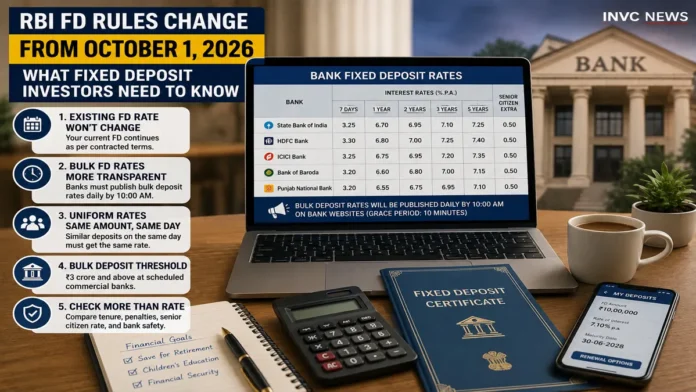
One of the biggest changes requires banks to publish their bulk deposit interest-rate schedule on their websites at 10:00 a.m. on every business day, with a grace period only until 10:10 a.m.
The rules also require rates on deposits of similar amounts accepted on the same day to remain uniform across branches and customers.
For regular retail depositors, however, the most important message is simple:
RBI has not ordered banks to automatically increase or reduce every retail FD rate from October 1.
The rules primarily change how deposit rates are disclosed and how banks can structure differential rates on large deposits.
1. Will Your Existing Fixed Deposit Rate Change on October 1?
For most retail FD investors, no.
Suppose you already booked a three-year fixed deposit at 6.75% per annum.
A new RBI disclosure rule taking effect October 1 does not ordinarily convert that existing contracted FD into whatever rate the bank offers on October 1.
A fixed deposit generally locks in the applicable contracted rate for the agreed tenure, subject to its terms and conditions.
What can change is the rate available to customers opening new deposits or renewing matured deposits after banks revise their rate cards.
That distinction is critical.
Existing FD
Normally continues according to its contracted terms until maturity.
New FD
Gets the rate applicable when it is booked.
Renewed FD
Usually receives the rate applicable at the time of renewal, subject to bank rules.
So depositors do not need to break an existing FD simply because the October 1 regulations are coming.
Premature closure can itself result in a lower applicable rate and/or penalty. RBI requires banks to clearly disclose their premature-withdrawal penalty policy when accepting the deposit.
2. Bulk FD Rates Must Become Much More Transparent
This is perhaps the most visible October 1 change.
Banks will be required to disclose the interest rates payable on deposits according to a schedule published in advance on their websites.
For bulk deposits, the rate card must be displayed:
At 10:00 a.m. on each business day
with only a 10-minute grace period, meaning publication must occur no later than 10:10 a.m.
This could make it considerably easier for large depositors, companies, institutions and high-net-worth customers to compare rates between banks.
Until now, bulk-deposit pricing could often feel less transparent than ordinary retail FD pricing.
The new regime effectively makes the day’s rate card much more visible.
What Counts as a Bulk Deposit?
For scheduled commercial banks, excluding Regional Rural Banks, and Small Finance Banks, RBI defines a bulk deposit as a:
Single rupee term deposit of ₹3 crore or more.
The thresholds differ for some other categories of banks.
| Bank Category | Bulk Deposit Threshold |
|---|---|
| Scheduled commercial banks, excluding RRBs | ₹3 crore and above |
| Small Finance Banks | ₹3 crore and above |
| Regional Rural Banks | ₹1 crore and above |
| Local Area Banks | ₹1 crore and above |
| Tier 3 and Tier 4 scheduled UCBs | ₹1 crore and above |
| Certain other cooperative banks | ₹15 lakh and above |
Therefore, a normal household FD of ₹1 lakh, ₹5 lakh, ₹10 lakh or even ₹50 lakh at a scheduled commercial bank is not suddenly treated as a ₹3 crore bulk FD under this definition.
3. Same Amount, Same Day: Banks Cannot Secretly Favor One Similar Depositor
RBI’s revised framework also strengthens uniformity.
From October 1, banks must ensure that deposit rates, including bulk deposit rates, are uniform across branches and customers for deposits of similar amounts accepted on the same day.
In other words, if two comparable depositors place similar-sized deposits on the same day under the same applicable framework, the bank should not arbitrarily give one a secret preferential rate simply because that customer negotiated harder at another branch.
That does not mean every ₹3 crore, ₹10 crore and ₹100 crore deposit has to earn exactly the same rate.
Banks can still structure differential rates according to permitted criteria.
But those differences must arise from the disclosed rate framework rather than opaque individual bargaining.
For large depositors, this is a significant transparency improvement.
4. Banks Get More Flexibility to Price Large Deposits
Interestingly, RBI is tightening transparency while simultaneously giving banks more flexibility in bulk-deposit pricing.
Banks can consider the different “run-off rates” applied under the Liquidity Coverage Ratio, or LCR, framework when determining differential interest rates on bulk deposits.
This sounds technical, but the basic concept is straightforward.
Banks evaluate how stable different types of deposits are and how likely they may be to leave during periods of liquidity stress.
A deposit that is considered more stable can affect a bank’s liquidity calculations differently from funding that could disappear quickly.
The new framework allows banks to take those distinctions into account when pricing large deposits.
For retail FD customers, this is largely a behind-the-scenes banking change.
For corporates and very large depositors, it could create more differentiated and competitive rate structures.
Could Banks Now Change FD Rates More Often?
Banks have already had substantial freedom to determine deposit rates within RBI’s regulatory framework.
The October rules do not create a mandatory daily change in FD rates.
A bank could keep the same rate card for several days or change rates when its:
- Liquidity requirements change
- Deposit growth changes
- Credit demand changes
- RBI monetary-policy environment changes
- Competitors alter rates
- Asset-liability strategy changes
The new rules primarily make the published structure more transparent.
A 10:00 a.m. bulk-rate publication requirement should therefore not be interpreted as:
“Every bank will announce a new FD rate every morning.”
It means the applicable bulk-deposit rate schedule must be publicly available by the required time.
5. Retail Depositors Should Still Compare More Than the Interest Rate
For someone investing ₹1 lakh or ₹10 lakh, the October bulk-deposit rule may not directly determine the rate.
But this is still a good reminder that choosing an FD solely because it advertises the highest interest rate can be a mistake.
Before locking money away, check at least these factors.
FD Tenure
A bank offering 7.25% for 444 days may pay less on one-year or three-year deposits.
Always compare the exact tenure.
Senior Citizen Rate
Banks are permitted to offer additional interest on eligible deposits from resident senior citizens.
That can materially affect returns.
Premature Withdrawal Penalty
If you may need the money before maturity, check the penalty.
RBI permits banks to set their premature-withdrawal penalty policies, but the conditions must be disclosed to depositors when the deposit is accepted.
Auto-Renewal
Check whether the FD will renew automatically after maturity and what rate will apply.
Do not assume your original higher rate automatically continues.
Callable vs Non-Callable FD
Some term deposits can offer a better rate in exchange for restrictions on premature withdrawal.
Higher interest can therefore come with lower liquidity.
What About Senior Citizen FDs After October 1?
The October 1 changes do not abolish senior citizen FD benefits.
Banks can continue to offer higher rates to eligible resident senior citizens according to their policies and RBI rules.
The additional rate varies by bank and deposit scheme.
Therefore, a retired depositor should still compare:
Regular FD rate + senior citizen additional rate + tenure + premature withdrawal terms
rather than simply looking at the base rate.
Does RBI Set the Exact FD Interest Rate?
No.
This is another common misconception.
RBI does not ordinarily tell every bank:
“Your one-year FD must pay exactly 6.75%.”
Banks largely determine term-deposit rates according to their funding requirements, liquidity, competitive position and internal policies, within RBI’s regulatory framework.
RBI’s deposit rules govern areas such as:
- Transparency
- Uniformity
- Permitted differential pricing
- Premature-withdrawal policy
- Bulk-deposit treatment
- Non-resident deposit rules
This is why SBI, HDFC Bank, ICICI Bank, Bank of Baroda and other banks can offer different FD rates for similar tenures.
Could RBI Repo Rate Changes Affect Your New FD?
Yes—indirectly.
Bank FD rates frequently respond to monetary-policy and banking-liquidity conditions.
When interest rates fall and banks have abundant liquidity, deposit rates can come under downward pressure.
When banks need more deposits to finance credit growth, they may offer more attractive rates.
But there is no mechanical rule saying:
RBI cuts repo rate by 25 basis points → every FD immediately falls 25 basis points.
Banks decide their own deposit pricing.
For savers, this means the broader interest-rate cycle is worth watching before committing a large amount for several years.
₹5 Lakh DICGC Protection: FD Investors Should Know This Rule
Interest rate is only one part of FD investing.
Bank safety also matters.
Deposit Insurance and Credit Guarantee Corporation, or DICGC, insures eligible bank deposits up to a maximum of:
₹5 lakh per depositor per insured bank in the same right and capacity.
This amount includes both:
Principal + accrued interest.
Importantly, the ₹5 lakh limit is not separately available for every branch.
If a depositor has eligible savings accounts and FDs across several branches of the same bank, those balances in the same right and capacity are aggregated for insurance purposes.
DICGC says eligible savings, current, fixed and recurring deposits are covered under its deposit-insurance system.
Example: ₹10 Lakh FD Does Not Mean ₹10 Lakh DICGC Cover
Suppose a person has at one insured bank:
Savings account: ₹1 lakh
Fixed deposit: ₹9 lakh
Total eligible deposits:
₹10 lakh
If they are held in the same right and capacity, the standard DICGC insurance ceiling is still:
₹5 lakh, including eligible principal and interest.
That does not mean deposits above ₹5 lakh are automatically lost.
DICGC insurance is a statutory protection mechanism applicable in specified situations such as bank failure or restrictions covered under the scheme.
But the insurance limit is an important consideration when people place very large savings with a single bank.
Should You Break Your FD Before October 1?
Usually, not merely because of these new RBI rules.
Breaking an FD can reduce returns.
A bank may:
- Apply the rate corresponding to the actual period the deposit was held
- Apply a premature-withdrawal penalty
- Remove a special-rate benefit
The correct decision depends on how much better an alternative rate is and how much penalty would be incurred.
For example, moving from a 6.75% existing FD to a 7.00% new FD may sound attractive.
But if breaking the old deposit triggers a penalty or lower effective rate, the switch could leave you worse off.
Calculate the post-penalty return, not just the advertised new rate.
FD Laddering Can Reduce Rate-Timing Risk
Instead of locking an entire ₹10 lakh into one five-year FD, some savers use an FD ladder.
For example:
- ₹2 lakh for one year
- ₹2 lakh for two years
- ₹2 lakh for three years
- ₹2 lakh for four years
- ₹2 lakh for five years
As each FD matures, it can potentially be reinvested at prevailing rates.
This can reduce the risk of locking all savings at one interest-rate level.
However, the best structure depends on the investor’s liquidity needs and tax situation.
Remember: FD Interest Is Taxable
Another reason not to choose an FD based solely on its headline rate is taxation.
Interest earned on a bank fixed deposit is generally taxable according to the depositor’s applicable income-tax rules.
So an investor in a higher tax bracket may earn a significantly lower post-tax return than the advertised FD rate suggests.
Compare:
Nominal FD rate → tax impact → inflation → actual purchasing-power return.
That is more useful than chasing an extra 0.10% without considering the bigger financial picture.
RBI FD Rules October 1: 5 Things to Remember
1. Your existing retail FD rate does not automatically change on October 1.
2. Banks must publish bulk deposit rates on their websites by around 10:00–10:10 a.m. each business day.
3. Comparable deposit rates must be uniform across branches and customers rather than individually negotiated in an opaque manner.
4. Scheduled commercial-bank deposits of ₹3 crore and above are generally treated as bulk deposits.
5. Retail FD investors should continue comparing tenure, premature withdrawal conditions, senior citizen benefits and DICGC protection—not just headline interest rates.
The Bottom Line
The RBI FD Rules October 1 2026 are best understood as a transparency and bulk-deposit pricing reform, not as a nationwide reset of every household fixed-deposit rate.
From October 1, banks will have to publish applicable bulk-deposit interest rates on their websites around the start of each business day and apply their disclosed framework uniformly to comparable deposits.
Banks will also receive greater flexibility to account for liquidity-related characteristics when pricing bulk deposits.
For ordinary retail savers, the immediate impact is much smaller.
Your existing fixed deposit does not suddenly switch to a new interest rate on October 1 simply because these rules begin.
But when opening or renewing an FD, depositors should continue checking the rate actually available that day, tenure, senior citizen benefit, premature-withdrawal penalty and deposit protection.
And above all, remember:
The highest advertised FD rate is not automatically the best FD.
Liquidity, tax, bank risk and the terms hidden behind that rate can matter just as much.