NEW DELHI, INDIA | AUGUST 23, 2026 —
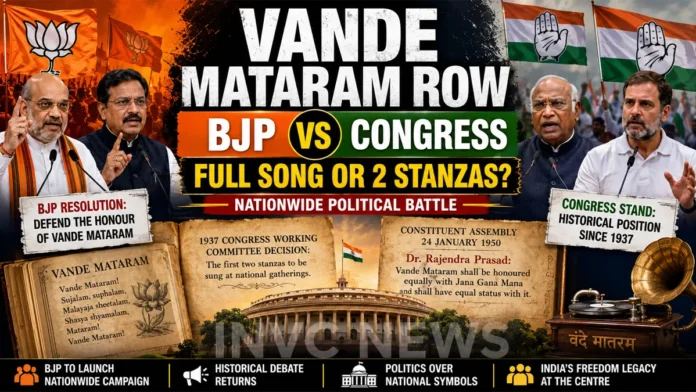
The Vande Mataram Row has developed into a major national political confrontation, with the Bharatiya Janata Party adopting a resolution defending the song’s full legacy and preparing to take the issue across the country, while the Congress is standing by its decision to sing the first two stanzas at party programs.
What began as a disagreement over how Vande Mataram should be rendered at political events has now expanded into a wider battle over nationalism, history, secularism and the interpretation of decisions taken during India’s freedom movement.
The BJP argues that limiting the song to two stanzas represents an unnecessary compromise over a powerful symbol of India’s national movement.
Congress rejects that interpretation and says its position follows a historical practice dating back to the 1937 Congress Working Committee decision, when the first two stanzas were recommended for use at national gatherings.
With both parties refusing to retreat, Vande Mataram is once again at the center of Indian political debate.
BJP Passes Resolution on Vande Mataram
The BJP has formally adopted a resolution at its national office-bearers’ meeting declaring that it will work to protect what it describes as the honor and legacy of Vande Mataram.
Party leaders have strongly criticized Congress’ decision to restrict renditions at its events to the first two stanzas.
The BJP’s position is that the entire composition represents an important part of India’s nationalist heritage and should not be reduced because of political or religious considerations.
Senior BJP leaders have indicated that the issue will now be taken beyond party meetings and into a broader nationwide campaign.
The move means the controversy is unlikely to disappear quickly.
Instead, Vande Mataram could become a recurring political theme at BJP meetings, public programs and legislative forums in the coming weeks.
Amit Shah Takes Aim at Congress
Union Home Minister Amit Shah has been among the BJP leaders to sharply challenge Congress over the issue.
The BJP has framed the Congress position as a question of national pride and has urged citizens to examine why the opposition party wants to continue with only two stanzas.
Congress has rejected the criticism and accused the BJP of attempting to turn a historical decision into a modern political controversy.
This fundamental disagreement now forms the core of the dispute.
The BJP is asking why the entire composition should not be embraced.
Congress is asking why a decades-old convention followed during the freedom movement is suddenly being presented as disrespect toward the song.
Congress Sticks to First Two Stanzas
Congress has made clear that it does not intend to abandon the two-stanza format.
The party argues that singing the first two stanzas is not an insult to Vande Mataram and points to its own long historical association with the song.
Congress leaders have highlighted that Rabindranath Tagore sang Vande Mataram at the 1896 session of the Indian National Congress in Calcutta, decades before independence.
The party also maintains that Vande Mataram played a central role in the freedom movement and says Congress workers and leaders historically used it as a rallying cry against British rule.
In Congress’ telling, therefore, the current controversy is not about whether it respects Vande Mataram.
It is about which portions became established for use at national gatherings and why.
Why Does Congress Sing Only Two Stanzas?
The answer takes the debate back almost nine decades.
In 1937, the Congress Working Committee considered objections that had emerged around the later portions of Vande Mataram.
The first two stanzas primarily celebrate the motherland, describing its natural beauty, abundance and landscape.
Later stanzas contain religious imagery and references that some Muslim leaders at the time argued could make the song difficult for them to sing as a national invocation.
Following deliberations and consultations, the Congress Working Committee recommended that the first two stanzas be used when Vande Mataram was sung at national gatherings.
Congress continues to cite that decision as the historical basis for its present practice.
BJP Challenges the 1937 Legacy
The BJP views the same episode very differently.
Its leaders argue that the 1937 restriction represented an unnecessary concession to communal pressure and that independent India should not continue to view Vande Mataram through those political circumstances.
That interpretation has transformed an old historical debate into a current political confrontation.
For the BJP, the issue is about restoring the complete legacy of one of the defining songs of India’s nationalist movement.
For Congress, the 1937 position represented an attempt to preserve both the song’s importance and the inclusive character of the national movement.
Those competing interpretations explain why neither party is likely to easily compromise.
What Did the Constituent Assembly Say?
There is another important historical element that can easily get lost in political arguments.
On January 24, 1950, Constituent Assembly President Dr. Rajendra Prasad addressed the question of India’s national anthem and Vande Mataram.
He declared Jana Gana Mana the National Anthem.
At the same time, he stated that Vande Mataram, because of its historic role in India’s freedom struggle, should be honored equally with Jana Gana Mana and have equal status with it.
That statement remains one of the most important constitutional-era references to Vande Mataram’s place in India’s national life.
Vande Mataram Has a Long Freedom-Struggle History
The current controversy involves much more than a modern political song.
Bankim Chandra Chattopadhyay composed Vande Mataram in the 19th century, and it later appeared in his novel Anandamath.
The song became increasingly associated with the nationalist movement, particularly during the campaign against the partition of Bengal in the early 20th century.
“Vande Mataram” developed into one of the most powerful slogans of anti-colonial mobilization.
Freedom fighters used it in demonstrations, political meetings and nationalist literature.
Its role in the independence movement is therefore acknowledged across the political spectrum, even though disagreements over particular stanzas have existed for decades.
Political Row Spreads Beyond Delhi
The controversy is no longer confined to statements by national party leaders.
The Vande Mataram dispute has begun entering state-level political and legislative debates as well.
The issue contributed to heated exchanges in the Himachal Pradesh Assembly, where proceedings were disrupted amid arguments around Vande Mataram.
That demonstrates how quickly a dispute over a party practice has expanded into a national political issue.
With the BJP preparing a broader campaign, similar confrontations could emerge in other states.
Congress Says BJP Is Diverting Attention
Congress leaders have responded by arguing that the BJP is trying to shift political attention away from issues such as unemployment, inflation, education and student concerns.
The opposition party has been building a wider campaign around those issues over recent months.
Also Read: Congress Launches Nationwide Protest Campaign Against Inflation, Unemployment and Exam Scandals
Congress’ political strategy appears to be to defend its historical position on Vande Mataram while attempting to move public discussion back toward economic and social issues.
BJP Sees Nationalism as a Powerful Political Issue
For the BJP, national identity and symbols associated with India’s freedom struggle have long formed an important part of its political message.
Taking the Vande Mataram dispute nationwide allows the party to connect the current Congress decision with a broader ideological argument over how India’s history should be remembered.
The issue could also give BJP workers a common political campaign capable of being organized across multiple states.
That makes the controversy strategically useful beyond the immediate dispute over how many stanzas should be sung.
The Debate Comes Amid Wider BJP-Congress Confrontation
The Vande Mataram battle arrives at a time when relations between the ruling BJP and Congress remain highly confrontational.
Parliament and political campaigns have recently seen disputes over students, jobs, religious issues and government accountability.
Also Read: Lok Sabha Disrupted as Opposition Presses Government Over Ram Temple Donation Row
The national-song controversy therefore becomes another front in a much broader political contest rather than an isolated disagreement.
Rahul Gandhi and Congress Are Also Focusing on Young Voters
Congress is simultaneously expanding its outreach among students and young voters, particularly around exams, employment and education.
Rahul Gandhi’s student campaign began building momentum from educational centers such as Kota.
That contrast could become politically important.
While BJP attempts to make nationalism and Vande Mataram a significant public issue, Congress is likely to keep redirecting attention toward employment, education and economic concerns.
Vande Mataram Row: What Each Side Is Arguing
BJP’s position: The complete heritage of Vande Mataram should be respected, and restricting the song to two stanzas reflects an outdated compromise that should be challenged.
Congress’ position: The first-two-stanza practice has deep historical roots in the freedom movement, and following it does not amount to disrespecting Vande Mataram.
The historical record: The Congress Working Committee recommended the first two stanzas for national gatherings in 1937, while Dr. Rajendra Prasad stated in the Constituent Assembly on January 24, 1950 that Vande Mataram should be honored equally with Jana Gana Mana and have equal status.
That is why the dispute cannot be understood simply as a question of whether one party supports or opposes Vande Mataram.
The real disagreement is over history, interpretation and how a national symbol should be used today.
Why the Vande Mataram Debate Could Grow Further
The BJP’s decision to turn the issue into a nationwide campaign means the controversy now has the potential to remain in headlines.
Political rallies, state assemblies and upcoming campaigns could provide repeated opportunities for leaders from both parties to revisit the dispute.
It may also become part of larger arguments over nationalism, the freedom movement, Jawaharlal Nehru’s legacy and the politics of secularism.
Congress is unlikely to abandon a position it says is rooted in decisions made during the independence movement.
The BJP, meanwhile, appears equally determined to challenge that interpretation.
The result is a political battle over a song that predates independent India but still carries enormous symbolic power.
For now, Vande Mataram has once again moved from India’s history books to the center of its contemporary political battlefield.