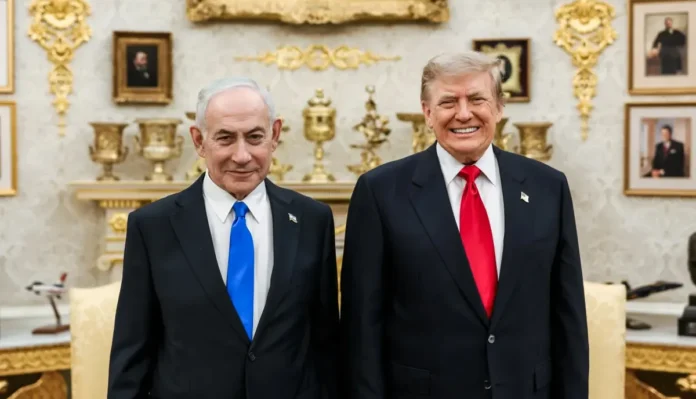
Jerusalem, Israel | October 26, 2026 : US President Donald Trump has renewed his public endorsement of Israeli Prime Minister Benjamin Netanyahu ahead of Israel’s October 27 parliamentary election, urging voters to return the longtime leader to office and declaring that the military campaign against Iran must be completed.
In a fresh post on his Truth Social platform on Sunday, Trump praised Netanyahu as a strong wartime leader and highlighted their close political and military partnership. His intervention comes just one day before Israeli voters head to the polls in an election that could reshape the country’s political leadership and its approach to the continuing confrontation with Iran.
Trump’s endorsement also brings the relationship between Washington and Jerusalem directly into Israel’s domestic election debate. While Netanyahu has welcomed the US president’s support, opposition figures have stressed that the decision over who leads Israel belongs exclusively to Israeli voters.
Trump Tells Israelis to Vote for Netanyahu
Trump reiterated his support for Netanyahu in a Truth Social post that referred back to his earlier endorsement on October 18.
Addressing Israeli voters, Trump urged them to remember the cooperation between the two leaders and argued that they had achieved significant results together. He also linked Netanyahu’s leadership to the US-Israeli military campaign against Iran.
“Vote for Bibi Netanyahu for prime minister, we have to finish the job that we started!” Trump wrote, reiterating his call for Netanyahu’s reelection.
The US president described Netanyahu as an outstanding wartime leader and emphasized their shared approach to confronting Iran. His message presented the election as an important decision about the future of the two countries’ security cooperation.
Trump’s latest intervention follows his earlier endorsement, in which he called Netanyahu a strong and capable partner in the campaign against the Iranian government. The renewed statement comes amid reports that the Israeli prime minister had sought additional public backing from Washington before election day.
According to Axios, Netanyahu had reportedly spoken with Trump twice over three days and sought a fresh expression of support. Netanyahu’s Likud party spokesperson, however, denied that the prime minister had requested the endorsement.
Trump Makes Major Claims About Iran’s Military and Economy
A central part of Trump’s message focused on the consequences of US and Israeli military operations against Iran.
Trump cited Operation Midnight Hammer and Operation Epic Fury while arguing that the military campaign had significantly weakened Iran’s capabilities. He claimed that Iran had lost its navy and air force and that both its military strength and economy were in serious condition.
He also claimed that Iran’s inflation rate had reached 301% and said a naval blockade had prevented the country from obtaining oil.
These figures and assessments were claims made by Trump in his political statement and should not be treated as independently verified economic or military measurements without additional evidence.
Trump also referred to the elimination of senior military and political leadership within Iran, arguing that the campaign had achieved substantial results. He presented continued cooperation with Netanyahu as essential to completing the objectives of the operation.
The statements underscore how the Iran conflict has become a major issue in the Israeli election campaign. Security policy, the future of military operations and the relationship with the United States are likely to remain central subjects in the debate over the country’s next government.
Why Trump’s Endorsement Matters
Trump’s public intervention is notable because US presidents have traditionally avoided explicitly endorsing candidates in Israeli national elections.
His support for Netanyahu signals the importance he attaches to their partnership, particularly on Iran. Trump has argued that a different Israeli leader could change the nature of Washington’s cooperation with Jerusalem.
In his earlier endorsement, the US president warned that if Israel elected someone other than Netanyahu, the United States could be left to confront Iran without the same level of Israeli partnership.
For Netanyahu, the endorsement provides an opportunity to emphasize his direct relationship with the White House and present cooperation with Trump as a central element of Israel’s security strategy.
However, the political effect of foreign endorsements cannot be determined in advance. Israeli voters will also weigh domestic concerns, including security failures, the government’s handling of the aftermath of the October 7, 2023, Hamas attack, the wars that followed and broader questions about political accountability.
The election is therefore about more than the personal relationship between two leaders. It will also test public opinion on Netanyahu’s record and the direction of Israeli policy.
Gadi Eisenkot Responds: Israelis Must Choose Their Own Leader
Netanyahu’s leading rival, former military chief Gadi Eisenkot, has challenged the idea that outside political support should determine Israel’s leadership.
Eisenkot has said he respects Trump and appreciates his support for Israel but maintains that the country’s voters must make the final decision.
His position reflects a broader argument within the opposition that Israel’s election should be decided on domestic political priorities rather than the preferences of a foreign leader.
The opposition has focused on questions surrounding national security, government accountability and the direction of the country after years of conflict. Netanyahu, meanwhile, has emphasized his experience and close relationship with Washington.
The contrast illustrates a central tension in the campaign: how much weight voters should give to continuity in wartime leadership compared with demands for political change and accountability.
Netanyahu Faces a Crucial Political Test
Israel’s October 27 election is the country’s first national election since the Hamas-led attack of October 7, 2023, and the wars that followed in Gaza, Lebanon and Iran.
Netanyahu, Israel’s longest-serving prime minister, is seeking to remain in office despite criticism of his government’s handling of the security failures preceding the October 7 attack.
His administration has faced sustained scrutiny over intelligence and security lapses, the conduct of the subsequent conflicts and broader questions surrounding its leadership.
At the same time, Netanyahu’s supporters argue that his experience and relationship with the United States are important assets at a time of continuing regional instability.
The electoral contest pits his Likud-led right-wing and religious coalition against an opposition landscape in which former military chief Gadi Eisenkot is a prominent challenger. The composition of the next Knesset, Israel’s parliament, will be critical to determining which political bloc can assemble the support needed to govern.
Pre-election polling has indicated that the race is competitive, with neither side assured of securing the 61 seats required for a parliamentary majority.
What Happens After the Election?
The election result will help determine the future of Israel’s domestic leadership and its strategic relationship with Washington. However, the outcome may not immediately resolve the country’s political divisions.
If Netanyahu remains in power, his government will face continued pressure to address security concerns and define the next phase of its Iran policy. If the opposition succeeds in forming a government, Israel’s approach to regional security and relations with the Trump administration could be subject to renewed negotiations.
Regardless of the result, cooperation between Israel and the United States will remain important to regional diplomacy, military planning and efforts to manage the wider Middle East conflict.
Trump’s latest endorsement makes clear that he wants Netanyahu to remain his partner. The Israeli electorate, however, will make the decision at the ballot box.
The Bottom Line
Trump has once again thrown his support behind Netanyahu ahead of Israel’s October 27 parliamentary election, linking the prime minister’s political future to their shared campaign against Iran.
His comments have intensified the international dimension of an already consequential domestic contest. Netanyahu has welcomed the endorsement, while Gadi Eisenkot and other opponents have emphasized Israel’s democratic right to choose its own leadership.
The election will determine not only the composition of the next Knesset but also the political mandate for Israel’s domestic and security policies in a period of continuing regional uncertainty.