
By Team INVC | INVC NEWS
Published: October 10, 2026 | 12 : 40 PM IST
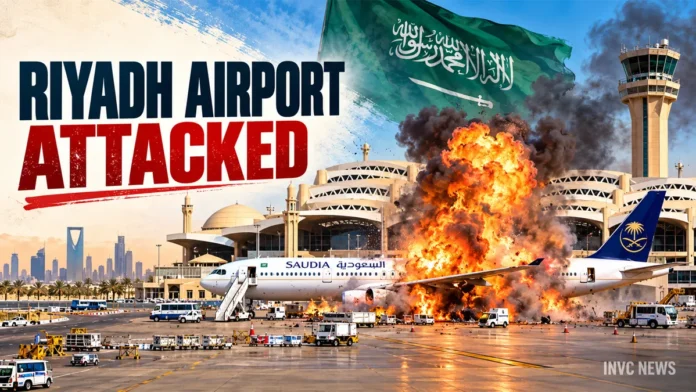
CAIRO, Egypt | October 10, 2026 — The Riyadh airport attacks have intensified concerns over civilian aviation after Saudi authorities reported that strikes targeting King Khalid International Airport and a Saudia aircraft killed three Saudi citizens. Egypt has condemned attacks on Saudi airports and reaffirmed its support for the kingdom’s security and sovereignty.
Saudi Arabia’s General Authority of Civil Aviation, or GACA, reported the latest fatalities on Friday, October 9, following two attacks on Thursday. Saudia separately confirmed that one of its pilots was among those who died.
Meanwhile, Egypt’s foreign ministry has warned that attacks on Saudi territory threaten regional security and stability. Its confirmed October 8 statement condemned strikes on both Abha and King Khalid airports.
The developments place passengers, aviation employees and international flight connections at the center of a widening regional confrontation.
Egypt backs Saudi Arabia’s security and sovereignty
Egypt’s condemnation emphasizes solidarity with Saudi Arabia as the kingdom responds to attacks on its territory.
In the statement published through Egypt’s State Information Service, the foreign ministry described the escalation as a threat to Saudi security and stability, with consequences for the wider region.
Cairo’s position reflects concern over the targeting of civilian aviation infrastructure. However, the statement does not establish responsibility for every incident or provide an independent assessment of the damage.
The confirmed Egyptian statement also predates Saudi Arabia’s October 9 announcement about the latest three deaths. Consequently, the two statements should not be treated as a single account of one attack.
Saudi authorities report two attacks on Thursday
According to GACA’s account, the first Thursday attack targeted facilities at King Khalid International Airport in Riyadh. The second targeted an aircraft belonging to national carrier Saudia.
The authority said three Saudi citizens died and several other people suffered injuries. Those injured included Saudi citizens and residents of different nationalities.
Reports citing GACA described injuries of varying severity, but the authority’s latest account did not specify a complete injury total.
Emergency teams responded under airport safety procedures and took injured people to hospitals. Meanwhile, authorities assessed damage to aviation facilities.
Saudia confirms pilot’s death and aircraft damage
Saudia identified the deceased pilot as Captain Hamoud Ali Al-Kalthami and paid tribute to his service.
The airline also confirmed damage to one of its aircraft while it was on the ground at the airport. It said no passengers were aboard that aircraft at the time.
That distinction matters: the reported strike involved a grounded plane. The available account does not describe an attack on a passenger aircraft during flight.
Although airport authorities reported a resumption of operations after the attacks, that announcement does not guarantee that every airline has restored its schedule. Individual carriers may continue cancellations or other operational changes.
Houthi responsibility remains clearly attributed
Yemen’s Iran-aligned Houthis claimed responsibility for attacks involving Riyadh’s airport.
However, Saudi aviation authorities did not identify the perpetrators in the initial account of the latest fatalities. Therefore, the description “Houthi-claimed attacks” distinguishes the group’s assertion from the aviation authority’s confirmation of deaths and damage.
Likewise, Egypt’s condemnation should not serve as evidence that its ministry independently established who carried out each strike.
The confirmed facts concern the targeted facilities, casualties and aircraft damage reported by Saudi authorities and Saudia. Responsibility requires separate attribution.
Earlier airport attacks involved a separate casualty report
The latest deaths follow attacks on October 6 and 7 at Abha International Airport and King Khalid International Airport.
In its earlier account, GACA reported three deaths and 36 injuries across those two locations. The victims included two women, one Moroccan and one Algerian, at Abha, and a Sudanese resident in Riyadh.
Those casualties belong to the earlier attacks. They are separate from the three Saudi citizens whom authorities reported dead after Thursday’s strikes.
Keeping the dates and locations distinct prevents confusion about who died in which incident and avoids treating older figures as an update to the latest attack.
Airline disruptions make flight checks essential
The attacks have affected international flight planning. Several airlines announced cancellations or suspensions involving Riyadh and other Saudi destinations.
Meanwhile, European aviation authorities expanded their warning about risks associated with missile and drone activity, interception operations and falling debris.
For passengers, a functioning airport and an operating flight are separate questions. Travelers should check their specific airline, departure date and booking status before going to the terminal.
They should also review instructions for connecting flights, particularly where a cancellation affects an onward journey.
Civilian protection remains the immediate concern
Egypt’s condemnation adds diplomatic support for Saudi Arabia as aviation authorities respond to repeated attacks.
However, the immediate priorities remain the treatment of injured people, protection of passengers and staff, and reliable information about flight operations.
The latest Saudi account confirms three deaths following Thursday’s attacks. Any subsequent update should identify the incident date clearly and distinguish official findings from claims of responsibility.