By Team INVC | INVC NEWS
Published: October 9, 2026 | 05:38 PM IST
ADDIS ABABA, Ethiopia | October 9, 2026 — India and Ethiopia are looking beyond traditional diplomacy as they move to deepen a strategic partnership spanning trade, investment, digitalization, infrastructure, security and education.
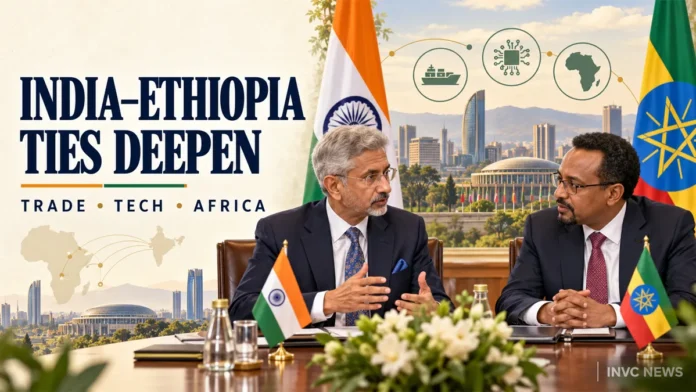
External Affairs Minister S. Jaishankar met Ethiopian Foreign Minister Gedion Timothewos in Addis Ababa on Friday, putting economic and technology cooperation at the center of talks that also carried a wider message about India’s engagement with Africa.
The meeting comes as New Delhi seeks to strengthen its partnerships across the continent while expanding cooperation with African countries on development, technology and multilateral platforms.
Why the Jaishankar–Timothewos Meeting Matters
The discussions were not limited to diplomatic coordination.
According to statements from the two sides, Jaishankar and Timothewos discussed ways to expand cooperation in education and culture, trade and investment, and digitalization.
Jaishankar said the India–Ethiopia strategic partnership rests on shared values, common aspirations and a history of South-South solidarity.
The talks also covered development projects, infrastructure, maritime issues, security, technology and cultural cooperation, according to Jaishankar’s public account of the meeting.
That broad agenda makes the visit important beyond ceremonial diplomacy.
For India, Ethiopia represents an important African partner and a platform for wider engagement with the continent. For Ethiopia, closer ties with India could create additional opportunities in investment, technology, skills, education and development cooperation.
Trade and Investment Move Higher on the Agenda
Economic cooperation emerged as one of the central themes.
India and Ethiopia discussed ways to strengthen trade and investment ties as both countries explore opportunities for businesses, infrastructure projects and development partnerships.
The emphasis on investment is significant because New Delhi’s Africa engagement increasingly combines diplomatic ties with commercial cooperation, capacity building and technology partnerships.
However, the meeting did not announce a new trade agreement or a specific investment package. The discussions instead focused on expanding existing cooperation and identifying areas where the strategic partnership can deepen.
That distinction matters because diplomatic discussions often signal political intent before they produce individual commercial agreements.
Digital Cooperation Could Become a Bigger Pillar
Digitalization also featured prominently in the talks.
India has increasingly highlighted its experience in digital public infrastructure, technology-led public services and capacity building when engaging with Global South partners.
The inclusion of digital cooperation in the Ethiopia discussions indicates that technology may become a more visible component of the relationship.
Any future initiatives, however, would depend on specific agreements and implementation plans between the two governments.
Education and Culture Remain Part of the Partnership
The ministers also discussed strengthening cooperation in education and culture.
These areas can play a long-term role in bilateral relations by supporting academic exchanges, professional training, skills development and broader people-to-people engagement.
Unlike high-profile diplomatic announcements, education and cultural cooperation often develops gradually. Yet it can create deeper institutional ties between countries over time.
BRICS Adds Another Strategic Layer
The meeting also carried a significant multilateral dimension.
Ethiopia’s Foreign Ministry said Jaishankar appreciated Ethiopia’s participation in the recent BRICS Summit hosted by India.
The discussion underlined growing coordination between New Delhi and Addis Ababa within international forums.
Both ministers also exchanged views on global developments and ways to strengthen multilateral engagement.
The BRICS dimension is especially important because it places India–Ethiopia ties within a broader conversation about emerging economies and the growing role of the Global South in international institutions.
India–African Union Partnership Discussed
Jaishankar and Timothewos also discussed the India–African Union partnership.
That gives the Addis Ababa visit importance beyond bilateral relations alone.
The Ethiopian capital occupies a central place in African diplomacy as the headquarters of the African Union, making high-level engagement there relevant to India’s wider outreach across the continent.
India has repeatedly sought to deepen cooperation with African countries through trade, development partnerships, technology, capacity building and multilateral coordination.
The Ethiopia visit fits directly into that larger diplomatic strategy.
Jaishankar Arrived After Africa Tour Stops
Jaishankar reached Ethiopia on October 8 and was welcomed by Ethiopian State Minister Berhanu Tsegaye.
Following his arrival, the Indian foreign minister said he was looking forward to productive engagements aimed at advancing the strategic partnership.
Ethiopia forms the final leg of Jaishankar’s African tour after engagements in Ghana and Côte d’Ivoire.
During the Ethiopia visit, he is also expected to hold discussions with the country’s leadership on bilateral, regional and international issues of shared interest.
He is additionally scheduled to chair a Regional Heads of Mission Conference in Addis Ababa.
What Comes Next?
The key question now is whether the political momentum from the visit translates into concrete projects.
Trade, investment, infrastructure, technology and digital cooperation offer obvious areas for expansion. Education and development partnerships could also deepen the relationship over the longer term.
For now, the Addis Ababa talks show that India and Ethiopia want their strategic partnership to operate across a much wider spectrum than traditional diplomacy.
The next test will be implementation.
If both sides can convert the areas identified during the talks into measurable cooperation, the relationship could gain greater economic and strategic significance within India’s broader Africa policy.
Why You Should Read This Story
This is more than a routine meeting between two foreign ministers. The discussions connect India’s trade ambitions, digital diplomacy, BRICS engagement and Africa strategy in one place.
For readers tracking India’s growing global footprint, the Addis Ababa meeting offers an early indication of where New Delhi may seek deeper economic and strategic partnerships next.
Why This Story Is Worth Sharing
India–Ethiopia ties rarely receive the attention given to India’s relationships with major global powers, yet Ethiopia occupies an important position in African diplomacy.
Sharing this story helps readers understand how India is building influence through trade, technology, development cooperation and multilateral partnerships—not only through traditional geopolitical alliances.