By Team INVC | INVC NEWS
Published: October 9, 2026 | 11 : 11 AM IST
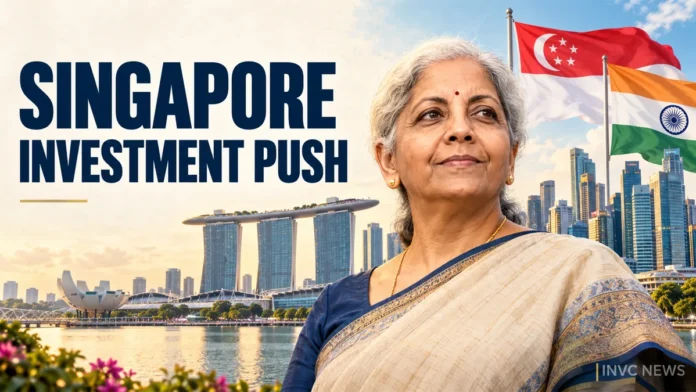
SINGAPORE, Singapore | October 9, 2026 — Nirmala Sitharaman’s Singapore visit puts India’s investment ambitions before some of the world’s most influential capital managers. During her October 9–11 trip, the finance minister will meet Singapore’s leadership and executives from major investment firms, banks and healthcare companies.
The agenda connects diplomacy with a practical economic objective: turning the India–Singapore partnership into more investment, stronger business relationships and projects that move beyond discussions.
Singapore already holds a central position in that effort. According to India’s Finance Ministry, it remains the country’s largest source of foreign direct investment, with cumulative inflows of approximately $194.68 billion between April 2000 and March 2026.
That figure describes an established investment relationship. The visit now seeks opportunities to deepen it.
GIC and Temasek anchor a high-profile investor agenda
Sitharaman’s scheduled engagements include senior executives from GIC and Temasek, whose investments already span several parts of the Indian economy.
The broader meeting list includes DBS Bank, Standard Chartered, British International Investment, IHH Healthcare, Mitsubishi UFJ Financial Group, B Capital, HPS Investment Partners, SEB, Mitsui & Co. and TPG.
The range matters. The itinerary brings together institutions with different business interests, rather than limiting the outreach to one sector or one type of investment.
Banking, healthcare, investment management and corporate partnerships all feature in the planned discussions. Consequently, the visit gives India an opportunity to present its growth prospects to several audiences within the same financial center.
However, scheduled meetings do not establish that these institutions have approved new investments. Any resulting commitments will require separate announcements.
Political meetings will set the wider direction
The finance minister will also meet President Tharman Shanmugaratnam, Prime Minister Lawrence Wong, Deputy Prime Minister Gan Kim Yong and Foreign Minister Vivian Balakrishnan.
According to the ministry, the discussions will advance the India–Singapore Comprehensive Strategic Partnership and follow up on outcomes of the India–Singapore Ministerial Roundtable, known as ISMR.
That framework links the investor outreach with a broader bilateral agenda.
The planned topics include trade and investment, digital financial connectivity, capital markets, taxation, semiconductors, advanced manufacturing, skills development and aviation.
These discussions could help identify where closer government cooperation supports commercial activity. Nevertheless, the published agenda does not announce new tax rules, semiconductor agreements or aviation arrangements.
Why the $194.68 billion figure matters
Singapore’s cumulative FDI contribution gives the visit a substantial economic backdrop.
The Finance Ministry’s approximately $194.68 billion figure covers almost 26 years, from April 2000 through March 2026. It should not appear as a fresh investment pledge secured during the three-day trip.
It also differs from portfolio investment, another area of the minister’s outreach.
Foreign direct investment and portfolio flows serve different functions. Direct investment generally involves a lasting business interest, while portfolio investment concerns financial assets such as shares and bonds.
Because the itinerary includes both institutional investors and portfolio fund managers, the discussions may address several channels through which overseas capital reaches India.
Fund managers will get a direct discussion on India’s growth
Sitharaman will participate in a roundtable with hedge fund and portfolio fund managers, alongside government-to-business meetings.
The ministry said these interactions would cover India’s growth trajectory, investment opportunities and the changing global economic and financial environment.
For India, the sessions provide an opportunity to hear how international investors assess opportunities and risks. For investors, they offer direct engagement with the minister responsible for the country’s fiscal and financial policy agenda.
However, a roundtable remains a discussion platform. It does not guarantee immediate market inflows or a particular outcome for Indian equities.
The more meaningful evidence will come from subsequent investment decisions, business partnerships and progress on specific projects.
NIIF and GIFT City offer routes for deeper participation
The visit also highlights platforms that could facilitate investment.
The National Investment and Infrastructure Fund and GIFT City feature as potential avenues for greater participation by Singapore-linked capital, including through funds and investment vehicles.
According to the ministry, officials will work with other ministries and industry organizations to connect interested investors with Indian companies, financial institutions and state governments.
That follow-up could prove important. Investors need more than a national growth presentation; they also need suitable counterparties and projects that match their requirements.
Connecting those participants can help move a preliminary expression of interest toward a concrete proposal.
What businesses and readers should watch next
The trip’s significance extends beyond its meeting list.
Indian businesses will watch for partnerships that bring capital or commercial expertise. Financial institutions will track discussions on market connectivity. Meanwhile, manufacturers and technology companies will look for progress in semiconductors, advanced production and skills.
For readers, the clearest test is whether the diplomatic engagement produces identifiable economic outcomes.
New investment announcements, project partnerships and implementation of earlier ministerial decisions would provide stronger evidence than a busy itinerary alone.
Sitharaman arrives with a major existing investment relationship behind her. The challenge is to use that foundation to develop the next set of opportunities—and bring interested institutions closer to Indian businesses and projects.