By Team INVC | INVC NEWS
Published: October 9, 2026 | 11 : 04 AM IST
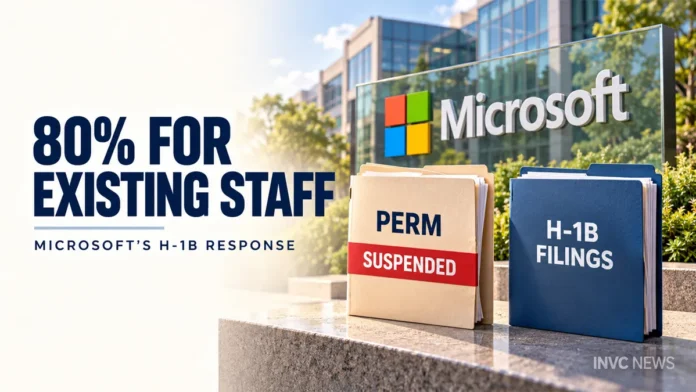
REDMOND, United States | October 9, 2026 — Microsoft’s H-1B defense centers on a distinction that raw immigration numbers can obscure: filing a petition does not necessarily mean hiring someone new. The company says about 80% of its approximately 6,000 applications last fiscal year involved employees already on its payroll.
The response follows the Trump administration’s decision to suspend Microsoft from the Permanent Labor Certification program, known as PERM—a key step in many employer-sponsored green card cases.
Microsoft wants the administration to examine the purpose of its filings. Meanwhile, employees seeking permanent residency face a separate question: how long will the interruption last, and which cases will it affect?
The 80% figure challenges the new-hire narrative
In its October 8 statement, Microsoft said most of its recent H-1B applications sought to extend or change the immigration status of existing employees.
The remaining filings concerned new Microsoft employees who already lived legally in the United States, according to the company. Microsoft said those employees represented about 1% of its American workforce.
These are company-reported figures. They explain Microsoft’s position but do not independently resolve the administration’s allegations about its employment practices.
Nevertheless, the distinction matters. A petition supporting an existing employee’s continued employment serves a different purpose from recruiting a worker arriving from abroad.
Similarly, the number of filings should not automatically become a count of newly created jobs, overseas arrivals or workers replacing laid-off employees.
Why Washington targeted Microsoft
The administration announced the PERM action on October 8 as part of its campaign against alleged misuse of employment-based immigration programs.
Vice President JD Vance accused Microsoft of abusing the system and criticized its layoffs alongside its use of foreign-worker programs.
Labor Secretary Keith Sonderling said the department would stop accepting new PERM applications and processing pending applications involving the affected companies.
The action also covers Adobe, Cognizant, Infosys, TCS, Wipro, HCLTech and Capgemini.
Those accusations remain the administration’s claims. The suspension alone does not establish that Microsoft unlawfully replaced American employees or violated wage requirements.
Microsoft said it welcomed the opportunity to provide officials with additional information.
Microsoft disputes the lower-pay argument
The company also defended its compensation practices.
Microsoft said it pays H-1B employees the same as other employees performing comparable work. It added that it files petitions only for people who meet the visa category’s requirements.
Separately, federal H-1B wage rules require employers to pay at least the actual wage for comparable employees or the prevailing wage for the occupation and location, whichever is higher.
That legal standard provides context for the dispute. However, a company’s statement about pay does not substitute for an examination of individual employment records.
The central issue therefore requires evidence about jobs, qualifications and compensation—not an assumption that every foreign-worker petition represents cheaper labor.
PERM and H-1B handle different parts of immigration
H-1B allows qualifying foreign professionals to work temporarily in specialty occupations. Employers can file petitions for several purposes, including continued employment and changes involving an employee’s status or employer.
PERM concerns permanent labor certification.
For many employment-based immigration cases, an employer must obtain Department of Labor certification before filing the associated immigrant petition with US Citizenship and Immigration Services.
The certification process examines whether sufficient qualified, willing and available US workers exist for the opportunity. It also addresses whether employing the foreign worker would adversely affect comparable American workers’ wages or working conditions.
Consequently, the administration’s PERM suspension interrupts a permanent residency pathway. It does not automatically cancel an employee’s existing H-1B status or require that person to leave the country.
What Microsoft’s statement leaves unanswered
The company’s response focuses on its H-1B filings and workforce practices. It does not provide a detailed account of the specific legal grounds for its PERM suspension.
It also does not identify how many employees have pending labor certification cases or how many future sponsorship plans could face disruption.
Furthermore, the statement gives no date for restoring access to the program.
These gaps matter because Microsoft’s explanation of temporary-worker filings does not, by itself, settle the separate question of permanent labor certification.
For affected workers, a reassuring corporate response and an uncertain residency timeline can exist at the same time.
What employees should distinguish
| Issue | What the available information establishes |
| Purpose of recent H-1B filings | Microsoft says about 80% concerned existing employees. |
| New Microsoft hires in the remaining filings | The company says they already lived legally in the United States. |
| Existing H-1B status | The PERM suspension alone does not cancel it. |
| PERM processing | Officials announced a halt to new and pending applications involving affected employers. |
| Number of affected Microsoft employees | The company’s statement does not disclose it. |
| End of the suspension | No fixed restoration date appears in the company’s response. |
Microsoft has answered the political criticism with its own workforce figures. The next substantive test lies in the information it provides to officials—and whether that review clarifies the future of employees whose permanent residency plans depend on PERM.