By Team INVC | INVC NEWS
Published: October 8, 2026 | 09 : 19 AM IST
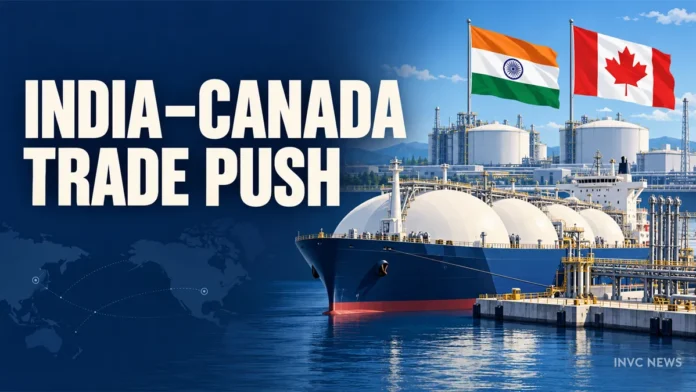
OTTAWA, Canada | October 8, 2026 — India-Canada trade talks are putting long-term supply relationships at the center of a renewed economic push. Canada is presenting its energy resources, critical minerals, and aerospace capabilities as potential answers to India’s growing industrial needs while negotiators hold a fifth round of discussions on a proposed trade agreement.
The immediate milestone is the October 5–9 negotiating round. However, the wider ambition stretches beyond this week: both sides aim to conclude negotiations on a Comprehensive Economic Partnership Agreement, or CEPA, by the end of 2026.
For businesses, the distinction matters. A negotiating deadline signals intent, while an agreed and implemented pact would determine the actual trading conditions.
Energy Supply Gives the Partnership a Concrete Starting Point
One existing commercial commitment already illustrates the long-term approach.
Cameco announced on March 2 that it had signed an agreement with India’s Department of Atomic Energy to supply nearly 22 million pounds of uranium ore concentrate. Deliveries are expected from 2027 through 2035.
The Canadian company estimated the contract’s value at approximately C$2.6 billion, based on market-related pricing. Consequently, the figure represents an estimated value rather than a fixed US-dollar amount.
The agreement provides a specific example of nuclear-fuel cooperation. It should remain separate from the proposed CEPA, which negotiators have yet to complete.
LNG Expansion Supports Canada’s Export Pitch
Canada is also expanding its liquefied natural gas export capacity.
LNG Canada’s partners approved the Phase 2 expansion in Kitimat, British Columbia, on September 29. The C$33 billion project will double the facility’s production capacity to 28 million tonnes annually.
That expansion supports Canada’s effort to reach overseas energy markets. However, additional export capacity does not automatically establish a dedicated supply agreement with India.
Any future purchase would require its own commercial terms, delivery arrangements, and timetable. Readers should therefore distinguish Canada’s capacity-building plans from confirmed Indian procurement.
Aerospace and Critical Minerals Broaden the Agenda
In its October 2 readout, Global Affairs Canada highlighted the country’s ability to meet Indian demand for energy, critical minerals, and other commodities.
Meanwhile, Canada’s September account of ministerial meetings identified aerospace among the priority sectors for collaboration.
These sectors give the talks an industrial dimension alongside conventional trade. For an Indian manufacturer or Canadian supplier, the useful question is which specific partnership can progress from discussion to a contract.
A general statement of capability does not mean Canada has secured an order for aircraft, minerals, or energy products. The available announcements describe opportunities and priorities.
Ministerial Meetings Build Momentum
Canadian International Trade Minister Maninder Sidhu and India’s Commerce and Industry Minister Piyush Goyal discussed CEPA progress during the G20 trade ministers’ meeting in Milwaukee.
Their discussions followed a meeting in Mumbai in September. Canada’s October 2 readout confirmed the fifth negotiating round and the effort to reach a mutually beneficial agreement by year-end.
Still, progress in talks and completion of talks are different milestones. Companies planning investments should assess the final negotiated text when it becomes available.
Canada Targets C$70 Billion in Annual Trade
Canada has set a goal of increasing annual two-way trade with India to C$70 billion by 2030.
Its government reported C$30.4 billion in goods-and-services trade during 2025, including C$13.6 billion in merchandise trade. Canadian goods exports to India totaled C$3.9 billion, while merchandise imports from India reached C$9.7 billion.
The 2030 figure remains a policy target. It does not represent trade already achieved or revenue guaranteed by a future agreement.
An October Trade Mission Offers the Next Business Milestone
Canada plans to send a Team Canada Trade Mission to India from October 12–17. The mission gives businesses another opportunity to explore commercial relationships while negotiations continue.
For companies tracking the partnership, useful developments will include named contracts, confirmed delivery schedules, and specific commitments from negotiating authorities.
For readers, the strongest reason to follow this story is the connection between diplomacy and long-term industrial supply. Uranium deliveries, LNG capacity, and aerospace cooperation could shape business relationships over many years.
The next test is concrete: whether the current negotiating round and upcoming mission produce commitments that companies can act on, alongside progress toward the proposed CEPA.