NEW DELHI, India | October 1, 2026 —
Delhi’s monsoon has delivered a warning just as the capital enters the season when air pollution typically becomes harder to disperse: rain can clean the air, but the relief may last only a matter of hours.
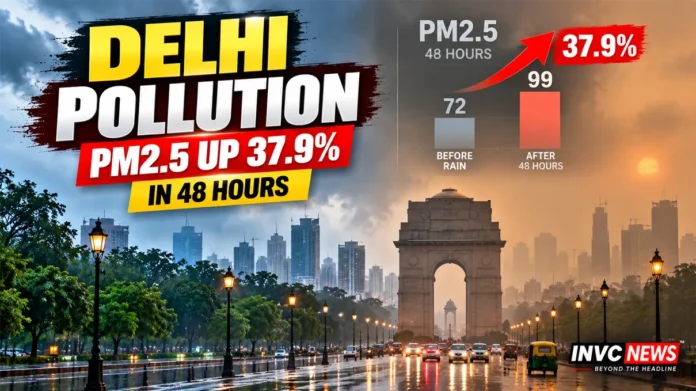
A new analysis by the Centre for Science and Environment found that average PM2.5 concentrations during selected monsoon rainfall events fell to 32.7 micrograms per cubic meter. Just 48 hours after the rain stopped, however, they climbed to 45.1 micrograms per cubic meter — a 37.9% rebound from the rain-time level and even higher than the pre-rain baseline.
For Delhi-NCR residents, that finding matters more than another daily AQI number.
The rain may be leaving. The pollution sources are not.
And with the post-monsoon and winter pollution season approaching, the speed at which particulate pollution returns could become one of the biggest air-quality concerns for the capital.
THE 60-SECOND BRIEF
Delhi recorded only one “Good” AQI day during the 92-day June-August monsoon period analyzed by CSE, despite substantial rainfall.
That single Good day came on July 9, 2026.
CSE found that average PM2.5 during six isolated monsoon rainfall events fell from 40.6 µg/m³ before rainfall to 32.7 µg/m³ during rainfall.
Within 24 hours after rain, it increased to 36.2 µg/m³.
Within 48 hours, it reached 45.1 µg/m³ — 37.9% above the concentration recorded during rainfall and 11.1% higher than the pre-rain baseline.
At the same time, there is another side to Delhi’s 2026 air-quality story: government data shows that September’s monthly average AQI was 102, the lowest September average recorded in the past five years.
So Delhi’s air has shown some broader improvement, but CSE’s analysis raises a more uncomfortable question: Why does pollution return so quickly when favorable weather disappears?
Rain Cut PM2.5 — Then Pollution Came Back Fast
The most important number in the new analysis is not Delhi’s highest AQI.
It is 48 hours.
CSE examined six isolated rainfall events during the June-August monsoon period to understand how particulate pollution responded before, during and after rain.
Before rainfall, average PM2.5 stood at 40.6 µg/m³.
During active rainfall, it dropped to 32.7 µg/m³, a decline of about 19.5%.
That is the effect Delhi residents recognize immediately after substantial rain: clearer skies and temporarily cleaner-feeling air.
But the improvement did not last.
Twenty-four hours after the rain stopped, average PM2.5 had climbed to 36.2 µg/m³.
After 48 hours, it reached 45.1 µg/m³.
That represents a 37.9% increase compared with the concentration measured during the rain.
More importantly, the 48-hour level was about 11.1% above the 40.6 µg/m³ pre-rain baseline.
In other words, rainfall temporarily washed particulate matter from the atmosphere, but it did not remove the sources continuously producing pollution.
Why Does Delhi’s Pollution Return So Quickly?
Rain can remove suspended particulate matter through a process known as wet deposition.
But it cannot permanently eliminate emissions.
Once the rain stops and atmospheric conditions change, pollution from vehicles, industry, waste burning, power generation, construction activity, dust and other sources continues entering the air.
CSE describes the pattern as a “washout and quick rebound” dynamic.
The finding is significant because it challenges the idea that a good monsoon can solve Delhi’s pollution problem even temporarily for long stretches.
Weather can help.
It cannot replace emission control.
Only One ‘Good’ Air Day in 92 Monsoon Days
CSE’s analysis of the 92 days from June 1 through August 31, 2026 produced another striking finding.
Delhi recorded only one day in the “Good” AQI category during that entire period.
That occurred on July 9, when the combined mean rainfall recorded across the Safdarjung and Palam meteorological stations reached 67.75 mm.
Of the 92 days analyzed:
53 days — 57.6% — were “Moderate.”
35 days — 38% — were “Satisfactory.”
Three days — 3.3% — were “Poor.”
Only one day — 1.1% — was “Good.”
Neither the summer nor the monsoon period analyzed by CSE recorded a “Very Poor” or “Severe” day.
That is important context.
The study does not say Delhi experienced extreme winter-like pollution throughout the monsoon. Instead, it shows how difficult it was for the capital to reach genuinely “Good” air quality even during the season most favorable for atmospheric cleansing.
Even the Heaviest Rain Did Not Deliver ‘Good’ Air
More rain did not automatically produce clean air.
According to CSE, the season’s highest daily rainfall event — 101.05 mm on August 8 — resulted in only a “Satisfactory” AQI classification.
That finding points toward the role of Delhi’s underlying pollution load.
If background emissions remain high, even substantial rainfall may provide only temporary relief.
And once the atmospheric cleaning effect disappears, concentrations can rebuild.
But Delhi Also Has Some Better News
The latest data is not uniformly negative.
According to the Ministry of Environment, Forest and Climate Change, Delhi’s average AQI for September 2026 was 102.
That was lower than:
105 in September 2025
105 in September 2024
108 in September 2023
104 in September 2022
The government described September 2026 as Delhi’s lowest September average AQI in the past five years.
From January through September, Delhi also recorded 194 days with a daily average AQI below 200, the highest such count during the corresponding period over the past five years.
Meanwhile, the number of “Poor to Severe+” days fell to 79, compared with 86 in 2025, 86 in 2024, 80 in 2023 and 127 in 2022.
That means two facts can be true at the same time:
Delhi’s broader 2026 air-quality indicators have improved in several respects, while the city’s underlying pollution remains high enough to rebound rapidly when rain stops.
PM2.5 Is Not the Whole Story
Rain is particularly effective at removing suspended particulate matter, but Delhi’s AQI is influenced by other pollutants as well.
CSE found that as particulate pollution fell during wetter conditions, gaseous pollutants sometimes became more prominent.
Ground-level ozone was the lead daily pollutant on 20 monsoon days in the analysis.
Nitrogen dioxide and carbon monoxide also became more prominent during parts of the season.
This matters because cleaner-looking skies do not necessarily mean that every harmful pollutant has disappeared.
Why October Changes the Equation
Delhi has now entered a more challenging part of its annual pollution cycle.
The southwest monsoon withdrew from Delhi on September 23, according to the meteorological information cited in CSE’s analysis.
That removes one of the natural mechanisms that periodically washes particulate matter from the atmosphere.
As the region moves toward winter, meteorological conditions can also become less favorable for pollution dispersion.
Shallower atmospheric mixing, temperature inversions and periods of stagnant air can allow emissions to accumulate closer to the surface.
That is why the speed of the post-rain PM2.5 rebound matters now.
It shows the pollution burden Delhi is carrying before the most difficult winter conditions fully arrive.
What Does AQI 129 Actually Mean?
An AQI reading between 101 and 200 falls in India’s “Moderate” category.
Under India’s AQI classification, 0-50 is “Good,” 51-100 is “Satisfactory,” 101-200 is “Moderate,” 201-300 is “Poor,” 301-400 is “Very Poor,” and 401-500 is “Severe.”
For readers, the important point is that “Moderate” does not mean pollution-free air.
Air-quality conditions can also vary significantly by monitoring station and time of day, so a citywide number should not be interpreted as the pollution level on every street.
What Should Delhi-NCR Residents Watch Now?
The most useful number over the coming weeks will not necessarily be one isolated AQI reading.
Watch the trend.
If PM2.5 and overall AQI begin climbing consistently as rainfall disappears and atmospheric dispersion weakens, that would indicate that Delhi is entering its seasonal pollution buildup.
People can also pay attention to official AQI information for their immediate area rather than relying solely on a citywide headline number.
Those particularly sensitive to air pollution should follow official health advisories when pollution levels rise.
Why Delhi Cannot Depend on Rain
The new analysis points toward a structural problem.
Rain is an atmospheric cleaner.
It is not an emissions-control policy.
CSE argues that Delhi-NCR needs year-round action across the entire airshed, including cleaner transportation, industrial emission reductions, better waste management, controls on open burning, cleaner energy and stronger dust management.
The NCR dimension is especially important because air pollution does not stop at Delhi’s administrative border.
Emissions generated elsewhere in the region can affect air quality across the wider metropolitan airshed.
What Happens Next
October will be an important transition month.
Delhi is moving from monsoon-assisted atmospheric cleaning toward the period when unfavorable meteorology can amplify existing emissions.
That makes the next several weeks an early test.
If pollution rises rapidly despite relatively favorable starting conditions, authorities may face pressure to act before Delhi reaches the severe episodes commonly associated with late fall and winter.
The central question is no longer whether rain can temporarily clean Delhi’s air.
The data shows that it can.
The harder question is whether Delhi can keep its air cleaner after the rain is gone.
INVC NEWS Bottom Line
Delhi’s 2026 air-quality story contains both progress and a warning.
September recorded the capital’s lowest average AQI for the month in five years, according to government data.
But CSE’s monsoon analysis found only one “Good” AQI day in 92 days, while PM2.5 rebounded 37.9% within 48 hours after rainfall during the isolated rain events it studied.
Those findings are not contradictory.
They reveal the difference between relative improvement and genuinely clean air.
For Delhi-NCR residents, that distinction matters now. Rain provided temporary relief. October will begin showing how the capital’s air performs without that natural washout — and before winter makes pollution harder to disperse.