THIRUVANANTHAPURAM, India | September 28, 2026 —
Virat Kohli did not merely reach another milestone on Sunday night.
He tore through it.
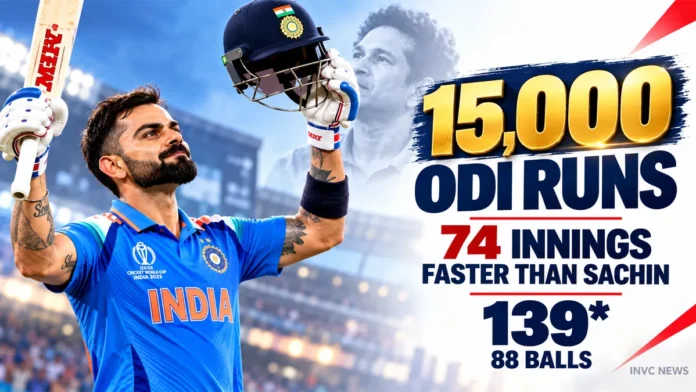
The Indian batting great became only the second player in men’s ODI history to score 15,000 runs, reaching the landmark in his 303rd innings — a staggering 74 innings faster than Sachin Tendulkar.
Then he kept going.
Kohli finished unbeaten on 139 from just 88 balls, hammering 10 fours and a career-best nine sixes as India chased 296 against West Indies with 50 balls to spare.
By the time the night was over, Kohli had his 55th ODI century, his 86th international hundred, 15,080 ODI runs and yet another entry in cricket’s record books.
But the number that should worry India’s opponents most is not 15,000.
It is 157.95 — Kohli’s strike rate during an innings that showed he is not simply extending his career.
He is changing the way he bats.
THE 60-SECOND BRIEF
Virat Kohli became only the second batter after Sachin Tendulkar to cross 15,000 ODI runs.
Kohli reached the landmark in his 303rd ODI innings.
Tendulkar needed 377 innings.
That makes Kohli 74 innings faster to the milestone.
He went on to smash an unbeaten 139 off 88 balls, including 10 fours and nine sixes.
It was Kohli’s record-extending 55th ODI century and his 86th international hundred.
India chased West Indies’ 295 for seven in just 41.4 overs to win by eight wickets and take a 1-0 lead in the three-match series.
And Kohli finished the chase himself.
15,000 Runs — But Look at How Fast He Got There
Sachin Tendulkar remains the highest run-scorer in ODI history with 18,426 runs.
That record still stands.
But Kohli has now reached the 15,000-run landmark substantially faster.
Tendulkar required 377 innings to get there.
Kohli needed only 303.
That difference — 74 innings — puts the scale of Kohli’s consistency into perspective.
He was already the fastest player to several previous ODI milestones.
Now 15,000 joins the list.
Only two men have ever reached this territory in ODI cricket.
Tendulkar.
Kohli.
Everyone else remains below them.
The Moment History Arrived
Kohli entered the match needing 59 runs to reach 15,000.
He did not crawl toward the landmark.
In the 29th over, facing West Indies fast bowler Alzarri Joseph, Kohli pulled a delivery to the boundary and crossed the mark.
The crowd erupted.
Kohli raised his arms.
But there was no long pause to admire the achievement.
There was still a chase to finish.
And that is where the innings became even more remarkable.
Kohli Wasn’t Satisfied With 15,000 — He Wanted the Match
Kohli reached his half-century from 40 balls.
His hundred arrived from only 74 deliveries, making it one of the fastest ODI centuries of his career.
He brought it up with a six.
Then he continued attacking.
By the finish, Kohli had smashed nine sixes — the most he has ever hit in a single ODI innings.
That statistic is worth stopping on.
At 37, after more than 15,000 ODI runs and nearly two decades of international cricket, Kohli has just produced the most six-heavy ODI innings of his career.
This was not an aging batter protecting his numbers.
This was a batter increasing the tempo.
139 Not Out From 88 Balls
Kohli’s final numbers were brutal:
139 not out
88 balls
10 fours
9 sixes
Strike rate: 157.95
And crucially, he remained there when the match ended.
India did not simply complete the chase.
It overwhelmed it.
A target of 296 could have produced a tense final 10 overs.
Instead, India finished in 41.4 overs, winning by eight wickets.
Shubman Gill Joins the Party
Kohli did not destroy West Indies alone.
India captain Shubman Gill produced a century of his own, scoring 110 from 108 balls.
Kohli and Gill combined for a commanding 151-run second-wicket partnership.
Once that partnership settled into the chase, West Indies gradually ran out of ways to stop India.
Gill provided control.
Kohli increasingly provided acceleration.
Together, they transformed what initially looked like a competitive target into a comfortable Indian victory.
West Indies Had Actually Set Up the Game Well
The final margin can make it easy to forget that West Indies had produced a strong batting performance.
They posted 295 for seven after receiving an excellent start.
Justin Greaves struck his maiden ODI century, scoring 101, while John Campbell made 62.
Their opening partnership gave West Indies a strong platform.
Later, Amir Jangoo’s unbeaten 58 helped push the total close to 300.
At that stage, 295 looked competitive.
Then Kohli walked out.
Kuldeep Yadav Changed the First Innings
Before Kohli took control of the chase, Kuldeep Yadav had already dragged India back into the contest.
West Indies were strongly placed before Kuldeep triggered a middle-order slowdown.
He finished with 4 for 40, helping prevent the visitors from turning a promising start into a total well above 300.
That spell gave India a target their batting lineup could attack.
Kohli and Gill did the rest.
Century No. 55 — And Sachin Appears Again
Kohli’s unbeaten 139 was his 55th ODI century, extending his own world record.
It was also his 86th international hundred.
That number inevitably brings Sachin Tendulkar back into the conversation.
Tendulkar finished his career with 100 international centuries.
Kohli now stands on 86.
Yet Kohli himself continues to play down milestone chasing.
After the match, his message was essentially about enjoying the journey, maintaining fitness and doing what the team requires rather than obsessing over personal numbers.
The numbers, however, keep following him anyway.
2027 World Cup Changes the Meaning of This Innings
There is another reason Sunday’s 139 matters.
Kohli now plays only ODI cricket internationally.
And the 2027 World Cup looms on the horizon.
That means every major Kohli innings will inevitably be viewed through the same question:
What version of Virat Kohli will India take to the World Cup?
Sunday provided a fascinating answer.
Not simply the accumulator.
Not simply the chase master.
But a batter prepared to attack at nearly 160 runs per 100 balls.
If that evolution continues, India may enter the World Cup with a version of Kohli opponents have not previously had to plan for.
THE BIGGER PICTURE
Cricket statistics can sometimes lose their meaning because modern fans see records broken constantly.
This one deserves perspective.
Fifteen thousand ODI runs is a milestone achieved by only two batters in the history of the format.
Kohli got there while maintaining an extraordinary scoring rate and century frequency.
He has now accumulated 15,080 ODI runs.
He owns the record for most ODI centuries.
He remains second only to Tendulkar on the all-time ODI run list.
And he has reached 15,000 considerably faster than the man he spent much of his career being compared with.
Yet perhaps the most interesting detail from Thiruvananthapuram was not historical.
It was contemporary.
Kohli still looks capable of changing.
INVC NEWS Bottom Line
Virat Kohli entered Sunday needing 59 runs for history.
He left with 139 not out, 15,080 career ODI runs, a 55th ODI hundred, nine sixes and another India victory.
He became only the second man to reach 15,000 ODI runs.
And he got there 74 innings faster than Sachin Tendulkar.
That alone would have made it a historic night.
But Kohli added something more important.
At 37, with nearly every major ODI batting achievement already attached to his name, he showed that he may not be slowing his game down.
He may actually be speeding it up.
And with the 2027 World Cup approaching, that could matter far more than another record.
What happened. Why it matters. What comes next.