WASHINGTON, United States | September 26, 2026 —
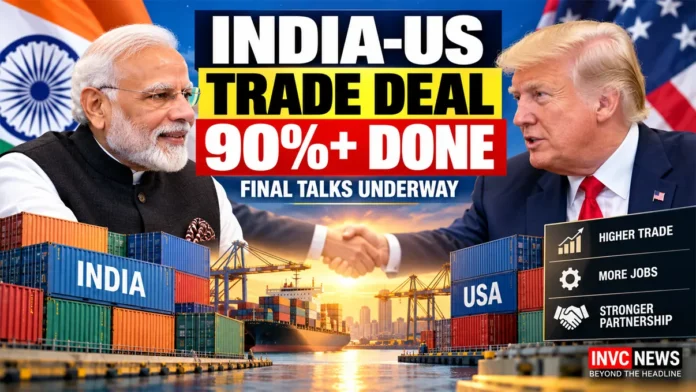
The proposed India-US trade agreement has moved into its final negotiating phase, with more than 90 percent of the work understood to be complete and only a limited number of sensitive issues still under discussion.
The development marks a significant moment in economic ties between the world’s two major democracies.
India and the United States have spent months negotiating a broader Bilateral Trade Agreement aimed at improving market access, reducing trade barriers, strengthening supply chains and expanding commercial cooperation.
The remaining negotiations are now expected to determine how far both sides are prepared to move on tariffs, market access and politically sensitive sectors.
THE 60-SECOND BRIEF
Trade Deal Status: More than 90 percent of negotiations are complete
Current Stage: Final issues remain under discussion
Main Areas: Tariffs, market access, non-tariff barriers, digital trade and supply chains
Bigger Goal: Expand India-US bilateral trade under Mission 500
What Is Not Done Yet: No final agreement or implementation date has been announced
What Comes Next: Negotiators must settle the remaining differences before a formal deal
India-US Trade Talks Enter Final Stretch
The latest stage of negotiations suggests that most of the technical groundwork has already been completed.
Indian and American negotiators have held repeated rounds of discussions covering goods trade, customs procedures, digital trade, investment, economic security and market access.
The focus has now shifted from broad principles to the more difficult final issues.
This is often the most sensitive phase of any major trade negotiation because the remaining points usually involve sectors where domestic political and economic interests are strongest.
Why This Trade Deal Matters
The United States is one of India’s most important economic partners.
The relationship already spans technology, pharmaceuticals, engineering, electronics, energy, defence manufacturing, digital services, financial services and investment.
A new trade agreement could deepen those links further.
For Indian companies, easier access to the American market could improve export competitiveness.
For American businesses, the agreement could create additional opportunities in India’s rapidly expanding consumer and industrial economy.
Mission 500 Is the Bigger Target
The proposed trade agreement sits inside the wider Mission 500 framework.
India and the United States have set a goal of increasing bilateral trade to $500 billion by 2030.
That target is ambitious.
Reaching it would require faster growth in goods trade, services, technology partnerships, investment and manufacturing cooperation.
A trade agreement could become one of the main tools for achieving that goal.
Tariffs Remain a Key Issue
Tariff reduction is one of the most important parts of the negotiations.
Both sides want better access for their exporters.
India is seeking competitive conditions for sectors where it has strong export potential.
The United States is also pushing for improved access for American products and services.
The final tariff structure will therefore be one of the most closely watched parts of the agreement.
Indian Exporters Could See New Opportunities
Several Indian industries could benefit if the final agreement reduces barriers in the US market.
These include:
Pharmaceuticals
Engineering goods
Textiles and apparel
Electronics
Auto components
Chemicals
Gems and jewellery
Information technology services
Professional services
However, the actual impact will depend on the final tariff schedules and product-specific commitments.
US Businesses Are Also Watching India
American companies are equally interested in the outcome.
India is one of the world’s fastest-growing major markets and offers opportunities across technology, energy, advanced manufacturing, machinery and services.
US businesses are likely to watch for changes in:
Import duties
Regulatory procedures
Market access
Investment rules
Customs processes
Digital trade provisions
A successful agreement could reduce friction for companies operating across both markets.
Agriculture Could Remain Sensitive
Agriculture is traditionally one of the most difficult areas in trade negotiations.
India has to balance international market access with the interests of domestic farmers and food security.
The United States, meanwhile, seeks stronger access for agricultural exports.
This makes agriculture one of the sectors where final negotiations could require careful compromise.
Digital Trade Has Become a Major Issue
The trade relationship is no longer only about physical goods.
India and the United States are deeply connected through technology and digital services.
Software, cloud computing, artificial intelligence, digital platforms and professional services all play a growing role in bilateral commerce.
That is why digital trade has emerged as an important part of the negotiations.
The final framework could influence how companies operate across both countries in the years ahead.
Supply Chains Are Now Strategic
Supply-chain resilience is another major part of the discussions.
Recent global disruptions have pushed countries to reduce dependence on a small number of manufacturing locations.
India wants to expand its role in global manufacturing.
The United States also wants more secure and diversified supply chains.
That creates potential for greater cooperation in areas such as electronics, pharmaceuticals, semiconductors, critical technologies and advanced manufacturing.
The Deal Is Not Signed Yet
This is the most important point for businesses and investors.
The negotiations may be close to completion, but the agreement has not yet been formally concluded.
No final implementation date has been announced.
Existing trade rules therefore remain in force.
The remaining issues must still be resolved before either government can formally announce the agreement.
Why the Final 10 Percent Matters Most
Trade negotiations often become harder near the finish line.
The first 80 or 90 percent may involve areas where broad agreement is easier.
The final portion often contains the most difficult questions.
These can include:
Sensitive tariff lines
Agricultural access
Regulatory standards
Domestic industry protection
Digital trade rules
Investment conditions
The final outcome will depend on how both sides balance these interests.
What It Could Mean for India
For India, a successful agreement could support exports, attract investment and strengthen manufacturing.
It could also deepen India’s role in global supply chains.
At the same time, New Delhi will want to protect sectors where sudden import competition could affect domestic producers.
The final agreement will therefore need to balance openness with domestic economic priorities.
What It Could Mean for the United States
For the United States, India represents a major long-term commercial market.
A trade agreement could provide American companies with better access to one of the world’s largest consumer bases.
It could also strengthen economic ties in strategic sectors where Washington wants closer cooperation with trusted partners.
More Than Just a Trade Agreement
The negotiations also have a strategic dimension.
India-US economic ties increasingly overlap with technology, manufacturing, energy security and global supply chains.
That means the agreement could influence the broader relationship well beyond tariffs.
If successfully concluded, it could become one of the most important economic pillars of India-US relations.
What Happens Next
Negotiators will now focus on the remaining unresolved issues.
If both sides reach a final understanding, the next step would be a formal announcement followed by implementation details.
Businesses will then closely examine:
Tariff changes
Sector-specific concessions
Implementation dates
Rules for exporters
Customs procedures
Investment provisions
Until that happens, the negotiations remain unfinished.
INVC NEWS Bottom Line
The India-US trade agreement has entered its final stage, with more than 90 percent of the negotiations understood to be complete. Most major issues have already been discussed, but the remaining differences could determine the real commercial value of the deal. The next breakthrough will come only when both sides formally settle the final tariff, market-access and regulatory questions.
What happened. Why it matters. What comes next.