HYDERABAD, India | September 24, 2026 —
Nani walks into The Paradise almost unrecognisable.
The easy smile is gone.
The familiar warmth is buried.
In its place stands Jadal — bruised, angry, unpredictable and carrying enough rage to set an entire world on fire.
And for a while, The Paradise feels exactly like the huge theatrical experience its makers promised.
The world looks lived-in. The violence hurts. The atmosphere feels dangerous. Nani attacks the role with startling physical commitment.
Then the interval arrives.
You lean forward expecting the film to explode.
And that is where the real problem begins.
The Paradise has the scale of an epic, the body of a blockbuster and a star giving almost everything he has — but does its screenplay have enough life to carry nearly three hours?
That is the question that matters before you spend your money and an entire evening on it.
Here is our spoiler-light The Paradise movie review, rating and final verdict.
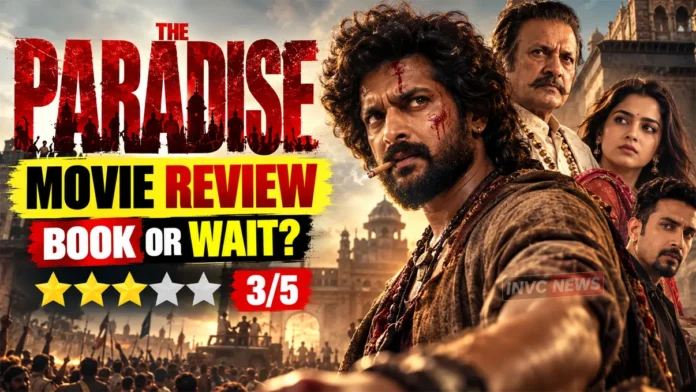
⭐ INVC NEWS Rating: 3/5
Movie: The Paradise
Genre: Period Action Drama / Thriller
Runtime: Approximately 2 Hours 54 Minutes
Director: Srikanth Odela
Lead: Nani
Cast: Mohan Babu, Kayadu Lohar, Sonali Kulkarni, Raghav Juyal, Sampoornesh Babu
Theatrical Release: September 24, 2026
The Paradise Story: What Is Nani’s New Movie About?
The Paradise takes us into 1980s Secunderabad, into the world of the Savaari community.
This is not presented as a comfortable world.
Power has already decided who gets dignity.
Who gets heard.
Who belongs.
And who must remain invisible.
At the centre of this landscape is Jadal, played by Nani.
He returns from prison and finds himself stepping back into a society dominated by the powerful Malik, played by Mohan Babu.
But Jadal does not immediately arrive as a roaring mass hero.
That is important.
Srikanth Odela initially allows him to exist inside the world before turning him into the force that begins challenging it.
The story gradually grows from one man’s survival into a larger struggle involving identity, dignity, power and rebellion.
And this gradual build is precisely why the first half works.
Nani Is Not Playing Jadal — He Almost Disappears Into Him
If there is one unquestionable reason to watch The Paradise, it is Nani.
This is not simply beard, hair, costume and dirt applied to a star.
His entire physical language changes.
The walk feels heavier.
The shoulders carry aggression.
The face rarely relaxes.
Even when Jadal is silent, he looks like someone constantly measuring the danger around him.
That is where Nani’s performance becomes impressive.
He does not begin the film screaming that he is a mass hero.
He lets Jadal become one.
And when the restrained anger finally erupts, the action carries more force because the character has spent time holding it back.
This is easily among the movie’s biggest strengths.
The First Half Makes You Believe You Are Watching Something Special
Srikanth Odela knows how to build a world.
That talent was visible in Dasara, and it is visible again here.
The setting does not merely sit behind the actors.
It shapes them.
The lanes, homes, hierarchy, clothing, dust and power structures make the environment feel hostile before anybody throws a punch.
The film’s first half understands something many large action movies forget:
Tension is more powerful when you earn the explosion.
For a significant stretch, The Paradise does exactly that.
It holds back.
It lets characters collide.
It allows Jadal’s place within this society to become clearer.
Then the action arrives with weight.
By the interval, the film has built enough momentum to make you expect an extraordinary second half.
And perhaps that expectation becomes its biggest enemy.
Then Comes the Second Half — Bigger, Bloodier… and Strangely Less Powerful
This is where The Paradise begins losing its grip.
The film becomes louder.
The confrontations become bigger.
The violence escalates.
But the emotional impact does not increase at the same rate.
That is a serious problem.
Because violence in cinema becomes powerful when we care deeply about who is hurting and why.
Without that emotional progression, one brutal confrontation can begin resembling the next.
The movie starts replacing dramatic development with escalation.
More rage.
More blood.
More bodies.
More spectacle.
But not necessarily more feeling.
Contemporary reviews have similarly identified the second half’s repetition, extended violence and pacing as major weaknesses, even while praising Nani’s commitment and the film’s craft.
The Biggest Problem? The Paradise Gives You a Familiar Story in Extremely Expensive Packaging
The central dramatic template is familiar.
An oppressed community.
A powerful figure controlling that world.
A reluctant man who gradually becomes the face of resistance.
A rebellion.
A bloody confrontation.
There is nothing inherently wrong with that structure.
Cinema has retold familiar stories for decades.
The difference lies in what new emotion, character or perspective a filmmaker brings to the template.
And that is where The Paradise feels uneven.
Visually, it often feels fresh.
Narratively, not always.
The world is distinctive.
The storytelling underneath it can feel surprisingly familiar.
That gap becomes more obvious as the film moves forward.
Mohan Babu Has the Presence — But the Film Needed More of Him
Mohan Babu has exactly the kind of authority required for a character like Malik.
He can dominate a frame without doing much.
The problem is not his presence.
The problem is how much the screenplay develops that presence.
A rebellion becomes far more compelling when the person or system being challenged feels equally formidable.
The Jadal-Malik equation therefore had the potential to become the film’s dramatic spine.
But the antagonist does not always receive enough depth or screen space to make that conflict as rich as it could have been.
The result?
Jadal often feels more developed than the force he is fighting.
That weakens the confrontation.
Raghav Juyal Brings Menace, But Deserved More Material
Raghav Juyal enters Telugu cinema with the kind of unpredictability that suits this world.
There is something naturally uneasy about his screen presence here.
But again, The Paradise has a recurring supporting-character problem.
It assembles interesting performers.
Then it does not always give them enough complexity.
Juyal makes an impression.
Yet you may leave wanting much more from the character.
Kayadu Lohar Gives the Film Some Much-Needed Warmth
In a movie soaked in aggression, Kayadu Lohar becomes important because her scenes allow the story to breathe.
Her character’s relationship with Jadal brings a softer register to a movie that otherwise spends long stretches operating at high intensity.
Those quieter moments matter.
In fact, the film could have used more of them.
Because emotional contrast makes violence stronger.
If everything is brutal, brutality stops surprising you.
Sonali Kulkarni Adds Emotion the Film Sometimes Forgets It Needs
Sonali Kulkarni brings credibility and emotional weight to the mother-son relationship.
Her presence reminds you that Jadal exists beyond rebellion and action.
There is a person underneath the rage.
This is another area where The Paradise reveals what it could have been with a little more patience.
Whenever the movie stops chasing spectacle and allows human relationships to breathe, it becomes more affecting.
Unfortunately, those moments gradually become less dominant.
The Action Is Raw — But More Is Not Always More
The action choreography is one of the film’s genuine attractions.
Hits feel heavy.
Bodies have weight.
The violence often looks dirty rather than decorative.
That suits Jadal’s world.
There are sequences where the sheer physicality of Nani’s performance creates a genuine theatrical rush.
But the film eventually runs into a basic problem:
How many times can you increase the violence before the audience becomes numb to it?
The first major eruption can shock.
The second can thrill.
By the fifth or sixth, scale alone is no longer enough.
Action needs emotional escalation too.
That is where the movie loses some of its power.
The Paradise Looks Expensive — And Often Beautifully Ugly
This may sound contradictory.
It is actually one of the film’s strengths.
The production design creates an environment that is deliberately rough, weathered and oppressive.
The movie does not need everything to look pretty.
It needs everything to feel authentic to the world it is constructing.
The cinematography supports that approach with textured landscapes and forceful action imagery.
On the craft level, The Paradise repeatedly reminds you that considerable ambition and resources went into putting this world on screen.
The frustration comes from wishing the writing had always matched the visual confidence.
Nearly Three Hours Is a Serious Commitment
A 2-hour-54-minute runtime changes how a movie must be judged.
A film can absolutely justify three hours.
But every additional sequence must deepen something:
Character.
Conflict.
Emotion.
World.
Or consequence.
The Paradise does not always pass that test.
The first half earns its patience.
The second half sometimes feels like it is circling emotions the movie has already established.
A tighter edit could have made the final stretch hit harder.
Because exhaustion should come from what characters endure.
Not from the viewer checking how much film remains.
Srikanth Odela Has a Voice — That Is Why the Misses Hurt More
There is no question that Srikanth Odela knows how to create cinematic atmosphere.
Even when The Paradise frustrates, it rarely looks anonymous.
That matters.
There is authorship here.
There is texture.
There is ambition.
There is a filmmaker attempting to build something much larger than a routine star vehicle.
But ambition creates expectation.
After the stronger stretches of the first half, viewers naturally expect the second half to deepen the world rather than simply amplify the spectacle.
That payoff does not arrive consistently.
The movie becomes bigger when it needed to become deeper.
Is The Paradise Worth Watching in Theatres?
Here is the answer most readers actually came for.
Yes — but with a major condition.
If you are going primarily for Nani’s transformation, big-screen action, production design and a raw theatrical atmosphere, The Paradise offers enough to justify a cinema visit.
If you are expecting an exceptionally fresh screenplay to match that scale, expectations should be moderated.
The first half promises a richer movie than the second half ultimately delivers.
That does not make The Paradise a worthless film.
Far from it.
There is too much craft, physical commitment and visual ambition here for that.
But it does make the film frustrating.
Because you can repeatedly see the much better movie hiding inside it.
Nani Fans: Should You Watch It?
Absolutely.
For Nani fans, the performance alone is a major attraction.
This is one of those films where the actor’s commitment is visible beyond dialogue delivery.
His physical transformation matters.
His body language matters.
His silence matters.
His action matters.
You may debate the film.
It is much harder to dismiss the effort he puts into Jadal.
Family Audience: Is The Paradise for Everyone?
Not necessarily.
The movie carries intense violence and dark themes.
Therefore, viewers seeking light family entertainment should know what kind of experience they are entering.
This is designed as an aggressive period-action film, not a relaxed commercial entertainer.
The Paradise — What Works and What Doesn’t
What works: Nani’s physical transformation and performance, the first-half world-building, raw action, production design, cinematography and atmospheric setting.
What struggles: an overextended second half, repetitive violence, familiar rebellion template, underdeveloped supporting characters and a climax that does not fully cash the emotional cheque written by the first half.
Final Verdict
The Paradise is a fascinating contradiction.
It looks enormous.
It feels raw.
It has an actor performing as though his life depends on every frame.
And yet the bigger the movie becomes, the less emotionally powerful it sometimes feels.
Nani gives Jadal flesh, rage and soul.
Srikanth Odela gives him a striking world.
What the film needed was a screenplay ruthless enough to cut away everything that did not deepen either.
The first half makes you think you may be watching something remarkable.
The second half reminds you that spectacle cannot keep replacing story forever.
Still, when The Paradise works, it demands the big screen.
And Nani?
He walks away from the wreckage with his performance intact.
⭐ INVC NEWS Rating: ★★★☆☆ — 3/5
Nani’s Performance: ★★★★☆
Action: ★★★★☆
Story: ★★½☆☆
Visuals & Production: ★★★★☆
Pacing: ★★½☆☆
Theatrical Value: ★★★½☆
Overall: 3/5
BOOK or Skip? This one is theatrical, so the better question is: