NEW DELHI, India | September 24, 2026 —
India is preparing to put a major part of its agricultural research infrastructure under solar power, with 76 Indian Council of Agricultural Research institutes set to receive grid-connected rooftop solar systems across 24 States and Union Territories.
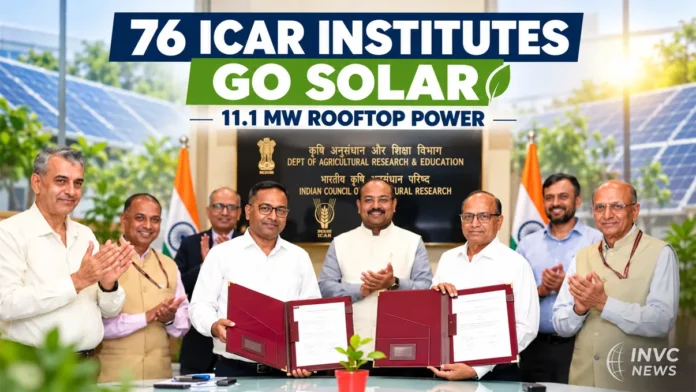
The ICAR rooftop solar project will add a combined 11.1 MW of solar capacity under the Government Building Solarisation component of the PM Surya Ghar: Muft Bijli Yojana.
ICAR has signed a Memorandum of Agreement with REC Power Development and Consultancy Limited, or RECPDCL, for the nationwide rollout.
Once operational, the installations are expected to generate approximately 1.73 crore units of clean electricity every year.
That scale could significantly reduce the participating institutes’ reliance on conventional grid electricity while expanding renewable energy use across India’s agricultural research network.
Solar capacity will reach 11,109.87 kW
Under the agreement, RECPDCL will install rooftop solar photovoltaic systems with an aggregate capacity of 11,109.87 kW, or about 11.1 MW.
The project will cover 76 ICAR institutes spread across 24 States and Union Territories.
Instead of limiting the project to a few large campuses, the programme will take solar generation into a wider network of agricultural research institutions.
That makes the initiative significant not only for electricity generation but also for the broader shift toward cleaner government infrastructure.
Around 1.73 crore units of electricity expected every year
The proposed rooftop systems are expected to produce approximately 17.3 million units, or 1.73 crore units, of clean electricity annually.
For ICAR institutions, this could reduce dependence on electricity generated from conventional sources and help campuses meet part of their power requirements through solar energy produced directly from their rooftops.
The installations will also put otherwise unused rooftop space to productive use.
As the systems begin generating electricity, participating institutions could see a greater share of their daytime electricity demand supported by renewable power.
ICAR will fund project, RECPDCL will execute it
ICAR will fund the rooftop solar projects.
Meanwhile, RECPDCL will act as the Turnkey Implementation Partner and oversee the project from design to commissioning.
Its responsibilities will include engineering, equipment supply, installation, testing and commissioning.
RECPDCL will execute the work through its empanelled EPC-cum-Operation and Maintenance agencies.
Importantly, the arrangement does not end after the solar panels start producing electricity.
The implementation package includes five years of comprehensive operation and maintenance, providing continued support after commissioning.
PM Surya Ghar scheme expands into government buildings
The project comes under the Government Building Solarisation component of PM Surya Ghar: Muft Bijli Yojana.
The Ministry of New and Renewable Energy has designated RECPDCL as a Scheme Implementation Partner for solarisation of government buildings under the programme.
While PM Surya Ghar has become widely associated with residential rooftop solar, government-building solarisation creates another large opportunity for expanding distributed renewable power.
Government offices, research centres, educational facilities and institutional buildings often have substantial rooftop areas that can support solar installations.
The ICAR project brings that strategy directly into India’s agricultural research ecosystem.
Agreement signed by ICAR and RECPDCL officials
Jaspal Singh Kushwaha, General Manager of the Renewable Division at RECPDCL, and Kumar Rajesh, Director (GAC) at ICAR, signed the agreement.
Senior officials from ICAR, the Department of Agricultural Research and Education and RECPDCL attended the signing.
They included Dr. M. L. Jat, Secretary, DARE and Director General, ICAR; Sandeep Sarkar, Additional Secretary, DARE and Financial Advisor, ICAR; Gyanendra D. Tripathi, Additional Secretary, DARE and Secretary, ICAR; and Prince Dhawan, CEO, RECPDCL.
Why the ICAR solar project matters
The project connects two major infrastructure priorities: agricultural research and clean energy.
ICAR operates a nationwide research network that supports work across crops, livestock, fisheries, horticulture, soil science and other areas of Indian agriculture.
Bringing rooftop solar into dozens of these institutions gives renewable energy a direct role in powering research infrastructure.
The programme also shows how government buildings can contribute to India’s clean-energy transition without requiring large new tracts of land for electricity generation.
Rooftop installations produce power close to where institutions consume it. At the same time, they can help reduce conventional electricity use during daylight hours.
With 76 institutes, 11.1 MW of planned capacity and an estimated 1.73 crore units of annual clean electricity generation, the ICAR-RECPDCL agreement creates one of the latest institutional rooftop-solar rollouts under the PM Surya Ghar programme.
The next important phase will be the actual installation and commissioning of systems across the participating ICAR campuses.