By Team INVC | INVC NEWS
MUMBAI, India | September 18, 2026 —
There is a moment early in Resident Evil when it becomes obvious that Zach Cregger has understood something several previous adaptations struggled to grasp.
A Resident Evil movie does not necessarily need to reproduce a Resident Evil game.
It needs to make you feel as though you are trapped inside one.
A dark corridor.
Something moving beyond the frame.
Not enough information.
A character who is clearly less prepared than the person holding the controller would like him to be.
Then survival becomes the only objective that matters.
That distinction transforms Cregger’s Resident Evil from another exercise in franchise reconstruction into a lean, nasty and frequently exhilarating survival-horror movie.
Austin Abrams plays Bryan, a medical courier whose ordinary assignment becomes a nightmare as one horrifying night collapses around him.
He is not Leon Kennedy.
He is not Chris Redfield.
He is not another unstoppable action hero with perfect aim and unlimited confidence.
He is simply a man who desperately wants to stay alive.
That turns out to be exactly what this franchise needed.
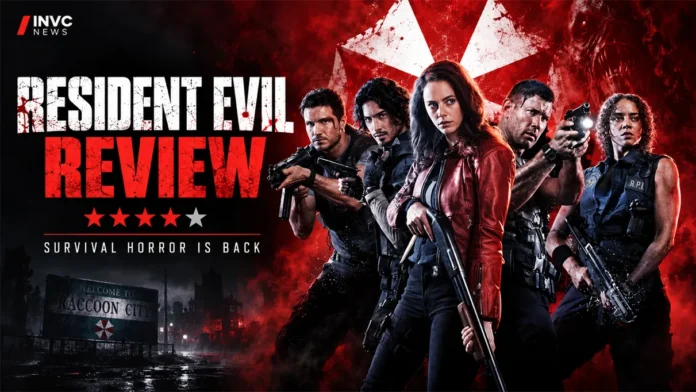
INVC NEWS Rating: ★★★★☆ — 4/5
The Best Resident Evil Idea Is Surprisingly Simple
Hollywood has already tried several approaches to this material.
The original live-action series increasingly turned survival horror into large-scale action.
Resident Evil: Welcome to Raccoon City attempted greater fidelity to the games, but fidelity alone could not produce cinematic tension.
Cregger takes a different route.
He keeps the world.
He keeps the dread.
He keeps the biological nightmare, grotesque creatures and feeling that the next room may contain something much worse than the previous one.
Then he refuses to chain himself to a familiar protagonist or a game-by-game reconstruction.
Bryan enters this universe almost like a new player.
He does not understand the rules.
Neither does he know what is waiting around the corner.
That makes every discovery more dangerous.
Austin Abrams Is Exactly the Kind of Hero Resident Evil Needs
Austin Abrams gives the film its human pulse.
Bryan does not walk into danger looking impressive.
He looks concerned.
Then frightened.
Then exhausted.
Eventually, he reaches the particular stage of survival where fear and irritation begin existing at the same time.
Abrams is excellent at that transition.
He gives Bryan an ordinary quality that makes every threat feel larger.
An invincible hero shrinks a monster.
Bryan makes the monster terrifying because we understand immediately how poorly equipped he is to fight it.
That vulnerability also gives Abrams room for comedy.
His reactions are frequently funny, but the humour does not depend on turning Bryan into a parody.
He remains believable.
Even when the film becomes increasingly extreme, Abrams behaves like someone whose brain is still attempting to process how an ordinary night became completely unmanageable.
That grounding performance allows Cregger to become far more adventurous around him.
Zach Cregger Understands That Horror Is About Anticipation
The director’s real weapon is not gore.
It is expectation.
Cregger already demonstrated with Barbarian and Weapons that he understands how uncomfortable an audience becomes when it cannot predict the shape of the next scene.
That instinct suits Resident Evil extraordinarily well.
A corridor is never merely a corridor.
A shadow matters.
Silence becomes suspicious.
A doorway begins to feel like a decision.
The camera often remains close enough to Bryan that viewers instinctively start scanning the background for danger.
That is where the movie feels most connected to the games.
Not through references.
Through behaviour.
Anyone who has played survival horror knows the feeling of approaching a corner more carefully than should ever be necessary.
Cregger translates that instinct into cinema.
This Is Faithful to Resident Evil Without Becoming a Checklist
The phrase “faithful adaptation” has become strangely limiting.
Fans understandably want filmmakers to respect the material they love.
But respect does not require duplication.
Resident Evil makes one of its smartest choices by separating faithfulness to mythology from faithfulness to experience.
Cregger is more interested in how the games feel than in recreating a familiar campaign beat by beat.
There is isolation.
Resource anxiety.
Uncertainty.
Claustrophobic spaces.
Biological horror.
Creatures that appear as if nature itself has taken a wrong turn.
Most importantly, there is escalation.
Something disturbing becomes something dangerous.
Something dangerous becomes something grotesque.
Then the movie finds something worse.
That progression feels unmistakably Resident Evil even when the story itself is new.
The Creature Work Is Where the Film Becomes Truly Unpleasant — in the Best Way
This is not a polite horror movie.
Bodies do things bodies should not do.
Creatures twist into shapes they have no business occupying.
Movement itself becomes disturbing.
Cregger does not treat monsters simply as obstacles that must be shot.
He allows viewers to look at them.
Sometimes longer than they would prefer.
Practical creature work and digital enhancement combine to produce monsters with weight and texture.
That physicality matters.
A creature becomes more frightening when it appears capable of occupying the same room as the actor.
Several designs recall the biological grotesquerie that has always made the games more memorable than conventional zombie fiction.
The zombies matter.
But mutation is the real nightmare.
Dariusz Wolski’s Camera Turns Space Into a Threat
The cinematography deserves particular attention.
Dariusz Wolski frequently shoots Bryan in ways that evoke the spatial anxiety of third-person survival games without making the film look like somebody recorded gameplay.
That is an important distinction.
The camera follows.
It observes.
Sometimes it appears to know slightly more than Bryan does.
Lighting becomes part of the suspense.
Darkness hides information, but artificial light does not necessarily provide safety.
A hallway may reveal enough for Bryan to move forward without revealing enough for him to feel secure.
That visual language gives the film a strong identity.
It also proves that adapting video games does not require copying their camera angles literally.
The objective is to reproduce the emotional relationship between player and space.
Resident Evil often succeeds.
Ninety Minutes Is One of the Film’s Greatest Strengths
The movie is refreshingly lean.
At approximately 90 minutes, it has little interest in spending half an hour building mythology for future sequels.
Bryan needs to survive tonight.
That is enough.
Scenes tend to arrive with a purpose.
Threats appear quickly.
The film moves from one escalating nightmare to another without becoming burdened by enormous amounts of exposition.
There are moments when Cregger deliberately slows things down.
Those pauses help rather than hurt.
Tension requires silence before impact.
The film understands that.
More franchise movies should.
The Humour Mostly Works Because Bryan Is Not Trying to Be Funny
Cregger’s comedy background remains visible.
Resident Evil can be surprisingly funny.
Fortunately, most of the humour comes from human reactions rather than jokes inserted simply because the audience needs relief.
Bryan behaves like somebody experiencing an increasingly unbelievable night.
Sometimes his frustration becomes funny because the alternative would be screaming continuously for 90 minutes.
That comic instinct gives the movie personality.
It also creates one of its few weaknesses.
Occasionally, a joke arrives at precisely the moment when fear is beginning to peak.
Instead of releasing tension naturally, the humour punctures it.
This does not happen often enough to damage the film.
Still, there are scenes where allowing terror to remain uninterrupted for another minute would have produced a stronger effect.
Paul Walter Hauser Knows Exactly What Kind of Movie He Is In
The supporting cast enters a film that fundamentally belongs to Abrams.
That means several performers receive relatively limited screen time.
Paul Walter Hauser makes particularly effective use of his appearance.
He understands Cregger’s tonal mixture immediately.
The performance can be amusing without behaving as though the surrounding horror is meaningless.
Zach Cherry and Kali Reis contribute to the strange collection of people Bryan encounters as the night deteriorates.
However, this remains deliberately close to a one-man survival experience.
Anyone expecting a large ensemble resembling the games may initially find that surprising.
For this particular story, the decision works.
Isolation strengthens Bryan.
Resident Evil Becomes Better the Less It Explains
One of the film’s smartest qualities is its reluctance to answer every question immediately.
Franchise movies often fear uncertainty.
They explain corporations.
Viruses.
Experiments.
Timelines.
Organizations.
Connections.
Then they explain the explanation.
Cregger understands that a person running for his life does not require a complete corporate history.
Bryan needs enough information to make his next decision.
So does the audience.
That restraint keeps the film moving.
It also makes the world feel larger than the story.
There are things happening beyond Bryan’s understanding.
That is exactly how a nightmare should feel.
Where Resident Evil Loses Some of Its Precision
For most of the runtime, the movie has remarkable control.
The final stretch is less precise.
Escalation eventually becomes so extreme that the careful survival-horror rhythm starts moving closer to spectacle.
That transition is understandable.
A movie cannot keep Bryan walking through dark corridors forever.
Still, the smaller scares are often more effective than the largest ones.
There is also an abruptness to the resolution.
After spending so much time making Bryan worth following, the movie could have given his emotional journey a more satisfying final beat.
The plot finishes more confidently than the character arc does.
That keeps a very good film from becoming exceptional.
The Ending Is the Movie’s Weakest Decision
Without discussing spoilers, the finale presents an interesting contradiction.
Cregger spends most of Resident Evil proving that less can be more.
Then the climax becomes louder.
Bigger.
More overtly constructed as a final encounter.
Some viewers will embrace that escalation.
Others may prefer the tighter dread of what came before.
The larger problem is not scale.
It is emotional completion.
Bryan survives enough for us to become invested in him as more than a disposable franchise protagonist.
The ending does not completely reward that investment.
A few additional minutes focused on consequence rather than spectacle might have changed the aftertaste considerably.
Is This Really the Best Resident Evil Movie?
That question will dominate discussion around the film.
At the time of publication, Rotten Tomatoes lists Resident Evil at 96% from 116 critic reviews.
For comparison, the platform currently lists the original 2002 Resident Evil at 36% and Resident Evil: Welcome to Raccoon City at 30%.
On that measure, Zach Cregger’s film is currently the strongest-reviewed live-action entry in the franchise by a substantial margin.
That is a noteworthy achievement.
It should not, however, become the only reason to watch it.
Critical percentages change as reviews accumulate.
More importantly, franchises are not mathematical competitions.
The Paul W.S. Anderson films have their own identity and an audience that remains deeply attached to them.
Cregger wins a different battle.
He makes a movie that captures the anxiety of playing Resident Evil without pretending cinema and video games must tell stories in exactly the same way.
That may ultimately be the more meaningful achievement.
Gamers Will Notice What Cregger Chooses Not to Do
Fans arriving with a checklist may initially feel disoriented.
This is not a direct recreation of a famous game.
Familiar franchise expectations do not control every scene.
Cregger deliberately creates an original protagonist and lets him enter a recognizable universe from another angle.
Some purists may resist that choice.
Yet the approach offers something endless references cannot.
Surprise.
A survival-horror film loses enormous power when the audience knows exactly which iconic scene will arrive next.
Bryan’s unfamiliar journey restores uncertainty.
And uncertainty is the oxygen of horror.
Newcomers Do Not Need Homework
Another major advantage is accessibility.
You do not need to understand decades of Resident Evil mythology before entering the theater.
The movie gives newcomers enough information to understand the immediate threat.
Longtime fans will recognize the larger DNA.
Everyone else can simply follow Bryan.
That makes this reboot potentially far more durable than a movie built entirely around nostalgia.
References age.
Fear travels surprisingly well.
What Resident Evil Gets Right About Video Game Adaptations
For years, Hollywood often treated video game adaptations as one of two things.
Either copy the story.
Or use the name and ignore almost everything else.
The better approach lies somewhere in between.
Understand why people loved the game.
Then identify which of those feelings cinema can reproduce.
Resident Evil understands that players remember more than characters and lore.
They remember vulnerability.
They remember opening a door without knowing what waited behind it.
They remember conserving resources.
They remember spaces that became terrifying because they had to enter them anyway.
Cregger builds his movie around that memory.
That is why it works.
Should You Watch Resident Evil?
Absolutely—provided you are comfortable with graphic horror, body horror and substantial gore.
This is not a softened franchise reboot designed to satisfy every possible demographic.
Cregger makes an R-rated survival-horror movie and embraces the ugliness that comes with that decision.
Fans receive a film that respects the spirit of the games without becoming imprisoned by their continuity.
New viewers get a compact horror story that requires almost no previous knowledge.
Austin Abrams gives the film a protagonist worth caring about.
The creature design is memorable.
The cinematography creates genuine unease.
Humour prevents relentless darkness from becoming exhausting, even if it occasionally interrupts a scare that deserved more room.
Most importantly, the film remembers the basic principle of survival horror:
The hero should never look completely safe.
Bryan rarely does.
Neither do we.
KEY MOVIE DETAILS
Movie: Resident Evil
Release Date: September 18, 2026
Director: Zach Cregger
Writers: Zach Cregger and Shay Hatten
Lead Actor: Austin Abrams
Genre: Survival Horror / Action
Runtime: Approximately 90 minutes
INVC NEWS Rating: ★★★★☆ — 4/5
Resident Evil Movie Review: INVC NEWS Verdict
Zach Cregger does not make the most literal Resident Evil adaptation.
He makes something more useful.
A movie that understands why people enjoyed being frightened by these games in the first place.
Austin Abrams transforms Bryan into a vulnerable, funny and surprisingly engaging survivor. Dariusz Wolski makes darkness feel dangerous again, while the creature team delivers biological nightmares worthy of the franchise name.
The final act sacrifices some of the film’s earlier precision for larger spectacle, and Bryan’s journey deserves a slightly stronger emotional conclusion.
Those weaknesses prevent perfection.
They do not prevent this from being the most convincing live-action argument yet for what a Resident Evil movie can become.
INVC NEWS Rating: ★★★★☆ — 4/5
Final Verdict: Resident Evil succeeds because Zach Cregger stops trying to turn a game into a movie and starts translating the feeling of playing one. Lean, gruesome, funny and frequently frightening, this is survival horror with a pulse.